
Korea Smart Nova LASIK Candidate List: Who Should Wait or Skip It?
Did a “Korea smart nova lasik candidate list” search leave you wondering whether one line on it rules you out: a cornea someone called thin, a prescription that moved last year, eyes that feel like sandpaper by 3 p.m.?
On this page
What decides whether you're on the list?
If a surgeon at home has already told you “not a good candidate,” the sections on who should wait and who shouldn't have it at all matter most before you book a flight.
They cover the measurements that actually decide candidacy, the reasons a doctor says “not yet” or “not this eye,” the risks that stay even without a flap, and the alternatives if Smart Nova is off the table for you.
Hello, I'm Dr. Kim Sang-Myung, an ophthalmologist at Sky Eye Clinic in Seoul. I completed my ophthalmology training at Yonsei Severance Hospital and work in vision correction: LASIK, LASEK and New SMILE.
Sky Eye Clinic has 10 ophthalmologists and separate centers for vision correction, cataract and presbyopia, and retina and glaucoma. The operating surgeon's name is published on the clinic's surgeon page, and foreign patients get a medical interpreter for their language at no extra charge.
A list of who qualifies leaves out the half that matters. The rare serious problems after laser vision correction tend to come from operating on eyes that should have been turned down.
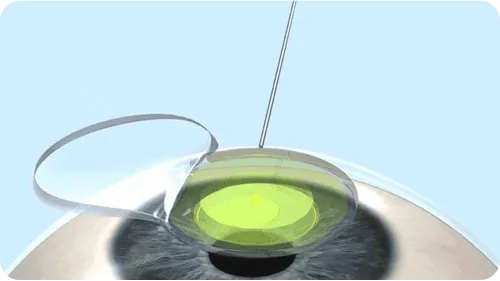
Smart Nova LASIK is our New SMILE LASIK (a 2 mm incision with no flap, on the SCHWIND ATOS laser) with CenTrax added to correct eye rotation and docking error. It usually fits adults with nearsightedness, with or without astigmatism, whose prescription has held steady and whose cornea is regular in shape and thick enough for the correction. An irregular cornea, a changing prescription, pregnancy and some eye or immune conditions put you on the wait-or-skip side.
Three things matter more to me than the prescription number on its own.
The first is how much cornea is left after the correction. Every laser procedure removes tissue. In a lenticule procedure like Smart Nova, the laser shapes a thin disc inside the cornea, and that disc comes out through the small incision. A higher prescription means a thicker disc, so the same corneal thickness can be plenty for minus 3 and tight for minus 9. Thickness is always judged against the correction you need.
The second is shape. A cornea that steepens toward the bottom, or looks noticeably different between your two eyes, can be an early sign of keratoconus, where the cornea is structurally weak. Removing tissue from a weak cornea can make it bulge further. The clinic has a Pentacam, which maps the front and back surfaces of the cornea, and a Corvis ST, which records how the cornea deforms under a puff of air. One shows shape, the other stiffness, and a thickness reading shows neither.
The third is stability. If your glasses prescription changed in the past year, the laser would be aiming at a moving target. The U.S. Food and Drug Administration lists a prescription change within the past year among the reasons LASIK may not be for you, and the same logic applies to any corneal laser.
CenTrax matters most if you have astigmatism. When you lie down, the eye rotates slightly in its socket, and an astigmatism correction placed at the wrong angle loses part of its effect. CenTrax is there to correct that rotation and the docking error. It helps the treatment line up with your eye. It doesn't add tissue to a cornea that has too little. The Smart Nova LASIK page describes the method itself.
Who should wait, and for how long?
Some items on the list are about timing. Once the reason passes, many of these eyes become reasonable candidates.

- Your prescription changed in the last year. A year of steady readings is the usual target before planning.
- You're under 18. The FDA describes LASIK as a procedure for adults, partly because prescriptions often still change in the teens.
- You're pregnant or breastfeeding. Hormonal changes can shift the prescription and affect how the eye heals, so surgery is usually planned some months after breastfeeding ends.
- You take, or recently stopped, medication that affects healing. Isotretinoin for acne and long courses of steroids are the common ones. Bring the names and dates.
- Your eyes are inflamed right now. Blepharitis, an eye infection or an allergy flare needs to settle before measurements are reliable.
- Your eyes are already dry. Laser surgery tends to make dry eyes drier for a while. Get the dryness under control with your eye doctor at home first, and keep in mind that a lens-based option may fit better.
When isn't Smart Nova the right surgery at all?
Any Korea Smart Nova LASIK candidate list should also have a section for people who shouldn't have it, whatever the schedule.
Keratoconus, or a scan that suggests it, is the clearest case. A laser that removes tissue is the wrong direction for a cornea that's already weak. Keratoconus treatment and corneal cross-linking, which stiffens the cornea, are on the clinic's menu, but that's a different conversation from vision correction.
A cornea too thin for your correction is the second. The clinic's own comparison lists New SMILE for high myopia with thin corneas, because without a flap less of the load-bearing tissue is used up. There is still a floor, though. If the disc your prescription needs would leave too little cornea behind, the method doesn't change that answer.
The FDA also lists conditions that call for careful screening or a different plan: autoimmune disease, diabetes that isn't well controlled, glaucoma or high eye pressure, a history of herpes infection of the eye, uveitis, previous eye injury and previous refractive surgery. None of these is automatically a no, but each changes how the eye heals or how the result holds.
If your scan says no, I'll tell you no, even if you've flown ten hours to hear it. Serious visual side effects are rare, but they have happened when surgery went ahead despite an exam result advising against it, and no flight schedule is worth that. A no to Smart Nova is often a yes to something else, and I'd much rather have that conversation.
Told no at home? How I'd reason through it
Say you're minus 8.5 with some astigmatism, you've worn contacts for fifteen years, and a surgeon at home measured your corneas, called them on the thin side and said LASIK was off the table.
Before anything else, I'd want to know why the answer was no. If it was thickness alone, the flap is part of the reason: a LASIK flap uses up tissue that contributes little to the cornea's strength afterward. That's why the comparison on our site points thin corneas toward LASEK when LASIK would leave too little, and lists New SMILE for high myopia with thin corneas.
If the no came from shape, I'd tell you the same thing your surgeon did. Switching methods doesn't make a weak cornea safe to thin.
And if neither laser leaves enough tissue, the next question is the EVO/EVO+ ICL, a lens placed inside the eye in front of your natural lens with no corneal tissue removed. The clinic lists it for high myopia, thin corneas and dry eyes. It is an operation inside the eye, and the FDA lists risks such as raised eye pressure, earlier cataract and loss of the cells lining the inner surface of the cornea, so it needs its own measurements, including enough space inside the eye. The ICL lens implant page covers who it is meant for.
LASEK sits between the two. There's no flap, and the surface layer regrows under a protective lens, but the clinic's comparison notes discomfort for up to 3 to 4 days and blurring for 5 to 7 days, which matters if you're flying soon after.
If this sounds like you, write down the reason you were given at home, word for word if you can, and send it on WhatsApp with your thickness reading, asking which of these methods is worth an exam trip for your eyes.
Risks and side effects to know
The common effects are temporary. Dry, gritty eyes for weeks to a few months, halos or glare around lights at night in the early period, and vision that sharpens and blurs from day to day while the surface settles. Some studies of SMILE-type surgery describe sharpness in the first days settling a little more slowly than after LASIK.
Less common: the correction lands short or overshoots, some astigmatism remains, or the eye drifts back slightly over time and a second treatment is discussed.
Rare but serious: infection, inflammation inside the cornea, and ectasia, a progressive weakening and bulging of the cornea that is mostly linked to corneas that were weaker than the screening showed. With no flap there's nothing to dislocate, which is why our comparison lists no flap complications for New SMILE. The cornea is still being reshaped, and the rest of this list still applies. How strongly and how long these effects show up differs from eye to eye.
Once you're home, sudden pain, redness that keeps increasing, a drop in vision or light sensitivity that gets worse are reasons to see an ophthalmologist the same day. Take your surgery record and drop schedule with you. In Seoul, the same team supports you from the exam through surgery and the key checks after it, so before booking, ask which of those checks fall inside your trip and how you'd reach the team from home if something feels off.
What you can check before you fly
- Your prescriptions from the last two years. If they moved, you know the answer on timing already.
- Your contact lens break. The FDA's guidance is to stop soft lenses about two weeks before the baseline exam, toric soft and rigid gas permeable lenses about three weeks, and hard lenses about four. Contacts reshape the cornea slightly, and the measurements need the cornea's own shape.
- Any scan or thickness reading you already have, plus the exact reason any surgeon gave for a no.
- A list of your medications and eye history: isotretinoin, steroids, herpes eye infection, glaucoma, injuries.
- Your calendar. The clinic closes on Thursdays for equipment inspection, and its complication-prevention program includes daily equipment checks, so keep Thursday free of appointments. Ask how many days in Seoul to plan for the exam, surgery and the checks after it before you buy flights.
The consultation is free, and you can write in English on WhatsApp Business. Send your travel dates and your two most recent prescriptions, and ask which checks would need to fit inside those dates; when you're ready to book, add the deposit and payment question, since both are settled after the consultation.
Results vary by individual.
Sources
Questions answered
Is there an age limit for Smart Nova LASIK?
The FDA describes LASIK as a procedure for adults, 18 and over, and the same lower limit is usual for SMILE-type surgery. At the other end, from the early to mid 40s most people start losing close-up focus (presbyopia), which correcting distance vision won't fix. The clinic offers presbyopic LASIK and LASEK for that, and it's worth raising if you already hold your phone further away to read.
I had LASIK years ago and some nearsightedness came back. Can Smart Nova fix it?
Usually not as a first choice. A lenticule procedure cuts a disc from tissue that hasn't been treated, and after an earlier flap a second treatment is often planned differently, frequently on the surface. Previous refractive surgery is on the FDA's screening list, so bring your old surgery record and the earliest prescription you can find.
Does Smart Nova treat farsightedness?
SMILE-type surgery was developed and studied mainly for nearsightedness with or without astigmatism, as the 2014 review by Reinstein and colleagues describes. If your prescription is a plus number, ask which method on the clinic's menu applies to it before planning a trip around Smart Nova.
I play rugby and do martial arts. Does that change anything?
The FDA mentions contact sports as a concern because a LASIK flap can shift after a blow to the eye. With a 2 mm incision and no flap, that particular risk isn't there, which is one reason active people look at flapless methods. An eye injury is still an eye injury, so wear eye protection, especially in the first weeks.
Do large pupils rule me out?
Not automatically. The FDA lists large pupils among the things to screen for, because a pupil that opens wider than the treated zone in dim light can make halos at night more noticeable. Pupil size is measured in low light and compared with the planned treatment zone, and it's one more number to weigh alongside thickness and shape.
Get your free consultation before you decide
- Free consultation and checkup, even if you decide against surgery
- Same price as Korean patients, no overseas surcharge
- Interpreters in English, Japanese and Chinese


