
Retina & glaucoma
Retinal detachment surgery Korea: signs, types, treatment
Retinal detachment is an emergency: the retina lifts away from the eye wall and can cause blindness. For retinal detachment surgery Korea has a retina team ready at Sky Eye Clinic in Seoul. We examine you and explain laser, vitrectomy, scleral buckling and gas options.
What retinal detachment is
The retina is a thin, transparent layer at the back of your eye that works like camera film. In retinal detachment, it separates from the inner eye wall. The inner retinal layers and photoreceptors pull away from the retinal pigment epithelium.
When detachment reaches the macula at the center, nutrition and blood supply fail and blindness can follow. That is why it counts as an emergency. See also our retina clinic overview.
Causes and risk factors
It now occurs often in younger people too. If you have high myopia, be especially careful.
- Aging
- Previous eye surgery
- Family history of retinal abnormalities
- Eye trauma
Types of retinal detachment
- Rhegmatogenous: trauma, surgery, high myopia or aging causes a tear or hole. Vitreous fluid passes through it and the retina lifts.
- Tractional: membranes formed by diabetic retinopathy, uveitis, hypertension, retinal vasculitis or retinopathy of prematurity pull on the retina.
- Exudative: fluid collects under the retina because of retina or choroid disease. It progresses gradually from the periphery, causes few symptoms and is often found by chance.
Symptoms: act quickly
Nobody else can see retinal detachment from outside. Only you feel the symptoms, so get examined fast.
- Floaters, like flying insects
- Photopsia: flashes like a camera flash or rolling light balls
- A curtain effect: your visual field darkens as if a black curtain fell
- Sudden vision loss
If you notice flashes, many new floaters, a dark curtain or sudden vision loss, get an eye exam immediately.
Treatment options
When detachment is limited to an early stage, laser photocoagulation is done right away. Once it has advanced, retinal detachment surgery Korea patients need is one of these: vitrectomy, gas injection into the eye, or scleral buckling.
Scleral buckling
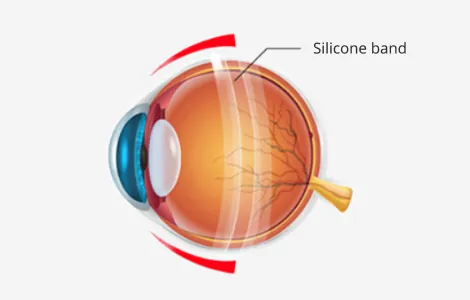
A silicone band is attached to the sclera, the eye's outer shell, and tied to press the retina into place. Once the tear closes, the fluid under the retina is absorbed and the retina is fixed in its original position.
Vitrectomy
Small openings are made in the eye, the vitreous is removed, and gas or oil is placed to press the retina flat. The retina returns to its place faster, but you must hold a specific posture for a period to recover.

Pneumatic retinopexy
A large gas bubble is injected into the center of the eye. It is mainly for tears in the upper peripheral retina, macular holes, re-detachment after scleral buckling, or hemorrhage. Like vitrectomy, it requires rest in a set posture for a period.
Questions answered
What are the warning signs of retinal detachment?
Floaters, flashes of light, a dark curtain across your vision and sudden vision loss. Seek an exam quickly if you notice any of them.
Who is at higher risk?
People with high myopia, aging eyes, past eye surgery, a family history of retinal abnormalities or eye trauma.
How is early retinal detachment treated?
When it is confined to an early stage, laser photocoagulation is performed immediately.
Do I need to keep a certain posture after surgery?
After vitrectomy or pneumatic retinopexy you must rest in a specific posture for a period so the retina can recover.
Get your free consultation before you decide
- Free consultation and checkup, even if you decide against surgery
- Same price as Korean patients, no overseas surcharge
- Interpreters in English, Japanese and Chinese

