
Vision correction
ICL lens implant in Korea: vision correction without cutting the cornea
An ICL lens implant in Korea corrects vision by placing a specially designed lens inside the eye, behind the iris, without cutting or reshaping the cornea. Sky Eye Clinic in Seoul offers EVO/EVO+ ICL, often chosen for high myopia, thin corneas or dry eye. Here is how it works and who it suits.
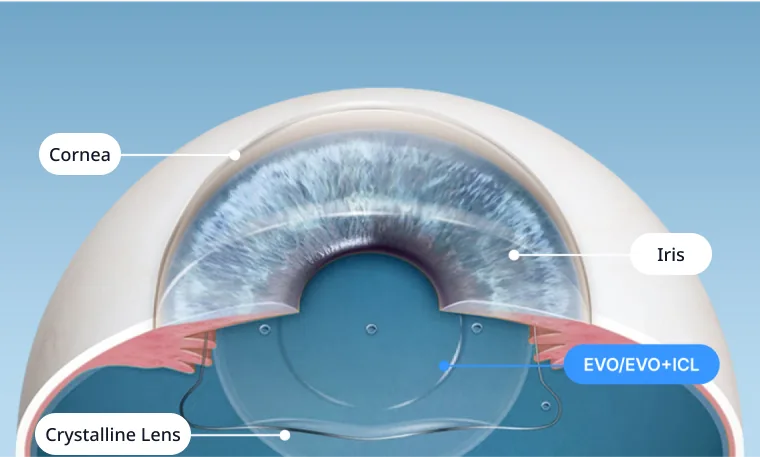
What an ICL is
ICL stands for implantable contact lens. The lens is implanted inside the eye and corrects vision permanently, with no corneal cutting. Because the lens must fit the space inside your eye, the surgeon's experience and accurate measurement are crucial.
It is a good fit if laser surgery is difficult for you. If you would rather compare laser options, see LASIK and LASEK.
Who an ICL suits
- Laser vision correction is difficult because of high myopia or astigmatism.
- You want to minimise side effects such as halos.
- You have dry eye syndrome or large pupils at night.
- You are concerned about corneal ablation.
- You have a corneal stromal disease such as Avellino corneal dystrophy.
The clinic also uses EVO/EVO+ ICL for ultra-high myopia that LASIK or LASEK cannot treat, and for abnormally thin corneas.
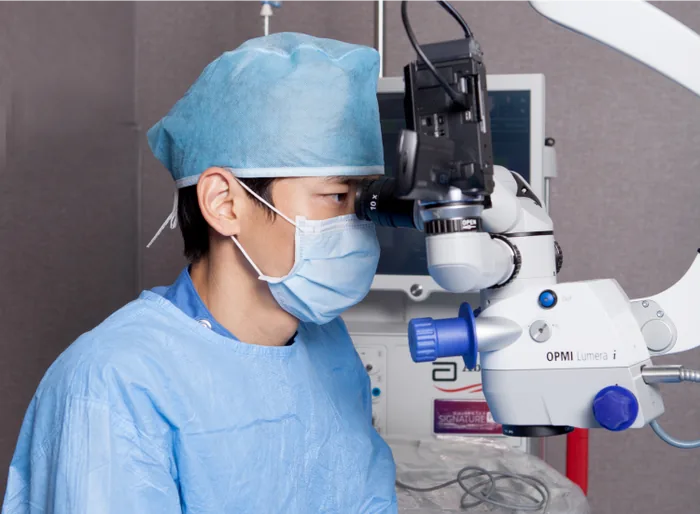
Before surgery, corneal thickness, pupil size and retinal condition are examined closely so the right method is chosen for you. The attending surgeon checks your eyes before and after the operation.
How ICL surgery works
- Prepare the eye
Eye drops dilate the pupil and numb the eye.
- Make a small incision
A small incision at the base of the cornea lets the lens in. With anesthesia, there is no pain.
- Insert the folded lens
The lens is folded and passed through the incision.
- Position it behind the iris
The lens settles between the iris and the natural lens.
EVO and EVO+ ICL features
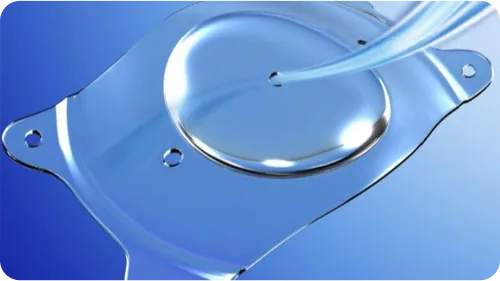
Conventional ICL lenses needed a hole made in the iris beforehand (iridotomy). EVO/EVO+ has a 360 micrometer hole at the optic center, so fluid flows freely and no iridotomy is needed. This reduces the chance of raised eye pressure, cataract and glaucoma.
| Feature | What it means for you |
|---|---|
| Biocompatible Collamer material | Blends with the eye, reduces dry eye and foreign body sensation |
| 360 micrometer central hole | Aqueous humor flows normally; no iridotomy needed |
| UVA and UVB blocking | Protects the eye from ultraviolet rays |
| Cornea preserved | Dry eye does not worsen, and glare and halos are reduced |
| Removable | The lens can be taken out in a further operation if needed |
The clinic reports very low risk of myopia regression because the cornea is not ablated, and recovery that lets you return to daily life from the next day. People with keratoconus may combine an ICL with corneal cross-linking; see keratoconus treatment.
Next step
Return to vision correction in Korea for all options, review the pre and post-op guide, then book your free consultation.
Questions answered
Does ICL surgery cut the cornea?
No. The lens goes in through a small incision at the base of the cornea. The cornea is preserved, and dry eye does not worsen.
Who is ICL surgery recommended for?
People for whom laser correction is difficult because of high myopia or astigmatism, those with dry eye or large night pupils, and those with abnormally thin corneas or stromal diseases such as Avellino corneal dystrophy.
Is an iridotomy needed before EVO ICL?
No. The 360 micrometer hole in the center of the lens lets aqueous humor flow, so the iridotomy needed with conventional ICL lenses is not required.
Can the lens be removed?
Yes. Because the cornea is not ablated, the eye can be restored to its original state through lens removal surgery if needed.
Get your free consultation before you decide
- Free consultation and checkup, even if you decide against surgery
- Same price as Korean patients, no overseas surcharge
- Interpreters in English, Japanese and Chinese

