
Vision correction
LASEK in Korea: surface laser surgery for thin corneas
LASEK in Korea corrects vision by removing only the thin surface epithelium and applying the laser to the cornea beneath, leaving no flap. It is often chosen when LASIK would leave too little cornea. Sky Eye Clinic in Seoul offers standard, Amaris Red and 2Day all-laser LASEK.
How LASEK works
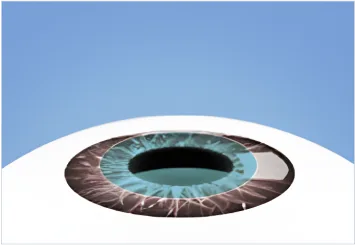
LASEK (laser epithelial keratomileusis) was developed in 1999 and combines the advantages of PRK and LASIK. The principle matches LASIK, but the surgeon removes only the corneal epithelium (about 50 micrometers) instead of cutting a flap.
The laser then reshapes the exposed stroma. A high-water-content therapeutic contact lens is placed over the area to relieve pain and help the epithelium regrow. LASEK also works when the eye is too small for the microkeratome. Choosing LASEK in Korea therefore often comes down to corneal thickness and lifestyle.
- Remove the epithelium
The uppermost corneal cells are removed with a brush.
- Apply the excimer laser
The laser is applied according to your prescription.
- Place a protective lens
A special lens relieves pain and helps the epithelium regenerate.
Who LASEK suits
LASEK in Korea is usually recommended in these situations:
- Your cornea is too thin for your degree of myopia, so LASIK would leave too little stroma.
- You need extra correction after cataract surgery or ICL surgery.
- You play contact sports or have a job with a risk of direct eye injury.
- You developed corneal neovascularization from long-term contact lens wear.
- Your cornea is too flat or too steep, raising flap risk in LASIK.
- You have corneal haze and want it removed at the same time.
Advantages and drawbacks
| Advantages | Drawbacks |
|---|---|
| Less pain and foreign body sensation than older PRK, with less haze risk at the treated area | More pain than LASIK and slower recovery, with blurring for 5 to 7 days |
| Safe vision recovery even when the cornea is too thin for LASIK | Mild to moderate foreign body sensation for 2 to 3 days |
| Suits eyes too small for the microkeratome | Steroid drops are required, with check-ups for eye pressure |
| No flap, so no flap displacement after full healing | Medication lasts longer; light sensitivity or glare may last weeks to months |
| Corneal haze may develop in high myopia |
Expect more discomfort than after LASIK: irritation that can last up to 3 to 4 days. Use steroid drops exactly as prescribed and keep every check-up, because they can raise eye pressure. See the pre and post-op guide.
Amaris Red LASEK
Older LASEK removed the epithelium with chemicals and surgical brushes, which damaged the cornea. The clinic says vision then took 1 to 2 months to recover. Amaris Red LASEK uses the laser for the epithelium step too, and the clinic gives 2 to 4 weeks for vision recovery.
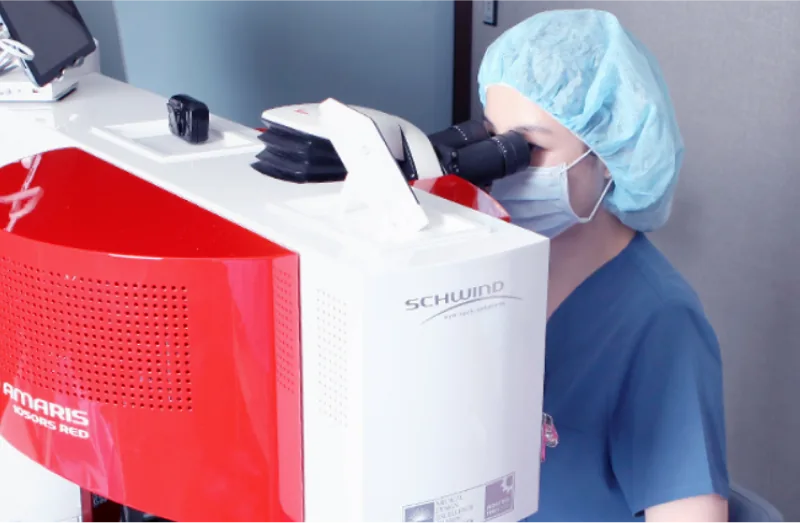
The Amaris Red laser fires at 1050Hz, tracks the eye in 7 dimensions and has a 0.54mm spot. It also measures corneal thickness in real time. See the equipment page.
2Day all-laser LASEK
2Day LASEK removes the epithelium with the laser alone, with no chemicals or instruments. The clinic says this lowers infection risk, dry eye and pain, and leaves less corneal consumption, even in high myopia and astigmatism.
| Conventional LASEK | 2Day all-laser LASEK | |
|---|---|---|
| Epithelium removal | Alcohol and special instruments | Laser only |
| Post-op dry eye | Minimal | Very minimal |
| Post-op pain | 3 to 4 days | About 2 days (varies) |
| Corneal haze | Occurs in some patients | Almost none |
| Epithelium regrowth | 4 to 5 days | 2 to 3 days (varies) |
It suits people who want faster recovery, fear pain or worry about dry eye. Compare it with New SMILE LASIK, or book your free consultation to see whether LASEK in Korea suits you. Co-Wave LASEK, which smooths the corneal surface using wavefront data, is also available; see LASIK for how Co-Wave works.
Questions answered
What is the difference between LASEK and LASIK?
LASIK cuts a flap. LASEK removes only the surface epithelium, applies the laser, then covers the eye with a protective lens. LASEK recovers more slowly but suits thin corneas.
How long is recovery after LASEK?
Expect blurring for 5 to 7 days and mild to moderate foreign body sensation for 2 to 3 days. Light sensitivity or glare may last weeks to months.
Why are steroid eye drops required?
They are part of LASEK aftercare. Because they can raise eye pressure, regular check-ups are needed during use.
What is 2Day all-laser LASEK?
It removes the epithelium with a laser instead of chemicals or instruments, which the clinic says reduces pain, dry eye and haze compared with conventional LASEK.
Get your free consultation before you decide
- Free consultation and checkup, even if you decide against surgery
- Same price as Korean patients, no overseas surcharge
- Interpreters in English, Japanese and Chinese

