
Vision correction
Keratoconus treatment in Korea: causes and four treatment options
Keratoconus treatment in Korea starts with an accurate diagnosis, because the cornea thins and bulges into a cone shape that glasses cannot fully correct. Sky Eye Clinic in Seoul uses cross-linking, corneal rings, special contact lenses and, last, transplantation. Here is how each option works and when it is used.

What keratoconus is
Keratoconus is a progressive disease. Part of the cornea becomes abnormally thin and protrudes, so the cornea takes a cone-like shape. The result is irregular astigmatism and reduced vision that cannot be corrected with glasses.
Because it is progressive, early assessment matters. It is also why careful screening comes before any laser surgery; see LASIK and New SMILE LASIK.
Causes and risk factors
Causes fall into genetic and environmental groups. DNA research on the genetic side is still ongoing. Frequent eye rubbing is known as the most common environmental factor.
- Heredity
- Effects of systemic disease
- Frequent eye rubbing
- Contact lens wear
- UV exposure
Rubbing sends repeated shocks to the cornea and can speed up the disease. Avoiding it is one of the most important things you can do.
Four ways to treat keratoconus
1. Corneal cross-linking
This strengthens the cornea by increasing the bonding strength of collagen. It is only possible when the cornea is thick enough. Combined with Co-Wave, it can partly correct irregular astigmatism. A solution is absorbed into the stroma, rinsed off, and UVA light is then applied. Full detail: corneal cross-linking.
Cross-linking can be followed by an ICL lens implant about a month later. EVO+ Aqua ICL corrects vision by placing a lens inside the eye and preserving the cornea.
2. Corneal ring implantation
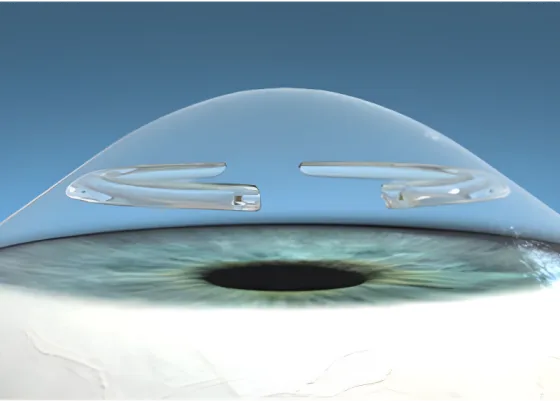
A semi-circular ring is inserted into the corneal stroma. It pulls the protruding cornea outward to flatten it, easing keratoconus and also correcting myopia. The cornea must not be too thin, so advanced keratoconus may rule it out. For this reason rings are sometimes placed early.
3. Keratoconus contact lenses
Hard lenses that fit the cornea well suit early keratoconus or a corneal shape that has stabilised. They can slow progression to some extent and may give better vision than glasses. Prolonged wear may cause pain and foreign body sensation, and fitting on an irregular cornea must be precise. If the disease keeps progressing, other methods are needed.
4. Corneal transplantation
This is the most traditional surgery and has a high success rate. Rejection, however, can cause lifelong problems, and recovery takes more than a year. Doctors delay it as long as possible.
Which option fits you
| Option | Used when | Main caution |
|---|---|---|
| Cross-linking | Cornea thick enough | Not possible if too thin |
| Corneal ring | Cornea not too thin, often early disease | May be impossible if advanced |
| Special contact lenses | Early disease or stabilised cornea | Pain or foreign body sensation with long wear |
| Transplant | Other methods insufficient | Rejection risk; recovery over 1 year |
Your surgeon recommends an option after measuring your cornea. See the equipment page for corneal topography tools, then book your free consultation. More options are listed on the vision correction in Korea hub.
Questions answered
What causes keratoconus?
Genetic and environmental factors. Genetic research is continuing. Frequent eye rubbing is the most common environmental factor, and contact lens wear and UV exposure are also listed.
Can keratoconus be treated without a transplant?
Yes. Cross-linking, corneal ring implantation and special contact lenses are used first. Transplantation is the most traditional surgery and is delayed as long as possible.
Who can have corneal cross-linking?
Only people whose corneal thickness is sufficient. It strengthens the cornea by increasing collagen bonding.
Why should I avoid rubbing my eyes?
Rubbing delivers continuous shock to the cornea and can accelerate disease progression.
Get your free consultation before you decide
- Free consultation and checkup, even if you decide against surgery
- Same price as Korean patients, no overseas surcharge
- Interpreters in English, Japanese and Chinese

