
Cataract & presbyopia
Presbyopia and cataract symptoms and causes: how to tell them apart
Holding your phone farther away, or seeing the world through fog, can both feel like aging eyes. Yet presbyopia and cataract symptoms come from different problems in the lens. This guide shows what each one feels like, how they differ and which treatments exist.
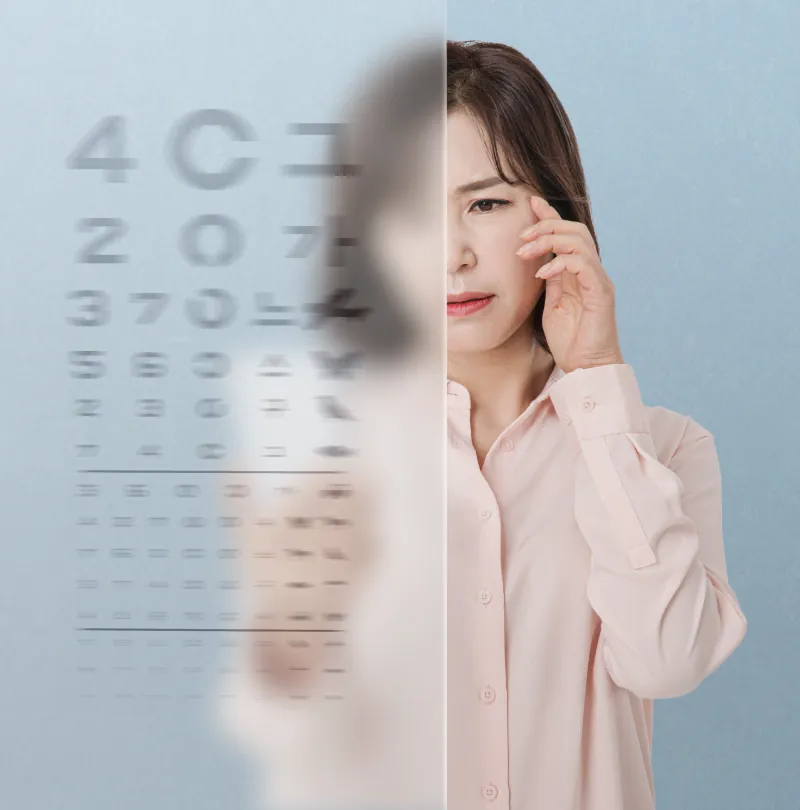
What presbyopia is and what you notice
Presbyopia is an age-related change. The eye's focusing power slowly declines, so close-up text gets hard to read. The timing varies with your refractive status. In general, focusing ability starts to fall in the early 40s and nearly disappears by the late 50s.
Common signs of presbyopia
- You hold newspapers or books farther and farther away.
- Text on your smartphone is hard to read.
- Reading causes eye fatigue and headaches.
- Your eyes feel dry and heavy.
- Symptoms get worse in dim light.
- Vision clears up when you put on reading glasses.

Presbyopia vs cataract: the difference
Presbyopia blurs near vision because the lens loses elasticity and cannot focus. A cataract makes vision cloudy and hazy because the lens itself turns opaque. The two look alike, so an eye checkup is the only way to be sure which one you have.
| Normal eye | Presbyopia | Cataract | |
|---|---|---|---|
| What happens to the lens | Contracts and relaxes normally | Loses elasticity, so focusing ability drops | Becomes cloudy |
| What you see | Near objects look clear | Near objects look blurry | Overall vision looks hazy and blurry |
Presbyopia can be treated with surgery or without it. Surgical options are presbyopia LASIK or LASEK and multifocal cataract surgery. Non-surgical options are reading glasses, progressive multifocal glasses and contact lenses made for presbyopia.
What a cataract is and its six main symptoms
Of all the presbyopia and cataract symptoms, cloudy vision is the one that points to the lens turning opaque. A cataract comes to everyone with age. Your eye has a lens that adjusts focus for different distances. When it turns cloudy, light cannot pass through properly. Vision looks hazy, as if covered by fog, and sight declines. Cataracts develop in 70% of people in their 60s, 90% in their 70s and everyone after 80.
- Vision loss: everything looks hazy and dim. Because it progresses slowly, you may not notice it at first.
- Double vision: objects look doubled even when you look with one eye only.
- Glare: your eyes feel irritated and you squint at light. Sunlight, car headlights and fluorescent lights bother you most.
- Color distortion: white objects look yellowish.
- Myopia shift: you can see near objects without reading glasses, but over time both near and far become difficult.
- Day blindness: vision drops in bright places and you see better at night than in the day.

How cataract surgery works
Cataract surgery removes the cloudy lens and replaces it with an artificial lens. Choosing that lens is a big decision, so read our guide to cataract IOL types before your visit.
- Incision
A cut of 2.8 mm or less is made at the edge of the eye. Viscoelastic material is injected to protect the tissue in the front chamber.
- Open the capsule
The upper part of the lens capsule is removed to reach the cloudy lens.
- Remove the lens
The cloudy lens is completely removed from the capsule.
- Reshape the capsule
Viscoelastic material is injected into the capsule to restore its shape so the new lens goes in easily.
- Insert the lens
The intraocular lens (IOL) is placed in the lens capsule.
Before surgery, you will have a detailed exam: see cataract tests and diagnosis. Afterward, follow our recovery guide. Ready to be checked? Book your free consultation.
Questions answered
At what age does presbyopia start?
Focusing ability generally begins to decline in the early 40s and nearly disappears by the late 50s. The exact timing depends on your refractive status.
How can I tell presbyopia from a cataract?
Presbyopia makes near objects blurry because the lens loses elasticity. A cataract makes overall vision hazy because the lens is cloudy. Since they are hard to separate yourself, get an eye exam.
What are the main symptoms of a cataract?
Hazy vision, double vision in one eye, glare, yellowish whites, a short period when near objects look clearer without reading glasses, and vision that is better at night than in bright light.
How big is the incision in cataract surgery?
The incision at the edge of the eye is 2.8 mm or less. The cloudy lens is removed and an intraocular lens is placed in the capsule.
Get your free consultation before you decide
- Free consultation and checkup, even if you decide against surgery
- Same price as Korean patients, no overseas surcharge
- Interpreters in English, Japanese and Chinese

