
Can You Wear Contacts After Cataract Surgery? Timing Mistakes to Skip
Have you worn contact lenses for twenty years and now wonder whether a cataract operation ends that habit, or sends you straight back to it?
On this page
Will you still need contacts once the new lens is in?
Usually you can wear contacts again, but only after the eye has healed and your surgeon has checked it, which for many people means waiting about a month. Many find they no longer need contacts for distance at all, because the implanted lens is calculated to correct much of the old prescription.
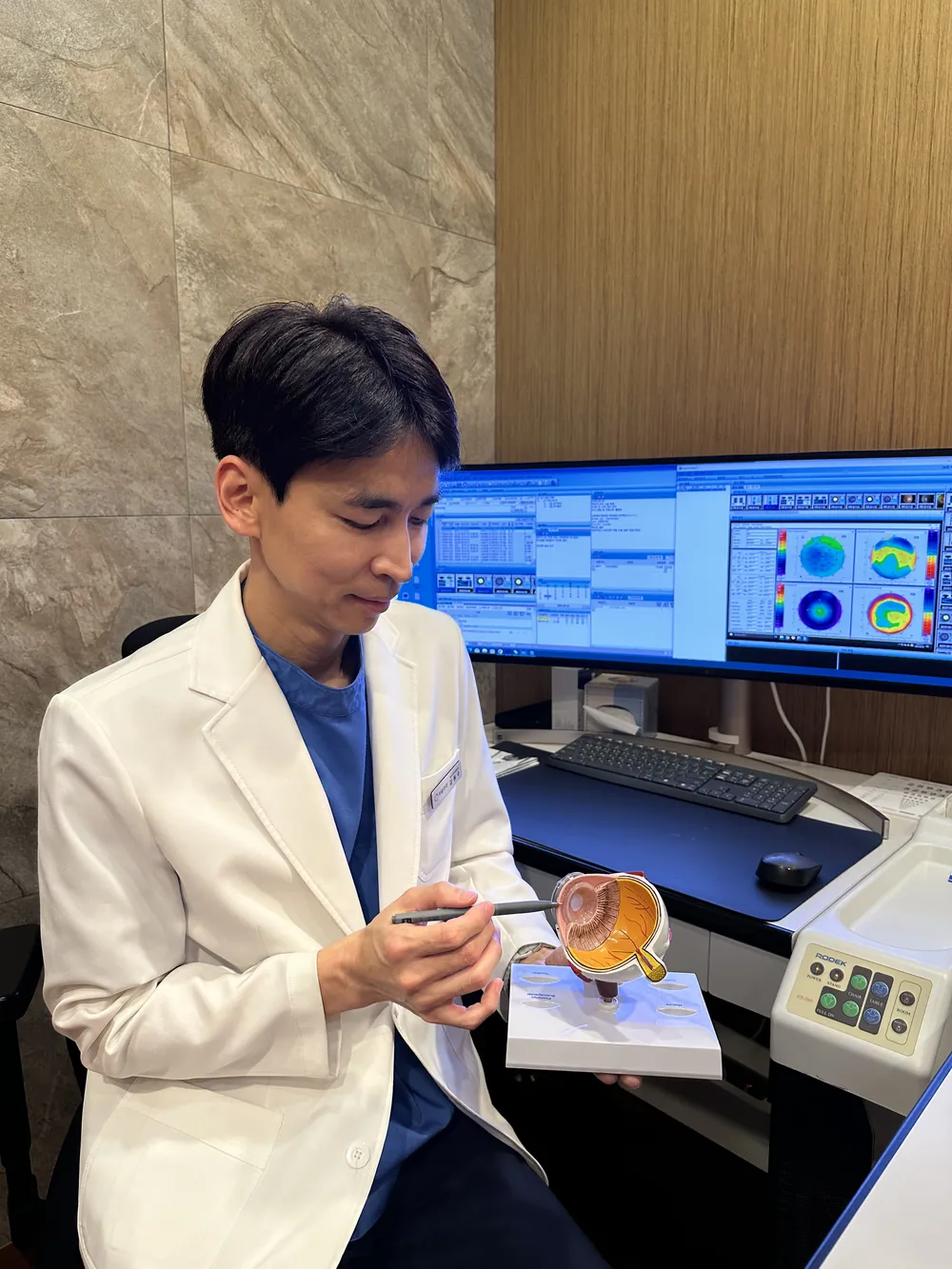
Hello, I'm Dr. Kim Dong-Soo, Center Director at Sky Eye Clinic in Seoul. Cataract and presbyopia surgery is my field.
I'm a full member of the Korean Contact Lens Study Society as well as the Korean Society of Cataract and Refractive Surgery, so the lens you wear today and the lens that gets implanted are one conversation for me. Interpreters work on site in English, Japanese and Chinese, at no extra charge.
The consultation is free. If your surgery is already behind you, send the same photo and say how many weeks ago it was.
Often not for distance. During cataract surgery the clouded natural lens is removed and an artificial lens takes its place. Its power is chosen from measurements of your eye's length and the curve of your cornea, so a large part of a lifetime of short- or long-sightedness can be corrected in the same step.
Those measurements are where long-time contact wearers get caught out. Measuring a cornea that has worn a lens every day for years is a bit like a tailor measuring you for a suit while you still have a thick winter coat on. Soft lenses gently flatten or warp the front of the cornea, and rigid gas-permeable lenses do it more. If the eye is measured in that shape, the implant is calculated for a cornea that changes once the lenses stay out. As a general rule, soft lenses are left out for at least a week or two before biometry and rigid lenses for several weeks, and a second reading is taken if the numbers are still moving.
What remains after surgery decides whether contacts come back. A monofocal lens set for distance usually means reading glasses for close work. Multifocal and extended-focus designs spread focus across distances, so many people reach for glasses or contacts less, though some still keep readers for fine print. Leftover astigmatism or a small miss in power is the usual reason someone goes back to a contact lens.
When can I wear contacts after cataract surgery?
Not in the first weeks. The incision is small and self-sealing, but it still needs time to knit, and during that stretch you're putting in antibiotic and anti-inflammatory drops several times a day. A contact lens on that surface holds germs against a fresh wound and can rub the healing edge.

Ophthalmologists commonly allow soft contacts again sometime after the first month, once three things line up: the incision looks sealed, the drops are finished or nearly so, and your refraction has stopped shifting. I want you to get that date from the doctor who looked at your healed eye, not from a forum thread, because a cornea that heals slowly pushes it later.
When both eyes are operated a week or two apart, the question waits until the second eye has healed as well.
Three timing mistakes long-time contact wearers make
Wearing your lenses right up to measurement day
The cornea gets measured in its lens-shaped form and the implant power can land off target. Instead, ask exactly how many days your type of lens needs to be out, and plan to wear glasses for that whole stretch, including the flight to Seoul and the first days in the city. Pack your glasses in your carry-on, not your checked bag.
Slipping a contact in during the first weeks
It's tempting when the new eye still feels a little blurry or the other eye needs correction. Instead, wear glasses until you're cleared. While you wait for the second eye, an old pair of glasses with the lens on the operated side taken out is a common stopgap, and the unoperated eye keeps its correction.
Ordering a new prescription too soon
Vision often drifts for the first few weeks as swelling settles, so a contact lens or glasses prescription taken in week one can be wrong a month later. Instead, wait until your doctor says the refraction is stable, then have the fitting done. Once you're home, your own optometrist can do it, and a contact lens fitting checks how the lens sits on the cornea, which glasses never need.
Did you have LASIK or wear monovision contacts before?
Tell the surgeon either way, because both change the plan. Earlier laser vision correction reshaped your cornea, and standard lens formulas can misjudge an eye like that, so old surgery records are worth digging out. If you want to see what those surgeries changed, our post on how corneal thickness decides between LASIK and LASEK walks through it.
Monovision is the other one. If you've happily worn one contact for distance and one for near for years, mention it: some people choose a similar split with monofocal implants so they can read without glasses. If you've never tried it, a trial with contact lenses before surgery is a common way to find out whether your brain accepts it, and that is the one time contacts help the lens decision instead of distorting it.
What can go wrong with a contact on a healing eye?
In the first days after surgery, a scratchy feeling, mild redness, some haze and glare around lights are typical and usually fade within days to a few weeks. Healing speed differs from person to person, so the timing here is a general pattern, not a promise.
Putting a contact in too early adds three specific risks: infection reaching the wound, which is rare but can be serious inside the eye; a scratch at the incision edge; and more surface dryness and swelling just as the cornea is recovering.
Some people are usually asked to wait longer, or are steered away from contacts after surgery altogether:
- severe dry eye, or inflammation still being treated with drops
- a cornea that heals slowly, which is more common with poorly controlled diabetes
- a weak inner corneal layer (endothelium), for example with Fuchs dystrophy
- an incision that hasn't fully sealed at the last check
If you're already home and something changes, remove any lens and see an ophthalmologist the same day for pain that gets worse instead of easing, vision that drops after it had improved, spreading redness or discharge, or a curtain or a shower of new floaters. Bring your surgery record and the name and power of your implant, so whoever examines you knows what is in the eye.
Months or years later, vision can turn hazy again because the thin capsule behind the implant clouds over. That is secondary cataract. A contact lens won't clear it, but a quick laser opening of the capsule usually does, and we treat it at the clinic.
What should you check before booking cataract surgery abroad?
In short, these are worth asking any clinic you're considering. Here is how each one is answered at ours.
- Will the doctor who examines me perform the surgery? Yes. The surgeon who consults with you performs your procedure, and the surgeon's name is listed on a public disclosure page.
- What measures my eye for the implant? IOLMaster biometry. Ask in the same breath how long your lens type must be out beforehand.
- Who sees me at the checks after surgery? The same medical team supports you from the exam and consultation through surgery and the key post-operative checks.
- Will I follow everything said in the exam room? Interpreters work on site in English, Japanese and Chinese, at no extra charge.
- Which days can a check-up actually happen? We close on Thursdays for equipment inspection and on Sundays and holidays, and Saturdays are for exams and surgeries only, with no follow-ups. Plan your check-up days around that before you book flights.
- How is the equipment kept safe? A complication prevention program includes daily equipment checks.
Where I stand on contacts after a new lens
A lot of long-time wearers assume they'll be back in contacts within weeks of surgery. I'd like the implant to be aimed at the life you actually lead: night driving, a phone in your hand, a screen at arm's length. Then contacts become an option you can pick up, not something you depend on.
What decides this for you is how your cornea measures once the lenses have been out long enough: that reading sets the implant power, and the implant power sets whether contacts come back at all.
Your first WhatsApp message can be a single prescription photo, with the box label or glasses prescription, plus one question: how long does my lens type need to stay out before measurement, or, if surgery is done, is it too early at this many weeks. The consultation is free, and you can write in English. We're at 723-26 Banpo-dong, Seocho-gu, Seoul, about a five-minute walk from Nonhyeon or Sinnonhyeon Station.
— Dr. Kim Dong-Soo, Center Director
Results vary by individual.
Sources
Questions answered
Can I wear a contact lens in my other eye while waiting for the second surgery?
Often yes, in the eye that hasn't been operated yet, as long as you take it out early enough before that eye is measured. The difference between a corrected new eye and an uncorrected old one can feel unbalanced for a week or two, which is why some people prefer an old pair of glasses with one lens removed.
Can I put my post-surgery eye drops in while wearing contacts?
During the drop period you shouldn't be wearing contacts in the operated eye at all. Later, if you use lubricating drops with lenses, many preserved drops soak into soft lenses, so people usually remove the lens first or choose drops labeled safe for contacts, then wait about ten to fifteen minutes before putting the lens back.
Are daily disposables or overnight lenses better after cataract surgery?
If you go back to contacts, daily disposables worn only while awake are generally the lower-risk choice for a post-surgery cornea. Sleeping in lenses raises infection risk in any eye, so overnight wear is usually discouraged after an operation.
Will my old contact lens prescription still work after the new lens is in?
Almost never. The implant replaces most of the power your old lenses were providing, so the old prescription would overcorrect you. If you need contacts afterwards, you'll need a new fitting once your refraction is stable.
Can a contact fix blur that comes back years after surgery?
If the blur is from the capsule behind the implant clouding over, no. That is secondary cataract and is treated with a short laser procedure. A new contact or glasses prescription only helps if the blur comes from a refractive change.
Get your free consultation before you decide
- Free consultation and checkup, even if you decide against surgery
- Same price as Korean patients, no overseas surcharge
- Interpreters in English, Japanese and Chinese