
How Long Between Cataract Surgeries? Usually Weeks, Set by 3 Things
Do you need cataract surgery in both eyes and can't tell whether one trip to Seoul will cover them, or whether you'll be flying back a second time?
On this page
Why isn't the second eye done on the same day?
Whether both eyes fit into one stay comes down to three things: how the first eye heals, the lens plan, and how you manage with one new eye and one old one in between.
Hello, I'm Dr. Kim Dong-Soo, Center Director for presbyopia and cataract at Sky Eye Clinic.
I'm a J&J and Alcon certified cataract specialist and LENSAR certified for laser cataract surgery. If your scans show the second eye needs more time than your trip allows, I'll tell you that plainly rather than squeeze it in. A medical interpreter for your language is provided at no extra charge.
Send a photo of your most recent eye exam report on WhatsApp, along with one question: can both eyes fit into the days you have?
Send your eye exam report and ask if both eyes fit your dates
Cataract surgery is done one eye at a time almost everywhere, and the reason is safety. Infection inside the eye is rare, but if it happened in both eyes at once, the stakes would be far higher. Waiting also lets the first eye teach us something before we commit the second.
Some surgeons in some countries do operate on both eyes on the same day under a strict protocol. Its main trade-off is that a problem with sterility or lens calculation could reach both eyes together, so most surgeons still prefer a gap. In this post I'm talking about planning that gap.
Three things that set the gap between your eyes
There isn't one fixed number of days. These three things move it, and every one of them can be checked during your stay.
1. How the first eye looks at its early checks
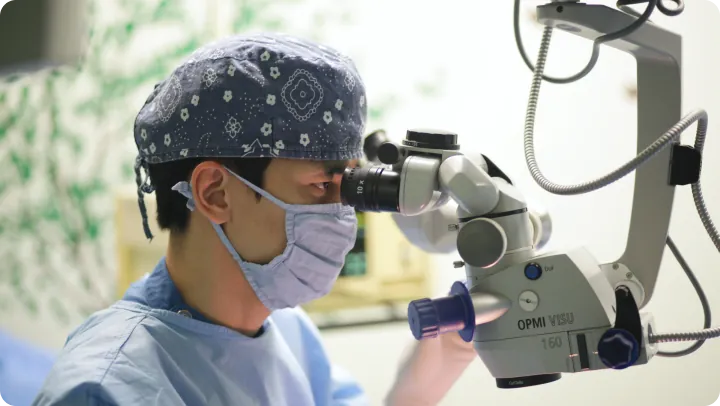
After surgery, most people feel better within a day or two, though full healing takes weeks. Before the second eye, a surgeon wants to see normal eye pressure, a clear cornea without swelling, little inflammation inside the eye and vision that's heading the right way. If any of those lag, the second eye waits. Pre-existing conditions such as glaucoma, diabetic eye disease or past uveitis often mean a longer, more cautious gap.
2. The lens plan
The first eye's result is useful information. If it lands slightly off the target power, the second lens can be adjusted to balance the pair. That matters even more if you've had laser vision correction before, because a reshaped cornea makes lens power harder to predict; my colleagues explain how the cornea is changed in how LASIK and LASEK reshape the cornea differently. If you're choosing between monofocal, multifocal or specialty lenses, the overview of cataract lens types shows what each one is built to do.
I'd rather know exactly where the first eye landed than hit an arbitrary date for the second. A few extra days of watching that first result can change which power I choose for the other eye. That choice stays with you for the rest of your life, so it deserves the wait.
3. How you cope with uneven eyes in between
This one pushes the other way. If you were nearsighted, your old glasses stop working once one eye is corrected: one lens is now far too strong for the new eye. Some people get headaches or feel unsteady, and judging distance on stairs gets harder. A contact lens in the unoperated eye can bridge the gap for some people. If the imbalance is hard to live with, that's a reason to keep the gap short once the first eye allows it.
Can both eyes fit into one trip to Seoul?
Often yes, if your schedule has room. Here's how the days tend to run, using our clinic's calendar and general cataract care.
Your first day goes to the full exam, including any earlier laser vision correction, since that can change how lens power is planned. Dilating drops usually blur close-up vision for a few hours, so leave that afternoon free. Surgery on the first eye follows on a day the surgeon schedules with you. Most surgeons check the eye again within a day or two, and that first check tells you a lot about how the plan is holding.
The days after are quiet. Walking around Seoul is generally fine, but pools and public baths aren't. If the first eye looks settled at its checks, the second eye can follow, often a week or more after the first. After that, you need time for the second eye's early checks too.
Put together, a one-trip plan for both eyes usually means a stay of a couple of weeks or more, and your exact length is confirmed at the consultation. The alternative is two shorter trips: the first eye and its early checks now, and the second eye on a return visit a few weeks later. Two trips suit people who can't take a long leave but can travel twice.
Saturday runs 10:00 to 14:30 for exams and surgeries only.
Flying between or after the surgeries is generally fine, because routine cataract surgery doesn't leave a gas bubble in the eye the way some retina operations do. Cabin air is dry, so keep your drops in your carry-on and ask your surgeon to clear you before you book.
Inflammation, pressure and swelling: what can push the second eye back
In the first days, grittiness, light sensitivity, watering and some blur are expected and usually fade within days. Less often, eye pressure rises, the cornea swells, or the center of the retina swells a few weeks later (cystoid macular edema). Each of these is treatable, and each is a reason to hold the second eye until it settles. Rarely, there's serious infection inside the eye or retinal detachment.
Some people should plan a slower gap or extra checks first:
- people with diabetes, especially with diabetic retinopathy
- people with glaucoma or high eye pressure
- anyone with a history of uveitis or macular disease
- people who have had laser vision correction or other eye surgery
Healing differs from person to person, which is why the date for the second eye is set by the checks on the first. Serious visual side effects, although rare, have happened when surgery went ahead despite an exam result advising against it. If your first eye says wait, I'll say wait. The clinic also has a separate retina and glaucoma center, which matters if your exam turns up something beyond the cataract.
What should you ask any clinic about the second eye?
In short, these questions are worth asking wherever you have surgery. Next to each is how it works here.
- Will the same surgeon operate on both eyes? Here, the surgeon who consults with you performs your procedure directly, and the clinic publishes its operating surgeons by name.
- What is measured before the lens power is chosen? Biometry is done on the IOLMaster, and the equipment list also includes Pentacam corneal mapping and Cirrus OCT 6000 retinal scanning.
- Will someone translate at every visit? A medical interpreter for your language is provided at no extra charge.
- Which days can't be used for checks or surgery? Thursdays, Sundays and public holidays are closed; Saturdays are for exams and surgeries only.
- Who supports me between surgery and the last check? The same medical team stays with you from the exam and consultation through surgery and the key post-operative checks.
You don't have to choose us. Bring these five questions to any clinic you're comparing, and the answers will tell you a lot about how the gap will be handled.
Who looks after your eyes once you're home?
Plan the key checks for both eyes while you're still in Seoul, since that's where the team that operated can see you. Before you leave, ask for a copy of your records, including the lens model and power in each eye. Then book a visit with a local ophthalmologist in the weeks after you return.
At home, finish each drop exactly as prescribed, even after the eye feels normal. Keep wearing the night shield for as long as you were told, don't rub your eyes and avoid swimming until you're cleared. For questions, the clinic's WhatsApp Business line is in English.
Some signs need a local eye doctor the same day: pain that gets worse instead of better, vision that drops, worsening redness, or a sudden shower of new floaters, flashes or a shadow across your vision. Months or years later, vision can also cloud again because the capsule behind the lens thickens.
Where I stand on the gap
I'd rather plan the treatment around your eyes than around volume. If your eyes need a month between surgeries, I'd rather you come back than shorten the gap to fit a flight. If the first eye heals quickly and the plan is clear, one trip for both eyes is often possible.
For your trip, the deciding fact is how your first eye looks at its first checks: the pressure, a clear cornea, a quiet inside of the eye, and how close the result came to target.
Send that same photo of your latest eye exam report on WhatsApp with your question about whether both eyes fit into your dates, and you'll have a concrete starting point. We're at 723-26 Banpo-dong, Seocho-gu, Seoul, about a five-minute walk from Nonhyeon or Sinnonhyeon Station.
— Dr. Kim Dong-Soo, Center Director
Results vary by individual.
Questions answered
Does the second cataract surgery feel different from the first?
Many people notice the second one more, because they know what's coming and are more aware of the lights and sensations.
Can I have only one eye done and leave the other for later?
Yes, if the cataract in the other eye is mild and you can live with the difference between the two eyes. A large difference in prescription between the eyes is the main reason people end up wanting the second eye sooner.
What if my first eye doesn't land exactly on target?
A small miss is common and often handled by adjusting the power chosen for the second lens, or with light glasses for certain tasks. Larger misses have their own options, which your surgeon discusses once the eye has healed.
Will both eyes get the same type of lens?
Usually yes, especially with multifocal or extended-depth lenses, which work best as a pair. Some people deliberately set one eye for distance and the other for near; that choice is made before the first eye, not between surgeries.
Can I drive between the two surgeries?
Not until your eye doctor confirms that your vision meets the driving rules where you live. With one eye corrected and the other blurred, depth judgment can be off, so many people stop driving until the second eye is done.
Get your free consultation before you decide
- Free consultation and checkup, even if you decide against surgery
- Same price as Korean patients, no overseas surcharge
- Interpreters in English, Japanese and Chinese