
Cataract Surgery Takes Minutes. Your Check-Ups Set the Trip
How long does cataract surgery last, and how many days of your trip to Seoul will it really take up?
On this page
How long does a cataract operation last on the table?
The operation itself usually takes under half an hour per eye, and you'll spend a few hours at the clinic that day. Most people see well enough for ordinary life within a few days, full healing takes about eight weeks, and the new lens is meant to stay for the rest of your life. Your stay is set by the check-ups, not by the surgery.
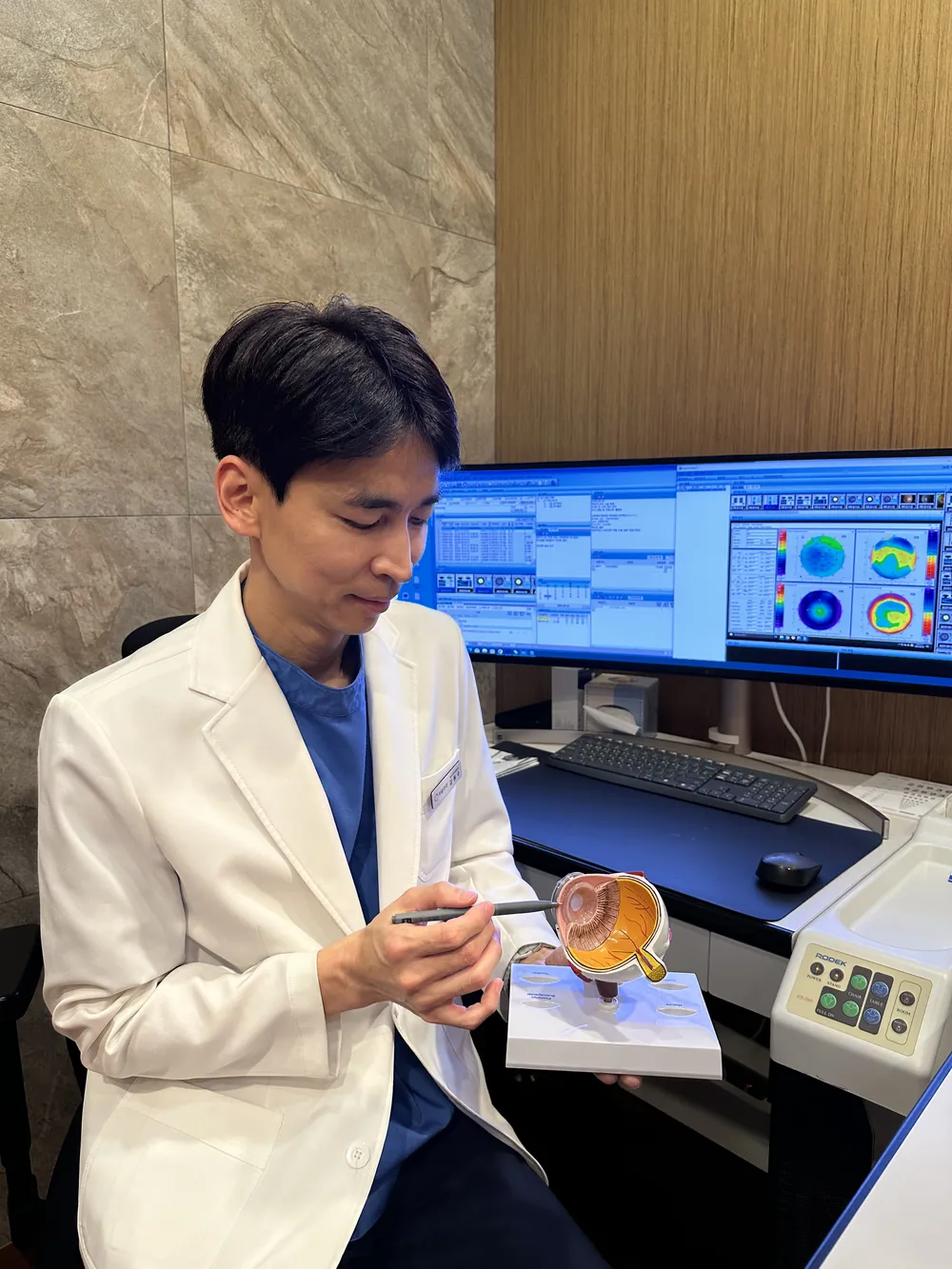
Hello, I'm Dr. Kim Dong-Soo, Center Director for presbyopia and cataract at Sky Eye Clinic in Seoul.
My certifications include LENSAR Certified Laser Cataract Specialist (USA) and J&J, Alcon Certified Cataract Specialist (USA). Here, the surgeon who consults with you performs your procedure directly, and the same team stays with you from the exam through the key post-operative checks, so the eye seen the next morning is seen by people who know what happened in the operating room. A medical interpreter for your language is provided at no extra charge.
If you have a recent eye report from home, send a photo of it on WhatsApp with the weeks you could travel, and ask how many check-ups your trip needs to hold. The consultation is free.
Usually under half an hour per eye. Through a tiny opening at the edge of the cornea, the surgeon breaks up the clouded natural lens, removes it, and slides a folded artificial lens (an IOL) into the same space. You're awake, the eye is numbed with drops, and what most people remember is bright light and some pressure, not the clock.
Think of a watch whose crystal has fogged over. Swapping the crystal is quick; the case around it needs a few weeks to settle after it has been opened. That settling period, not the swap, is what your travel plan has to fit around.
Time on the table runs longer when the cataract is very dense, the pupil doesn't widen well, or the eye is unusually long, which is common with high myopia. For lens planning, the clinic's cataract equipment includes IOLMaster biometry, which measures the eye's length and curvature to calculate lens power, and a LENSAR laser.
Your surgery day at the clinic
The day is much longer than the operation. Dilating drops need time to work, and after surgery you rest and have the eye checked before you leave. The clinic's surgery-day guide lists the same order: preparation, surgery, rest in the recovery room, a post-surgery eye check, then aftercare instructions and discharge.

Plan nothing for that afternoon or evening. You shouldn't drive, the eye will be hazy while the dilation wears off, and bright streets feel harsh, so pack sunglasses and have the hotel address saved on your phone for the taxi back.
What do the first week and the first two months feel like?
| When | What most people notice | What it means for your trip |
|---|---|---|
| Surgery day | Haze, glare, a gritty or scratchy feeling | Rest at the hotel, no plans |
| Next day | Vision often already clearer; first check-up | Don't fly before this check |
| Days 2–7 | Grittiness fading, drops several times a day, shield at night | Walking around Seoul is usually fine; skip pools, saunas and rubbing |
| Weeks 2–4 | Sight settling; glasses prescription still shifting | Usually home by now, with a local check |
| About 8 weeks | Eye fully healed | Get new glasses measured at home |
The US National Eye Institute puts complete healing at about eight weeks, which is why new glasses are usually measured near the end of that window rather than in the first week.
When can you fly home after cataract surgery?
Flying is rarely the problem after an uncomplicated cataract operation. Cabin pressure doesn't affect the small, self-sealing incision, and there's no gas bubble in the eye as there sometimes is after retinal surgery. What matters is that you leave after the eye has been checked, not before.
Cataract surgeons commonly see the eye the next day, again at around one week, and again at around one month. Many travelers aim to be seen at least the next morning, and ideally at the one-week mark, before flying; how many nights your own plan needs is settled at the consultation, from your exam.
My advice is simple: don't book a return flight you can't change that leaves before your day-after check. A pressure rise or early inflammation tends to show in the first days, and it is easiest to handle by the team that did the surgery. And if you cross many time zones on the way home, space your drops by hours since the last dose, not by the clock on the wall; ask for your schedule written that way before you leave.
Once you have a rough window, send your possible dates on WhatsApp with a line on whether you've had LASIK or have high myopia, and ask how many nights in Seoul to allow. Deposit and payment method are settled after the consultation, so you can raise those questions there before buying tickets.
Risks after cataract surgery: inflammation, pressure, retinal tears, a cloudy capsule
The common reactions in the first days are a gritty feeling, redness, watering, light sensitivity and some blur, and they usually fade within a week. Less often, inflammation needs a longer course of drops, eye pressure rises, or the central retina swells a few weeks later and blurs reading vision. Rarely, infection develops inside the eye or the retina tears or detaches; the detachment risk is higher in long, highly myopic eyes. How each eye heals differs, which is why the check-up dates matter more than any average.
Some eyes need more preparation or should wait:
- an active infection or inflammation in or around the eye
- uncontrolled blood sugar or untreated diabetic retinopathy
- glaucoma that isn't under control yet
- a very long, highly myopic eye that needs a careful retinal exam first
- earlier LASIK or LASEK, which makes lens power harder to calculate
Sky Eye Clinic has its own retina and glaucoma center and a Cirrus OCT 6000, which scans the layers of the retina, so those questions can be looked at in the same building.
Once home, treat these as same-day signs to see a local eye doctor or emergency department: pain that gets worse instead of easing, vision getting worse rather than better, a sudden shower of new floaters or flashes, or a shadow spreading across your vision. Carry your lens card, the surgery summary and your drop list in your hand luggage, and ask for them before your last visit, so whoever sees you at home has the details.
How long does cataract surgery last once the lens is in?
The artificial lens is made to stay in your eye for the rest of your life, and a cataract can't grow back in it. What can happen months or years later is that the thin capsule holding the lens turns hazy, which feels like the cataract has returned. This is called a secondary cataract or posterior capsule opacification, and it is treated with a short YAG laser in the clinic, with no new incision. The clinic's page on secondary cataract treatment describes it.
The lens type you choose changes how much you'll need glasses for reading or distance, not how long the lens lasts. If you're weighing monofocal against multifocal, the overview of IOL types lays out who each suits, and the cataract and presbyopia center covers the wider options.
One thing most first pages leave out: if you had LASIK or LASEK years ago, find the glasses prescription from before that surgery and bring it. Laser correction reshapes the cornea, and the standard formulas for lens power are less exact on a reshaped cornea, so those old numbers help. If you're not sure which surgery you had, this piece on how LASIK and LASEK change the cornea shows the difference.
Planning your days around Thursday and the check-ups
We're closed on Thursdays for equipment inspection, on Sundays and on public holidays, and Saturdays (10:00–14:30) are for exams and surgeries only. That matters more than it looks: a Wednesday operation would put your day-after check on a closed day, and a Saturday operation would put it on a Sunday. Ask about this before you pick the surgery date.
Say you're 55, living in Dublin, minus 10 since your teens, and you were told at home to wait until the cataract got worse. You could fly in over a weekend, have the exam on Monday, surgery early in the week once the measurements are confirmed, the day-after check, and the one-week check before flying. Because your eye is long, the retinal exam before surgery carries extra weight, and the warning signs above are the ones to keep in mind after you're home. If both eyes need surgery, they are usually done on separate days, so ask early whether the second eye fits in the same trip.
The clinic is about a five-minute walk from Nonhyeon Station (Line 7 Exit 5, Sinbundang Exit 4) or Sinnonhyeon Station (Line 9 Exit 2), so a hotel near either line keeps the check-up mornings short.
What to ask any clinic before you book the flight
Wherever you end up having this done, get clear answers to these first:
- Will the surgeon I meet at the consultation be the one who operates?
- How is my lens power measured, and how is it adjusted if I've had LASIK or LASEK?
- Which check-ups must happen before I fly, and which days is the clinic closed?
- Which records do I take home: lens model and power, surgery summary, drop schedule?
- If the capsule clouds later, what is the treatment and can it be done where I live?
- Is an interpreter there for the exam and on surgery day?
You can check two of these on our side from home: the clinic publishes a named-surgeon page, and its complication-prevention program includes daily equipment checks.
Where I stand on your timeline
The operation is the short part. What I care about is that you are still in Seoul when the eye is checked, and that you go home with your records in your bag. I would also rather suggest the lens and the plan your eye needs than add things it doesn't. Most cataracts change slowly, so taking a few weeks to line up dates that cover the check-ups is a reasonable choice.
What decides the length of your stay is how the eye looks the next morning and, in a long eye, the condition of the retina. The consultation on WhatsApp is free: send a photo of your latest eye report and the dates you could travel, and ask which weekday your surgery should fall on so the next-day check lands on an open day. We're at 723-26 Banpo-dong, Seocho-gu, Seoul (Building A B3–10F · Building B 1F).
— Dr. Kim Dong-Soo, Center Director
Results vary by individual.
Questions answered
Can both eyes be done on the same trip?
Often, yes, but on separate days rather than together, with the first eye checked before the second is done. That adds several days to the stay, so mention both eyes and your full travel window at the consultation.
Do I need someone with me on surgery day?
It helps. You shouldn't drive, and with the eye hazy from dilation, crossing busy streets is harder. If you travel alone, take a taxi straight to your hotel and keep the address saved on your phone.
How soon can I read or use my phone?
Most people can look at a screen the next day; it doesn't harm the eye. It may feel tiring and blurry for close work until the eye settles, and reading glasses are usually measured near the end of the healing period.
When can I wash my hair or swim?
Showering and washing your hair are usually fine after a day or two if you keep water and shampoo out of the operated eye. Pools, hot tubs and saunas are best left for about two weeks, or until your surgeon clears you.
Does a long, highly myopic eye change the recovery timeline?
Day-to-day healing is similar, but the retina needs closer attention, before surgery and in the months after.
Get your free consultation before you decide
- Free consultation and checkup, even if you decide against surgery
- Same price as Korean patients, no overseas surcharge
- Interpreters in English, Japanese and Chinese