
Choosing the Newest Cataract Lens? Avoid These 3 Mistakes
Hoping the newest lens will finally get you out of glasses, even after your eye doctor at home called your case difficult?
On this page
Which cataract lenses are actually new?
The newest lenses for cataract surgery are trifocal and extended-depth-of-focus (EDOF) designs, plus a light-adjustable lens whose power is tuned with UV light a few weeks after surgery. Which one is safe for you depends on your macula, your cornea and how long you can stay near the surgeon. For some eyes, the right answer is an older, simpler lens.
Hello, I'm Dr. Kim Dong-Soo, Center Director for presbyopia and cataract at Sky Eye Clinic in Seoul.
I'm a LENSAR Certified Laser Cataract Specialist (USA) and a J&J and Alcon Certified Cataract Specialist (USA), and the surgeon who consults with you is the one who performs your surgery. The clinic measures lens power with IOLMaster biometry and has a Cirrus OCT 6000 for scanning the retina, the two measurements that most often rule a new lens in or out. If English isn't your first language, or your parent's, a medical interpreter for your language is provided at no extra charge.
If you've been told your eye is complicated, send a photo of your latest eye exam report on WhatsApp with the question on your mind: which of the new lens types does my eye rule out? The consultation is free, and you can ask before booking anything.
Three designs are newer than the standard monofocal lens most people still receive: trifocals, EDOF lenses and the light-adjustable lens. Toric versions, which also correct astigmatism, exist within several of these groups.
A trifocal splits incoming light into three focal points: distance, arm's length and reading. The trade is that light is shared, so contrast drops slightly and most people see rings or halos around lights at night, at least for the first months. An EDOF lens stretches one focus into a longer range. It covers distance and screen or dashboard distance well, usually with fewer halos than a trifocal, and small print often still needs readers.
The light-adjustable lens is a different idea. Its power is set at surgery, then refined with UV light once the eye has healed, which helps people whose final prescription is hard to predict. The catch is time, which I come back to below.
Our lens page lists monofocal, multifocal and specialty lenses for cataract surgery, and you can see how those lens groups differ. The light-adjustable lens is not on that list. Keep in mind that a brochure calling a lens the newest describes its release date. It tells you nothing about how it fits your retina.
Three mistakes people make when choosing a new lens
Each of these is a common reason someone ends up unhappy with a lens that worked well for a friend.

Choosing the lens before the macula is scanned
Multifocal and trifocal lenses divide light. A healthy macula copes with that small loss of contrast. A macula with early degeneration, diabetic changes or an epiretinal membrane is already losing contrast, and the two losses add up to vision that looks washed out.
A cloudy lens can hide these changes on a routine look, because the view of the retina is blurred too. What to do instead: ask at booking whether a macular OCT scan is part of your exam, and bring any retina scans you've had at home.
Leaving the old LASIK records at home
If you had LASIK or LASEK years ago, standard lens-power formulas assume a corneal shape you no longer have. The chance of ending up a little near- or far-sighted after cataract surgery is higher, and a laser-treated cornea can add to the halos a multifocal lens creates.
What to do instead: find the old surgery record, especially your prescription before the laser. If you can't, biometry still works, but the margin for error is smaller. If you're not sure which surgery you had, what LASIK and LASEK each do to the cornea will help you tell them apart.
Picking a lens whose follow-up doesn't fit your trip
The light-adjustable lens needs the eye to heal before it can be tuned. According to the US Food and Drug Administration, light treatments start 17 to 21 days after surgery, with three or four sessions over one to two weeks, and you wear UV-protective glasses from surgery until the final treatment. Add it up and you need to stay near the light device for about five weeks per eye.
It also isn't used in people taking medication that raises sensitivity to UV light, or with a history of herpes infection in the eye. What to do instead: if you can stay a couple of weeks, choose among lenses whose power is fixed at surgery, and put your planning effort into accurate measurement.
When would I steer you away from a multifocal or EDOF lens?
When your retina, optic nerve or cornea is already costing you contrast, or when your days depend on sharp vision around lights at night. These are the situations where I would usually recommend a monofocal lens instead:
- macular degeneration, or diabetic retinopathy that affects the macula
- an epiretinal membrane, even a thin one
- glaucoma with loss in the visual field
- an irregular cornea, keratoconus, or marked irregularity after old laser surgery
- driving at night for work, if halos would be hard to live with
To be honest, the conversation I'd most like to have is about how you spend your day, and the model that came out last year matters much less.
Say you're 63, live in Calgary, had LASIK at 32, and an OCT scan at home showed a thin epiretinal membrane in your right eye. Your surgeon there said a trifocal was risky, and you're wondering whether a clinic in Korea will say yes. I would reach the same conclusion about the trifocal. With a membrane and a laser-treated cornea, I would lean toward a monofocal lens aimed at distance, with readers for close work, and I'd want a retina specialist's view on the membrane first. The clinic has a separate retina and glaucoma center for that question.
I'd rather put in the lens your retina can use than the one people ask for by name. A monofocal lens that gives you sharp distance and asks for reading glasses is a good result for many eyes, and it leaves fewer things to go wrong. Choosing that is part of the treatment.
What does a cataract trip look like while the lens is still undecided?
Build the trip around the exam day. The lens choice follows the measurements, so book nothing else until they're done.
Say you land in Seoul on a Sunday night. Monday is the exam: lens-power measurement on the IOLMaster, and a retinal scan if you asked for one at booking. Dilating drops usually blur near vision for a few hours, so leave that afternoon empty. The clinic is about a five-minute walk from Nonhyeon Station (Line 7, Exit 5) or Sinnonhyeon Station (Line 9, Exit 2).
If the exam supports surgery, the day is set with you. The clinic is closed on Thursdays for equipment inspection, and Saturday hours are for exams and surgeries only, so plan any check-up around those two days. Most surgeons see the eye the day after surgery, and when both eyes need surgery, doctors usually operate on one eye at a time.
When you can fly, and when the second eye can be done, are questions for your surgeon once the first eye has been checked. Leave at least one spare day before your flight. Full healing can take up to about eight weeks, so most of your recovery happens at home.
Halos, capsule haze and the rarer risks
In the first days, blur, a gritty feeling and light sensitivity are common and usually settle within days to a few weeks. With a trifocal or EDOF lens, halos around lights tend to fade over months as the brain adapts, though for some people they never fully go away. How quickly vision settles differs from person to person.
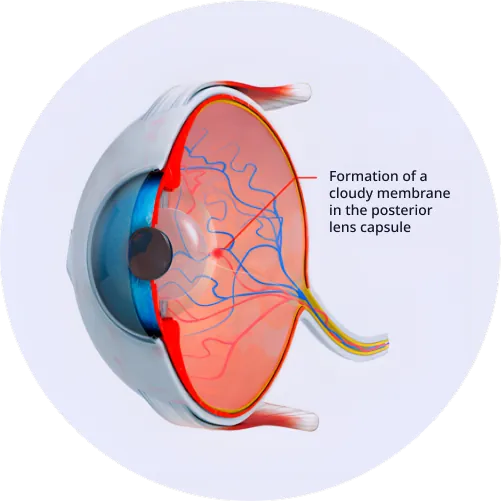
Months or years later, the thin capsule holding the lens can turn hazy, and vision blurs again. This isn't the cataract coming back. It's treated with a short laser procedure, described on our page on secondary cataract treatment. Rare but serious problems include infection inside the eye, swelling at the center of the retina, raised eye pressure and retinal detachment.
It's worth waiting if diabetes is poorly controlled, if there is active inflammation in the eye, or if a retinal problem needs treating first. Serious problems, though rare, have happened when surgery went ahead against what an exam advised, and that applies to lens choice too.
In Seoul, the same medical team supports you from the exam and consultation through surgery and the key post-operative checks. Once home, your local ophthalmologist takes over, so ask for your lens model, lens power and surgery notes before you fly. Sudden loss of vision, worsening pain, or a shower of new floaters or a curtain over your vision needs same-day care at home.
Where I stand on the newest lens
I like the newer lens designs. For the right eye, a trifocal or EDOF lens means getting through most of the day without glasses. I'm also willing to tell you a newer lens isn't for you when the scan gives a reason, and the overview of cataract and presbyopia surgery at the clinic shows the other options we can talk through.
Send that same photo of your latest eye exam report on WhatsApp, along with your question about which new lens types your eye rules out. The consultation is free, and the WhatsApp line is in English. When you come to Seoul, I'll examine both eyes and recommend the lens that fits what they show.
Sky Eye Clinic, 723-26 Banpo-dong, Seocho-gu, Seoul (Building A B3–10F · Building B 1F)
— Dr. Kim Dong-Soo, Center Director
Results vary by individual.
Sources
Questions answered
Can I get the light-adjustable lens at Sky Eye Clinic?
It isn't among the lens groups on our lens page, which lists monofocal, multifocal and specialty lenses. Even where it's offered, it requires UV-protective glasses from surgery until the last light treatment, which comes roughly five weeks later.
If I can't live with the halos, can the lens be swapped?
A lens exchange is possible, but it's a second operation inside the eye, and it gets harder as the capsule seals around the lens. Many surgeons first wait several months, because halos often fade as the brain adapts.
Is a toric lens one of the new lenses?
A toric lens corrects corneal astigmatism, and toric versions exist for monofocal and multifocal designs. If you have meaningful astigmatism, the question is whether your lens type comes in a toric version, separate from how new it is.
Should both eyes get the same type of lens?
Often yes, but not always. Some surgeons pair different designs, or set one eye slightly for near. That plan works better when it's decided before the first eye, because the first result shapes the second.
Will a newer lens stop the cloudiness from coming back?
The cataract itself doesn't return once the natural lens is removed. The capsule behind any artificial lens can turn hazy later, whatever the design, and that haze is cleared with a quick laser treatment.
Get your free consultation before you decide
- Free consultation and checkup, even if you decide against surgery
- Same price as Korean patients, no overseas surcharge
- Interpreters in English, Japanese and Chinese