
What Happens During Cataract Surgery? You're Awake but Numbed
Are you picturing yourself lying awake under a bright light while someone works on your eye, and wondering how much of it you'll actually feel?
On this page
Will I be asleep during cataract surgery?
You do stay awake, but numbing drops take the sensation out of the eye, and the operation itself is usually over in well under an hour. Through a tiny opening at the edge of the cornea, the surgeon breaks up the cloudy natural lens, removes it and puts a folded artificial lens in its place. What most people see is bright light and soft color, not instruments.
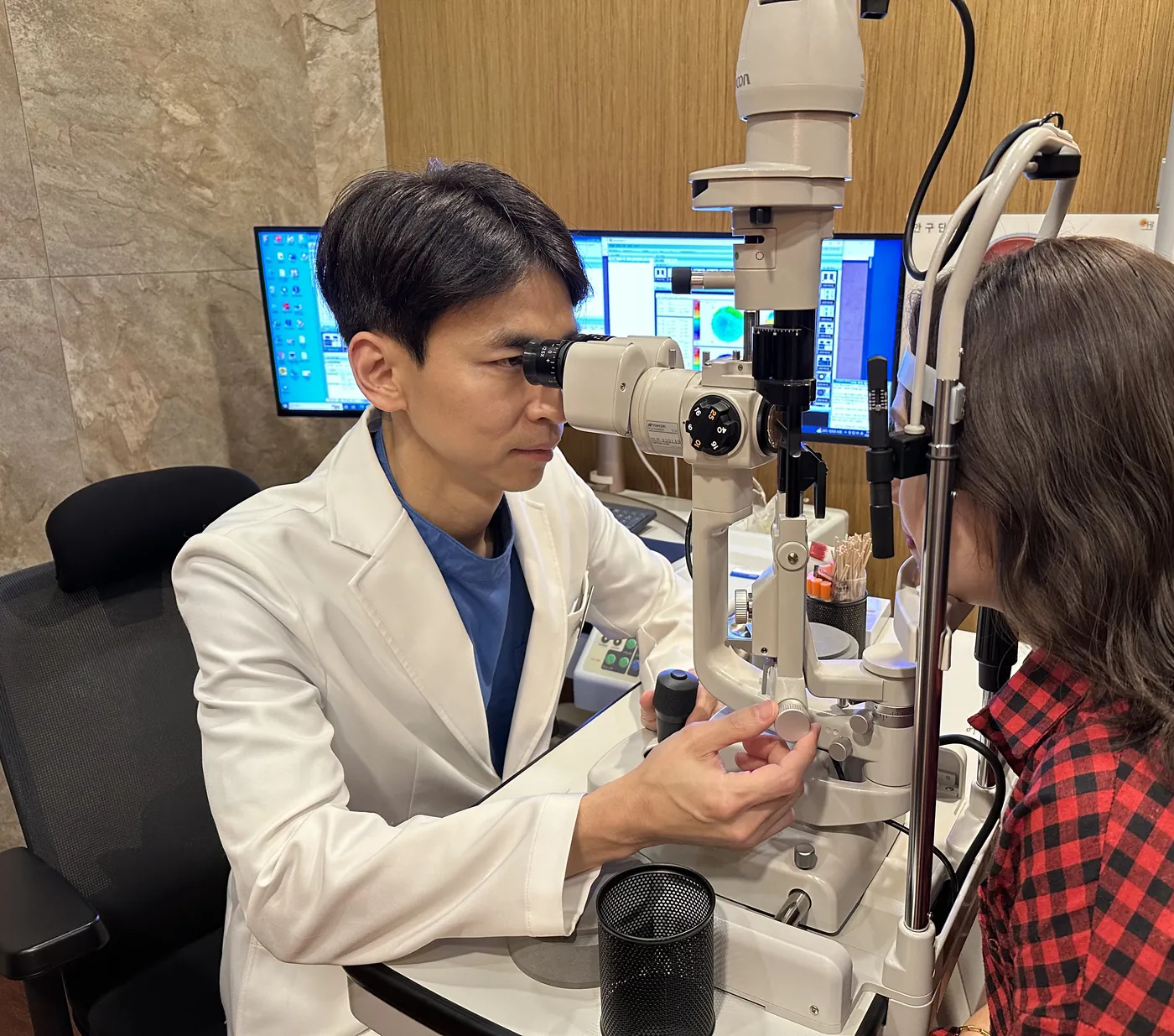
Hello, I'm Dr. Kim Dong-Soo, Center Director for presbyopia and cataract at Sky Eye Clinic in Seoul.
I'm a LENSAR Certified Laser Cataract Specialist (USA) and a J&J, Alcon Certified Cataract Specialist (USA). Here, the surgeon who consults with you is the surgeon who performs your operation. If you're traveling from abroad, you get a medical interpreter for your language at no extra charge, so every explanation before surgery reaches you in words you follow.
If you have an eye exam report from home, a photo of it on WhatsApp is enough to start, together with one question: which of the steps below would apply to your eyes? The consultation is free.
Usually not. General anesthesia tends to be kept for particular situations, such as someone who can't lie still. Ask at your consultation whether a sedative is an option for you.
Being awake has a practical purpose. You can follow a simple instruction, like looking toward the light, and you can usually go home the same day. Before anything starts, the skin around the eye is cleaned, a sterile drape covers your face except that eye, and a small clip holds the lids open, so blinking isn't something you have to manage.
The operation, step by step
The sequence is close to the same in most modern cataract surgery:

- Dilating drops widen the pupil so the whole lens is exposed.
- A small incision, a few millimeters long, is made at the edge of the cornea.
- A round opening is made in the thin front wall of the capsule, the clear bag that holds your natural lens.
- A fine probe uses ultrasound to break the cloudy lens into pieces, which are suctioned out. This step is called phacoemulsification.
- A folded artificial lens (IOL) goes in through the same incision and unfolds inside the capsule.
- The incision usually seals on its own without stitches, and a shield goes over the eye.
The back of the capsule is left in place on purpose. It becomes the pocket that keeps the new lens centered. The clinic has IOLMaster biometry, which measures the length and curvature of the eye to calculate the lens power, and a Signature Pro phaco system for the ultrasound step.
Which lens goes in is settled before surgery day, not on the table. Monofocal, multifocal and specialty lenses each trade something different, and the cataract lens options page sets them side by side.
What will I see and feel on the table?
What you feel is mostly cool fluid running over the eye and, at moments, light pressure when the eye is steadied. With the eye numbed, sharp pain isn't expected. If something does hurt, say so out loud; you can talk, as long as your head stays still.
What you see is the microscope light, often with shifting colors and blurry shapes. Some people notice vision dim for a moment when the cloudy lens comes out, then brighten when the new lens is in. You'll hear the machine and the team talking to each other.
Use the restroom right before you go in, and tell the team beforehand if you have back pain, a cough or trouble lying flat, so they can position you with that in mind.
The fear I'd most like to take away is the picture of watching a blade come toward your eye. With the pupil dilated and that light so bright, what reaches you is glare and color. What the surgeon needs from you is small: keep your head still and look where you're asked to look.
Does a laser do the whole operation?
No. In laser-assisted cataract surgery, a femtosecond laser can make the incision, open the capsule and soften or divide the lens before the ultrasound step. Ultrasound and suction still remove the lens, and the artificial lens is still placed by the surgeon's hand. The clinic has a LENSAR laser for this, and whether the laser step adds anything for your particular eye is something to discuss at the exam.
A cataract also isn't a film on the front of the eye that gets scraped away. It's the natural lens itself, sitting behind the iris, turning cloudy. That's why the lens is removed and replaced rather than cleaned.
Can a cataract come back after surgery?
The lens that was taken out can't cloud again. What can happen, months or years later, is that the back of the capsule behind the new lens turns hazy. This is posterior capsule opacification, often called secondary cataract, and it feels like the old blur creeping back.
It's treated with a YAG laser that clears a small opening in the hazy capsule. There's no incision, and the laser itself usually takes only a few minutes. You can read how that visit works on the secondary cataract treatment page.
What if you've had LASIK before?
Earlier LASIK or LASEK reshaped your cornea, and standard lens-power formulas assume a cornea that was never reshaped. It doesn't rule out cataract surgery. It means the measurements need extra care, so dig out your old records now: the date, the type of laser surgery, and, if you can find it, your prescription from before the laser. That last number is the one people most often lose and the one that helps most.
If you're not sure which procedure you had, the difference is explained in how LASIK and LASEK treat the cornea. Soft contact lenses can also change the cornea's shape for a while, so many surgeons ask you to leave them out for a period before measurement; check the exact gap when you plan your trip.
Infection, inflammation, pressure and the retina: the risks
In the first days, grittiness, watering, light sensitivity and blurred vision are common, and they usually fade as the eye settles. Mild inflammation inside the eye is expected and is treated with drops. How fast your eye settles varies from person to person.
Less common problems include raised eye pressure and swelling of the cornea or the center of the retina, which are usually treatable with drops or time. Rare but serious ones are infection inside the eye and retinal detachment, which needs urgent care.
Some people should wait or prepare differently:
- anyone with an active eye infection or inflammation
- people taking blood thinners, who need to discuss them before surgery rather than stop them on their own
- men taking alpha-blocker medicine for the prostate, which can make the pupil harder to keep wide during surgery
- people with diabetes or retinal disease, whose retina needs checking first
The clinic has a Cirrus OCT 6000, a scanner that images the retina in layers. Serious visual problems, although rare, have happened when surgery went ahead despite an exam result advising against it. If the exam says not yet, I'd rather postpone than operate.
Who looks after your eye once you're home?
Here, the same medical team supports you from the exam and consultation through surgery and the key post-operative checks, so plan your flight for after those checks. Once you're home, a local ophthalmologist takes over day-to-day follow-up. Bring them your records: the date of surgery, the lens model and power, and your drop schedule.
Most people use drops for several weeks. Don't rub the eye, and wear the shield at night for as long as you were told. Get same-day eye care at home if pain is getting worse, vision drops instead of improving, the eye turns increasingly red, or you notice a shower of new floaters, flashes of light or a shadow moving across your vision.
What should you ask any cataract surgeon?
Whichever clinic you choose, these questions are worth asking. Under each one is how it works at Sky Eye Clinic.
- Is the doctor who examines me the one who operates? Here, the surgeon who consults with you performs your procedure, and the clinic publishes its surgeons' names on a named-surgeon page.
- How is my lens power measured? The clinic uses IOLMaster biometry.
- Is laser assistance part of the plan, and why? A LENSAR laser is available; whether it's used is decided for your eye.
- How is the equipment kept in check? The clinic runs a complication-prevention program with daily equipment checks, and it's closed on Thursdays for equipment inspection.
- Who sees me at follow-up before I fly? The same medical team that handled your exam and surgery sees you through the key post-operative checks.
- Will I understand everything that's said? A medical interpreter for your language is provided at no extra charge.
Where I stand on cataract surgery for travelers
Cataract surgery is one of the shorter operations in eye care, but those minutes on the table rest on the measuring done beforehand. My view is that treatment should be for the patient, not for volume. If your cataract isn't yet getting in the way of how you live, I'll say so, and you can come back when it is. There's no need to fix a surgery date before your measurements are in; taking a few weeks to think it over is fine.
For most people, the factor that shapes their own operation most is the lens-power measurement, along with anything that can throw it off, such as earlier LASIK or a retinal problem.
The consultation is free. Sky Eye Clinic is at 723-26 Banpo-dong, Seocho-gu, Seoul, about a 5-minute walk from Nonhyeon Station or Sinnonhyeon Station.
— Dr. Kim Dong-Soo, Center Director
Results vary by individual.
Sources
Questions answered
Are both eyes operated on the same day?
If you're traveling, ask how the gap between the two eyes fits your dates before you book flights.
How soon after cataract surgery can I fly?
Routine cataract surgery doesn't leave a gas bubble in the eye, so cabin pressure is rarely the concern. What matters more is staying in Seoul for the key post-operative checks before you leave.
Will I still need glasses afterward?
That comes down to the lens. A monofocal lens set for distance often means you'll use reading glasses for close work. Multifocal lenses aim to reduce glasses use but can bring halos around lights at night.
What if I need to cough or sneeze during the operation?
Tell the team before you start if you have a cough or allergies. If you feel a cough or sneeze coming during surgery, say so right away. A warning gives the surgeon time to pause.
Can I go back to the hotel on my own afterward?
Plan on a taxi, not driving or navigating alone. Your pupil is still dilated and the eye is shielded, so depth and glare are off for the rest of that day.
Get your free consultation before you decide
- Free consultation and checkup, even if you decide against surgery
- Same price as Korean patients, no overseas surcharge
- Interpreters in English, Japanese and Chinese