
Who Does Cataract Surgery? The Eye Surgeon You Meet First
“Is the doctor I'm talking to now the one who will actually operate on my eye?”
On this page
What kind of doctor does cataract surgery?
People ask this before cataract surgery everywhere, and it gets sharper when the clinic is in another country. Underneath it sits a quieter thought: in a building where you can't read the signs, how would you even know who walked into the operating room?
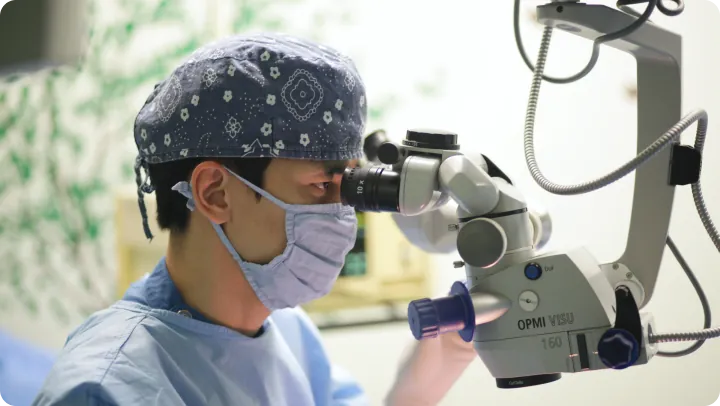
Asking who does cataract surgery is really two questions. The kind of doctor is always an ophthalmologist, a medical doctor trained in eye surgery; an optometrist or optician doesn't perform it. Which ophthalmologist is the part to pin down, and at our clinic the surgeon who consults with you performs your procedure, with the surgeon's name published.
Hello, I'm Dr. Kim Dong-Soo, Center Director for presbyopia and cataract at Sky Eye Clinic in Seoul.
I'm a LENSAR Certified Laser Cataract Specialist (USA) and a J&J, Alcon Certified Cataract Specialist (USA). That matters here for one reason: the doctor whose credentials you read on our doctors page is the doctor who examines your eye and then operates on it. If language is part of the fear, you get a medical interpreter for your language at no extra charge.
If an eye doctor at home has already found a cataract, send a photo of that report on WhatsApp along with the one thing you most want to know about who would operate.
An ophthalmologist. That means a medical degree, then several years of residency in eye disease and eye surgery. The US National Eye Institute describes the operation in plain terms: the surgeon removes the clouded natural lens and puts a clear artificial lens, called an IOL, in its place.
Think of a wristwatch whose crystal has fogged from the inside. You can't polish it from outside. The fix is to open the case, lift the old crystal out and fit a new one, and with the eye that new lens has to be cut to a calculated power, set by how long your eye is and how your cornea curves.
Several people touch your care, and it helps to know who does what:
| Role | What they do | Operates? |
|---|---|---|
| Ophthalmologist | Examines, chooses the lens, operates, treats complications | Yes |
| Optometrist | Often spots the cataract, refers you, may share routine checks later | No |
| Optician | Fits glasses after you've healed | No |
| Nurses and technicians | Measurements, drops, preparation, recovery room | No |
The split matters most after you fly home. In the US, Canada, the UK and Australia it's common for an optometrist to find the cataract and later help with routine checks, while anything surgical goes back to an ophthalmologist. Knowing that now tells you who to line up at home before you leave.
Will the surgeon I meet be the one who operates?
Here, yes. The surgeon who consults with you performs your procedure directly, and we keep a page that names the operating surgeon so you can check it before you book. The same medical team stays with you from the exam and consultation through surgery and the key post-operative checks.
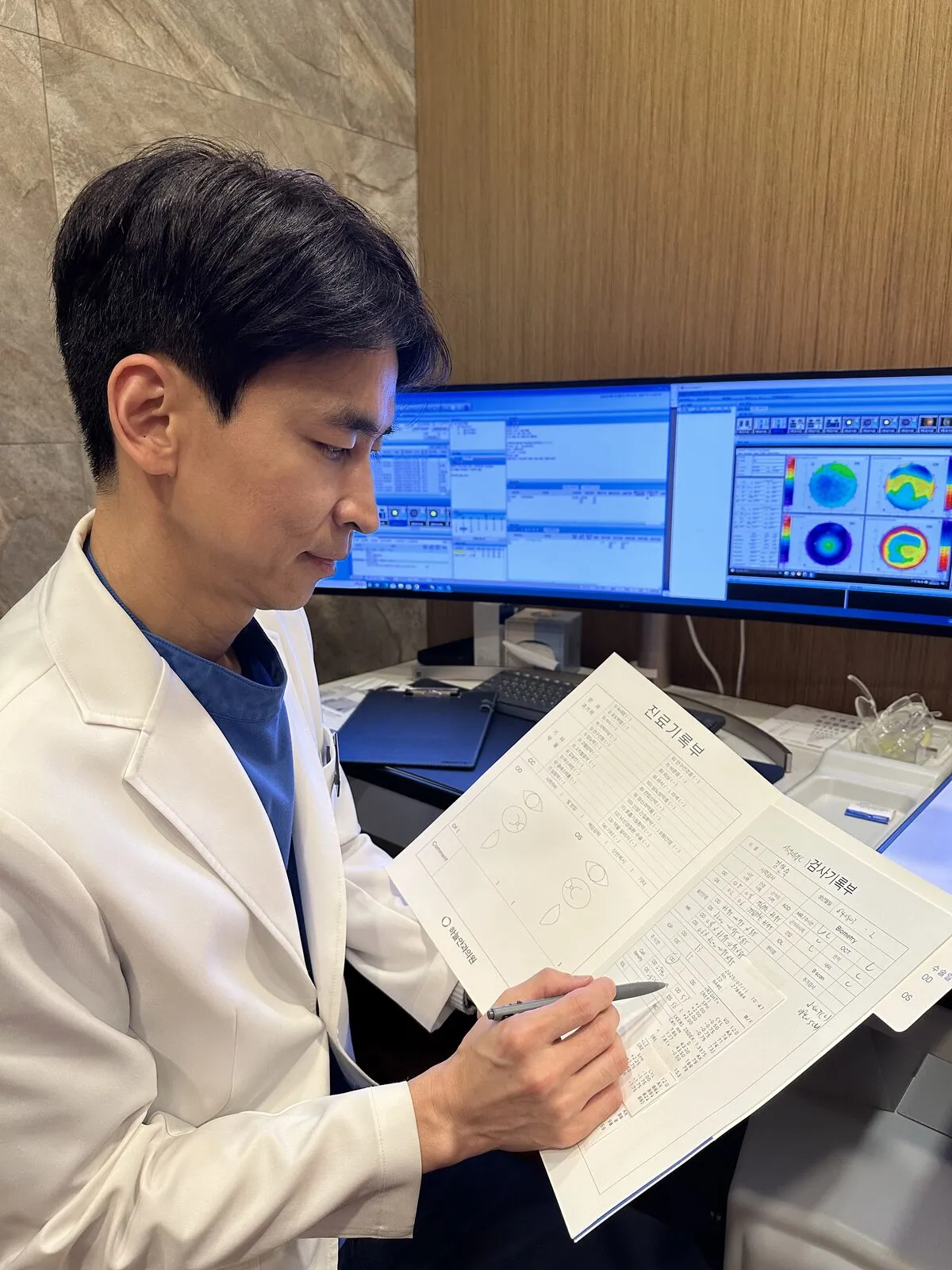
What this question guards against is substitute surgery: you agree to one surgeon and someone else operates. A published name is something you can verify from home, which a promise in a brochure isn't.
Sky Eye has ten ophthalmologists in three centers: vision correction, cataract and presbyopia, and retina and glaucoma. Cataract and lens work belongs to our cataract and presbyopia center. If the exam finds something behind the lens, such as changes in the macula, the retina center is part of the same clinic.
The surgeon matters most before the operation, not only during it. The lens power, the lens type and whether your retina or an old laser treatment changes the plan are all settled at the exam. I think the person who makes those calls should be the person who operates. Serious visual problems, though rare, have followed surgery that went ahead against what the exam advised, so if your results say not yet, I'll tell you that.
Send a photo of your latest eye exam and the dates you could travel, and ask which surgeon would be named for your case. With dates in the first message, the Thursday closure and the weekend won't catch you out later.
What does the surgeon decide before the operating day?
Three things, and each one is the surgeon's call.
Lens power. We measure eye length and corneal curvature with an IOLMaster, and the power of your new lens comes from those numbers. Soft contact lenses change the shape of the cornea for a while, so ask how long to leave yours out before the measurement.
Lens type. Monofocal lenses give one sharp distance and usually mean reading glasses; multifocal and specialty lenses spread focus across distances with their own trade-offs. The guide to IOL types for cataract surgery lays out who each one tends to suit.
Method. We have a LENSAR laser for laser-assisted cataract surgery and Signature Pro ultrasound equipment for phacoemulsification. Either way, an ophthalmologist is in control of every step.
The tip most people learn too late concerns laser vision correction. If you had LASIK or LASEK years ago, standard lens formulas can miss, because the reshaped cornea no longer matches what they assume. Your prescription from before that surgery helps the calculation, and older clinics can take weeks to dig records out of an archive, so request them now. If you're not sure which procedure you had, how LASIK and LASEK each change the cornea is a quick refresher.
Say you're 59, living outside Seattle, your optometrist has noted a cataract in your left eye, and you had laser correction in 2004 at a clinic that has since closed. Before you book a flight I'd want your current exam report, any old prescription you can find (even a glasses receipt), and your list of medications. Without the pre-laser numbers there are formulas that still work, but the power estimate carries more uncertainty. That's a reason to talk through which distance you'd most want sharp before choosing a lens, and it's better discussed at home than in the exam chair.
What should you ask any clinic before booking?
Use this list wherever you go. Clear answers to these are what you're really comparing:
- Who will operate, and can I see that surgeon's name before the day?
- Is the doctor who examines me the one who operates?
- Which measurements set my lens power, and do you need my old laser records?
- Which checks happen before I fly home, and do I leave with my operation record and the lens model and power?
- Will an interpreter be with me during the exam, and does it cost extra?
- If the capsule clouds later, who treats it, and can that be done where I live?
Inflammation, pressure and a cloudy capsule: what can go wrong
For the first days most eyes feel gritty, water easily and dislike bright light, and vision can be hazy while it settles over the following weeks. How fast that happens differs between people and even between your two eyes.
Risks and side effects to know
Less often, the eye pressure rises, the center of the retina swells, or inflammation lingers; these are usually treated with drops. Rarely, infection inside the eye or retinal detachment occurs, and both need prompt care.
Some people should wait or tell the surgeon early: anyone with an active eye infection or inflammation, poorly controlled diabetes, or a history of uveitis. Bring a full medication list, and flag blood thinners and the alpha-blocker medicines often used for prostate or urinary symptoms, since the second group can make the iris floppy during surgery.
Months or years later the thin capsule holding the new lens can cloud. This secondary cataract is fixed by an ophthalmologist with a YAG laser, an outpatient treatment; we have a YAG laser here, and secondary cataract treatment explains the steps. Any eye surgeon with that laser can do it near your home.
Once home, sudden pain, vision getting worse instead of better, a burst of new floaters or flashes, or a shadow moving across your sight means seeing a local ophthalmologist that day. Carry your operation record and lens card in your hand luggage so whoever sees you knows exactly what was done.
For your trip: the clinic is closed on Thursdays for equipment inspection, part of a daily equipment-check program, and Saturday hours are for exams and surgeries only. Build your exam day around that.
Where I stand on choosing a cataract surgeon
I'd rather you choose a named surgeon than a building. Ask for the name, check it, and make sure the person you meet at the exam is the one who operates. There's no need to decide this month; a cataract that's still mild gives you time to gather records and ask questions.
Send your latest eye report on WhatsApp, plus anything you have from an old laser surgery, and ask which checks you'd need to finish in Seoul before flying home. What decides your plan in person is how dense the cataract is and what lens power your measurements give, and that's what the exam here sets out to find.
— Dr. Kim Dong-Soo, Center Director
Results vary by individual.
Sources
Questions answered
Will I be awake during cataract surgery?
Usually, yes. The eye is numbed with drops, and in many practices a mild sedative is offered so you feel relaxed. You may see light and movement but not the instruments in detail. Ask at booking which numbing and sedation you'd receive.
Does the laser operate instead of the surgeon?
No. In laser-assisted surgery the laser makes precise openings and softens the lens, but an ophthalmologist plans every setting, removes the lens and places the IOL. The surgeon operates either way.
Are both eyes done on the same day?
Commonly, one eye is done first and the second follows after a gap of days to weeks, so the first eye can settle and the second lens can be fine-tuned. That gap affects how long you stay in Seoul, so raise it before booking flights.
Can I fly soon after cataract surgery?
Standard cataract surgery doesn't put a gas bubble in the eye, so cabin pressure itself is generally not the issue. What sets your flight is clearing your post-operative check, so keep your departure flexible until that check is booked.
Can an optometrist at home do my checks afterwards?
Often, yes, for routine checks, and many people do this. Give them your operation record and lens details. Anything that needs surgery or a laser, including a secondary cataract, goes to an ophthalmologist.
Get your free consultation before you decide
- Free consultation and checkup, even if you decide against surgery
- Same price as Korean patients, no overseas surcharge
- Interpreters in English, Japanese and Chinese