
Blurry Vision After LASIK: A Day for Most, Longer With LASEK
Have you been told your prescription is high, and now you're picturing a week of fog in a Seoul hotel room and a flight home you can't see through?
On this page
How long does LASIK blur last on the first day?
For most people, the heavy blur after LASIK lasts the rest of surgery day and is much lighter by the next morning. Smaller shifts in sharpness, worse when the eyes are dry, can continue for up to three to six months. LASEK, used when the cornea is too thin for LASIK, blurs for about 5 to 7 days.
Hello, I'm Dr. Kim Sang-Myung, an ophthalmologist on the vision correction team at Sky Eye Clinic in Seoul. I completed my ophthalmology training at Yonsei Severance Hospital.
Several of our doctors had LASIK or LASEK themselves and can describe that first evening from the patient's side. If English isn't your first language, a medical interpreter comes at no extra charge.
The consultation is free. Send a photo of your current glasses or contact-lens prescription with your dates on WhatsApp, and ask how long the blur is likely to last for eyes like yours.
Right after surgery your vision will be hazy, your eyes will water, and bright light will feel harsh. The US Food and Drug Administration describes the same picture and expects those symptoms to ease within the first few days. With LASIK, the grittiness and tearing usually last about half a day.
Many people sleep through part of that stretch, and the haze is usually much lighter on waking.
From then on, most of the blur that remains comes from the surface. A freshly treated cornea makes fewer tears for a while, and a dry surface scatters light. That's why vision can be crisp at breakfast and soft by evening, or clear again after a few blinks. Glare and halos around lights at night can stay with you while the eye settles, and that settling can take up to three to six months.
Here's the distinction I'd keep in your pocket: blur that clears when you blink or use your drops is a dryness signal, not a healing problem. Blur that stays the same through blinking and drops, or gets worse from one day to the next, is the kind to report.
Does a high prescription mean a longer blur?
Often a little. Correcting more myopia means reshaping more of the cornea, and a deeper treatment tends to bring more surface dryness and more noticeable night halos in the first months. The larger difference for a high prescription is which method your cornea can afford, because each method blurs on its own timetable.
| Method | What the cornea goes through | Blur to plan around |
|---|---|---|
| LASIK | Thin flap, laser on the deeper layer; discomfort about half a day | Heavy haze on surgery day, lighter by the next morning for most |
| LASEK | Surface layer removed and regrown under a protective lens; discomfort up to 3 to 4 days | Blurring for about 5 to 7 days |
| New SMILE LASIK | 2 mm micro-incision, tissue removed, no flap | For some people, sharpness in the first day or two comes in a little slower than with LASIK |
LASIK is not for everyone. When the cornea is thinner than a certain threshold for the correction you need, I recommend a LASEK-type procedure that keeps the most cornea in place, and that choice adds days of blur to your plans. How thickness steers that decision is covered in LASIK or LASEK: why your cornea decides. If you're leaning toward LASEK and its slower first week, the 5-to-7-day window is the number to build the trip around.
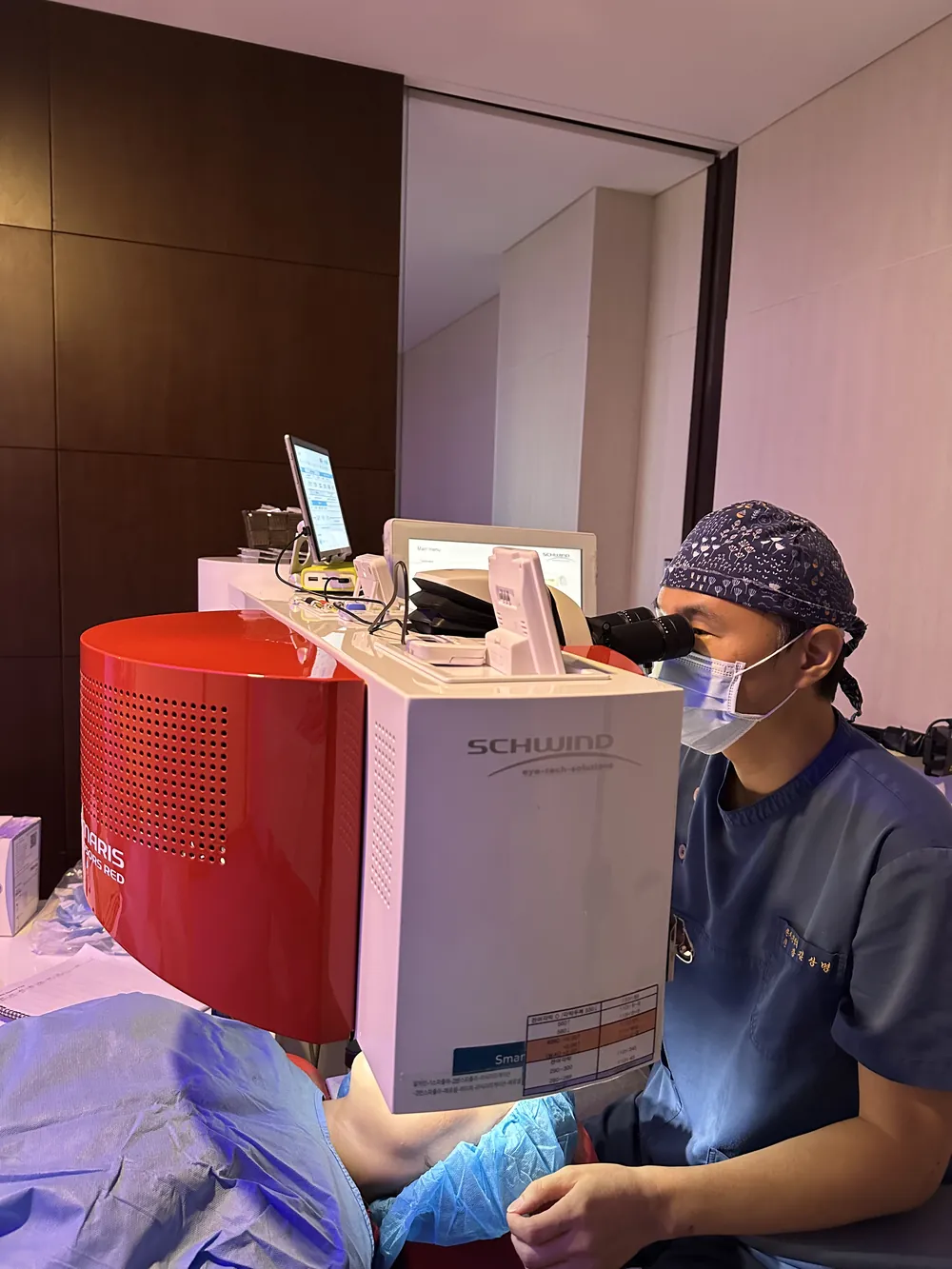
New SMILE LASIK is performed here on the SCHWIND ATOS laser, and it is listed for high myopia with thin corneas. Without a flap, there are no flap complications to think about, which matters to people with active jobs or contact sports.
When a scan advises against a procedure, I don't argue with it. Serious visual side effects, although rare, have occurred when surgery went ahead despite an examination result advising against it. With a high prescription, I'd rather you spend a blurry week after LASEK than recover quickly on a cornea that couldn't spare the tissue.
Planning the flight around the blur
The haze itself rarely stops anyone from flying. The flight date hangs on two things: the first check within 24 to 48 hours, and the blur window of the method you end up having.
The clinic is closed on Thursdays for equipment inspection, and on Sundays and public holidays. Surgery on a Wednesday or a Saturday puts the next day on a closed day, so look at the calendar before you settle on a surgery date and ask at consultation which day your first check would fall on.
With LASEK, a flight on day 3 or 4 lands in the blurriest part of the week.
Cabin air is dry, and dryness is the main source of blur after the first day. Pack the drops you were given in your carry-on rather than your checked bag, and keep the same spacing between doses when the time zone changes. Close your eyes for part of the flight instead of watching films back to back; people blink less at a screen, and the surface dries faster.
If your trip is already booked, or your surgery is already behind you, send that same prescription photo with your dates on WhatsApp (travel dates if you're planning, your surgery date if you've had it) and ask how long the blur should last for your eyes.
Dry-eye blur, night halos and the rare signs that need a doctor
The common reactions in the first days are haze, watering, redness and sensitivity to light. After that, dryness-related blur that comes and goes, plus glare and halos at night, can continue for weeks to months. How fast each eye clears varies from person to person, and the two eyes don't always heal in step. With LASIK, flap-related complications are possible, though uncommon.
As general medicine, some people should wait or choose another route:
- your glasses or contact-lens prescription changed in the past year
- your cornea is thin or irregular in shape, which can be an early sign of keratoconus
- you are pregnant or breastfeeding, since prescriptions can shift during that time
- you already have significant dry eye or large pupils, which raise the chance of lasting night glare
For very high prescriptions where the cornea can't spare tissue, an ICL lens implant corrects vision without reshaping the cornea. It carries its own risks, including raised eye pressure and earlier cataract, so it's a separate conversation with its own checks.
Back home and still blurry: who checks your eyes?
While you're in Seoul, the same medical team supports you from examination and consultation through surgery and the key post-operative checks.
Take three things to that first local visit: the name of the method you had, your prescription before surgery, and your surgery date. A doctor who sees you for the first time can read your eyes far better with those in hand.
If the blur has a pattern, write it down: worse by evening, better after drops, one eye slower than the other, and the day it started. That short note is more useful to a local doctor than any description from memory.
See an eye doctor the same day for severe pain, vision getting worse instead of better, or a red eye with discharge.
What should you ask any clinic about recovery?
Put these to every clinic on your shortlist, ours included. The answers tell you more about your blur window than any recovery chart.
- Which scans decide the method? Here: Pentacam and Corvis ST are among the clinic's listed devices.
- Is the doctor who examines me the one who operates? Here: the surgeon who consults with you performs your procedure, and surgeons' names are published on a disclosure page.
- Who sees me at the checks after surgery? Here: the same medical team, from examination through surgery and the key post-operative checks.
- Which days are you closed, and how is the equipment maintained? Here: closed Thursdays for equipment inspection and on Sundays and holidays, with daily equipment checks as part of a complication-prevention program.
- Will someone translate the medical details? Here: a medical interpreter for your language at no extra charge.
Where I stand on blur and flight dates
I'd rather plan a trip around the slowest version of your recovery than the fastest. The blur is short for most eyes, but a flight booked to the hour leaves no room for the eye that needs an extra day. Treatment should fit the eye, not the calendar, and with a high prescription that sometimes means a slower method.
There's no need to decide on a method or a date this week; your cornea will measure the same next month.
Sky Eye Clinic is at 723-26 Banpo-dong, Seocho-gu, Seoul, about a 5-minute walk from Nonhyeon or Sinnonhyeon Station. The consultation is free: send your prescription photo and your dates on WhatsApp, in English, with the one question about the blur you most want answered.
— Dr. Kim Sang-Myung, Ophthalmologist
Results vary by individual.
Sources
Questions answered
Can I look at my phone the evening after LASIK?
Briefly, yes, but the first evening goes better with your eyes mostly closed. People blink far less while reading a screen, so the surface dries and the haze feels heavier. Short glances are fine; a two-hour scroll is what makes the next morning blurrier.
Why is my vision sharper in the morning and blurrier at night?
Two things stack up by evening: the tear film thins after a day of screens and air conditioning, and pupils widen in dim light, which makes halos more visible. Both tend to ease over the months while the eye settles. If drops bring the sharpness back, dryness is the likely cause.
Is it normal for one eye to clear faster than the other?
Yes. Each eye heals at its own pace, and a difference of a day or two in the first week is common. What matters is direction: an eye that is slowly improving is on track, while an eye that is getting worse should be seen by an eye doctor that day.
Does LASEK blur feel different from LASIK blur?
It does. After LASIK the haze is heaviest on surgery day and lifts quickly. After LASEK the surface layer regrows under a protective lens, so vision can dip again over the first few days before it clears, with blurring for about 5 to 7 days and discomfort for up to 3 to 4.
When can I drive after LASIK?
Not on surgery day. Driving waits until a doctor has checked your vision and confirmed it meets the driving standard where you live. Night driving may take longer to feel comfortable because of halos around headlights in the early months.
Get your free consultation before you decide
- Free consultation and checkup, even if you decide against surgery
- Same price as Korean patients, no overseas surcharge
- Interpreters in English, Japanese and Chinese