
Can You Drive the Day After LASIK? Only If 3 Checks Pass
"Will I be able to drive myself home from the airport?" People ask this whenever LASIK has to fit around a flight. Under the question sits a quieter thought: what if I land, pick up the car, and the road looks smeared?
On this page
Why the next morning is the earliest, never the same day
Most people can drive the day after LASIK, once a doctor has checked the eye and confirmed their vision meets the standard on their licence. Nobody should drive on the day of surgery. With LASEK the wait is closer to a week, because blurring can last five to seven days.
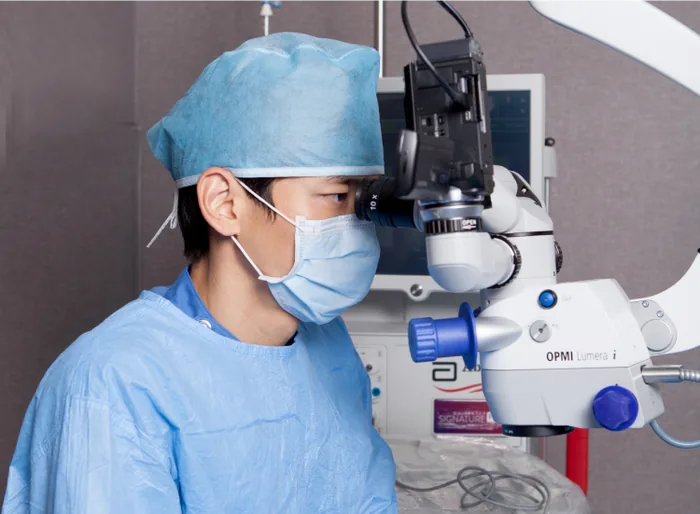
Hello, I'm Dr. Kim Sang-Myung, an ophthalmologist at Sky Eye Clinic in Seoul. I completed my ophthalmology training at Yonsei Severance Hospital, and my work is vision correction: LASIK, LASEK and New SMILE.
Three facts about how we work matter for a driving question. The surgeon who consults with you is the surgeon who operates on you. The same medical team stays with you through the key checks after surgery. And a medical interpreter for your language is available at no extra charge, so the instructions about driving and drops are clear the first time.
The consultation is free, and seeing your own dates laid out makes the driving plan concrete.
The numbing drops wear off within a few hours of LASIK. Then the eye tears, stings and feels gritty, and on our LASIK page that discomfort is listed at about half a day. Vision that first evening is often hazy, and most people want to keep their eyes closed anyway.
The FDA's patient guidance is plain on this: arrange for someone to take you home after surgery, and don't drive until your doctor says your vision is good enough. The first follow-up is usually within 24 to 48 hours. That visit is the real green light.
At that check, the doctor looks at whether the flap is sitting smoothly (our LASIK page describes a flap about 160 micrometres thick), whether the surface is clear, and what you read on the chart. Licence standards differ by country and by state, so the number that matters is the one your own licence requires.
What has to be true before you take the wheel?
Passing the chart is one of three things. All three need to be true before you drive.
- Your chart reading meets your licence standard with both eyes open. One eye can lag the other by a day. If the weaker eye drags the combined reading below the standard, you wait.
- Your sight stays clear for the whole drive. Early dryness makes vision come and go: sharp at the start, filmy twenty minutes later. Car vents blowing at your face make it worse. Point them away, use lubricating drops before you set off, and keep the first drives short.
- Night driving gets its own test. Halos and starbursts around headlights are common in the first weeks. Take the first night drives on roads you know, and if the glare stops you reading signs, wait longer.
I hold the same line after surgery that I hold before it: the exam result decides, not how the eye feels. Serious visual problems, though rare, have happened when surgery went ahead against what the exam showed. Driving early against what the check shows is the same mistake in a smaller form. I'd rather you lose a day behind the wheel than drive one day too soon.
Does LASEK or New SMILE change the answer?
Yes, and this is where a high prescription changes your plans. With a strong prescription, the cornea has to give up more tissue. If the cornea is thinner than a certain threshold, LASIK isn't the right trade, and a LASEK-type surgery that keeps the most cornea is recommended instead. If you want to see how that choice gets made, read whether your cornea points to LASIK or LASEK before you book flights.
| Method | First days (from our procedure pages) | Driving, usually |
|---|---|---|
| LASIK | Discomfort about half a day; thin flap | After the next-day check clears you |
| LASEK | Discomfort up to 3 to 4 days; blurring 5 to 7 days | Around a week, once the blur has cleared |
| New SMILE LASIK | 2 mm incision, no flap, minimal corneal damage | After the first check; some people need a day or two more for full sharpness |
LASEK heals under a protective contact lens while the surface layer grows back, so the week of blur is the healing itself, not a sign something has gone wrong. New SMILE LASIK, done here on the SCHWIND ATOS laser, leaves no flap. Sharpness in the first day or two can come back a little more gradually than after LASIK. Smart Nova LASIK is New SMILE with CenTrax correction for rotation and docking error, so for driving purposes it follows the New SMILE row.
How long after LASIK can I rub my eyes?
The answer to how long after LASIK you can rub your eyes is longer than the answer for driving. For the first week, don't rub at all. The flap is held in place by the eye's own suction while it seals, and a hard rub can shift it. Wear the shield at night for as long as you're told to. Many surgeons also ask for another few weeks of gentle handling.
After LASEK, rubbing can knock out the protective lens. After New SMILE there's no flap, but the small incision is still healing, so the same no-rubbing rule applies.
Here's the tip people miss: you're most likely to rub in your sleep, and the long flight home is where you'll sleep. Wear the shield or a pair of glasses on the plane. The itch in those first days is usually dryness, so drops work better than fingers.
What does this mean for your days in Seoul?
To be honest, the drive I think about isn't in Seoul. The drive that matters is the one from your home airport, after ten or more hours of dry cabin air on a newly treated eye.
Here's how your days might run. You land and rest. The exam comes next, and you can ask at booking whether surgery can follow on the same day or the day after. The morning after surgery is the first check. Our calendar has two snags. Sundays and public holidays are closed too. Saturday hours are listed for exams and surgeries only, so ask whether a post-op check can go there.
Say you're 33, about minus 8 in both eyes, flying in from Phoenix, and the surgeon at home called your cornea borderline. If they point to LASEK, the five-to-seven-day blur sets the length of the trip, and someone else should drive you home from Sky Harbor. Either way, book the ride from your home airport in advance and don't count on driving that leg yourself.
If you've already had surgery, here or elsewhere, and a week later road signs still swim, the date you had surgery is the one to send.
Put your flight in and flight out in a WhatsApp message and ask which day your first check would fall on. If you've already had surgery, send that date with the same question. Either way, you can then see whether the drive home from the airport is yours or someone else's.
Dryness, glare and the rarer problems
Dryness, vision that flickers between sharp and filmy, light sensitivity, and halos or glare at night are all common at first. They usually ease over weeks, though for some people night glare lasts a few months. How quickly they settle varies from eye to eye, and that's the main reason driving advice is given one check at a time.
You should wait or skip surgery if your prescription has changed within the past year, if you're under 18, pregnant or nursing, or if your cornea is too thin or irregular for the planned method. Autoimmune disease or poorly controlled diabetes, which can slow healing, are also reasons to wait. A screening exam with Pentacam and Corvis ST corneal scans is how those limits show up before surgery rather than after it.
Rare problems include a flap shifting after a blow to the eye, infection in the first days, and, rarer still, the cornea weakening and bulging over time. None of these is likely. They're the reason the no-rubbing and eye-protection rules exist.
Back home: who do you call if driving feels wrong?
Once you've flown home, the first thing is drops. Keep taking them on schedule, and set alarms by your home clock, since time zones can wreck a medication routine. Carry the record of your surgery: the date, the method, your prescription before surgery, and the names of your drops.
Go to an ophthalmologist near you the same day if pain gets worse instead of better, vision drops suddenly in one eye, redness spreads, or light sensitivity increases after the first few days. Don't drive yourself to that appointment. Book a local ophthalmologist before you travel so you know where to go, and bring the records with you.
Where I stand on driving after LASIK
Because of that, I plan the drive home as someone else's job, even when the eye looks good. One cautious day costs you little. Getting it wrong on a motorway costs a lot more.
The consultation is free. Send your travel dates on WhatsApp, or your surgery date if it's already behind you, and ask which day your first check would fall on. We're at 723-26 Banpo-dong, Seocho-gu, Seoul.
— Dr. Kim Sang-Myung, Ophthalmologist
Results vary by individual.
Sources
Questions answered
Can I take the subway to my check the morning after surgery?
Yes, if someone goes with you. Your eyes will be light-sensitive, so wear sunglasses. The clinic is about five minutes on foot from Nonhyeon Station (Line 7 Exit 5, Sinbundang Exit 4) or Sinnonhyeon Station (Line 9 Exit 2), and a taxi also works.
My licence says I need corrective lenses. Can I drive without glasses after LASIK?
In many places the restriction stays on your licence until the licensing office retests your vision and removes it. Until then you may still be legally required to wear glasses, even if you see well without them. Check your local rules and book the retest once your vision has stabilised.
Should I wear sunglasses when I start driving again?
Yes, in daylight. They cut glare while your eyes are still sensitive and give some protection from wind and dust. At night, don't wear tinted lenses. If headlights still bother you, wait longer before driving after dark.
Is it safe to fly the day after LASIK?
Flying doesn't put pressure on the flap, so for most people the main problem is dryness from cabin air. Use your lubricating drops often during the flight, avoid rubbing your eyes while you sleep, and fly only after your first post-op check has cleared you.
Get your free consultation before you decide
- Free consultation and checkup, even if you decide against surgery
- Same price as Korean patients, no overseas surcharge
- Interpreters in English, Japanese and Chinese