
How Long Has LASIK Been Around? About 35 Years, in 3 Dates
Is an operation that has been done for decades still the right one for eyes a surgeon at home already turned down?
On this page
Where did LASIK start, and when did it reach patients?
LASIK has been around for about 35 years. It was patented in 1989, the first US cases were done in 1991, and a laser was approved for LASIK in the US in 1999. That long record means its risks are well understood, but whether it fits you still comes down to your cornea.
Hello, I'm Dr. Kim Sang-Myung, an ophthalmologist at Sky Eye Clinic in Seoul. I completed my ophthalmology training at Yonsei Severance Hospital, and I'm a full member of the Korean Society of Cataract and Refractive Surgery.
If your corneal scan says LASIK is a poor fit, I'll tell you so and talk about LASEK or a lens implant instead. The clinic has a Pentacam and a Corvis ST for mapping corneal shape and stiffness, and the surgeon who consults with you is the one who performs your procedure.
LASIK grew out of earlier work on reshaping the cornea and became a working operation around 1990. Three dates explain how it turned into the procedure clinics offer today.
- 1989 to 1991: the patent and the first operations. The LASIK procedure was patented in 1989, and the first LASIK cases in the United States were performed in 1991. The idea was to lift a thin flap of cornea, reshape the tissue underneath with an excimer laser, then lay the flap back down.
- 1999: approval for LASIK in the US. An excimer laser had been approved in 1995 for mild to moderate myopia, using surface treatment. In 1999 the FDA approved a commercial excimer laser for LASIK itself.
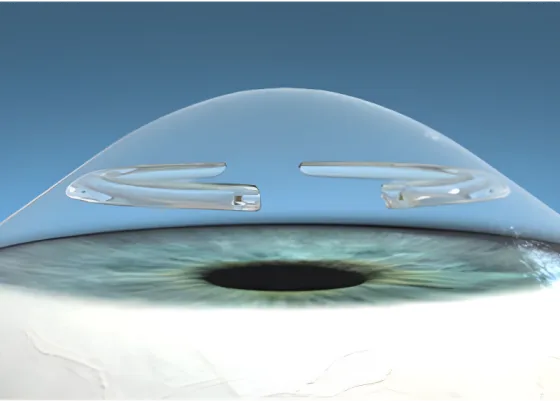
A later branch came in the early 2010s: lenticule extraction, which reshapes the cornea through a small incision with no flap. New SMILE LASIK belongs to that family.
Does a long track record mean LASIK suits my eyes?
In short, it means the failure points are well known. It can't tell you whether your cornea is safe from them.
Think of a bridge design that has stood for 35 years. The design is proven, but an engineer still tests the ground at your site before building. In LASIK, your cornea is the ground. The flap is about 160 micrometers thick, and the laser removes tissue beneath it. A cornea that is thin for the amount of correction leaves too little behind once the flap and the treatment are both counted.
That's why I say plainly that LASIK is not for everyone. When a cornea is thinner than a certain threshold, I recommend a LASEK-type procedure that preserves the most residual cornea. I lay out that choice in more detail in how LASIK and LASEK compare for your cornea. For a high prescription on a thin cornea, the ICL lens implant is on our menu because it doesn't remove corneal tissue. As an implanted lens, it carries its own risks, such as raised eye pressure or cataract, which is why it needs its own exam.
The basic gate hasn't changed in 35 years. LASIK is for adults 18 or older whose prescription hasn't changed in the past year, and whom a doctor has approved after a full examination.
I'll admit something about this history: a long record also means a long list of people who should never have had the operation. Serious visual side effects, although rare, have occurred when surgery went ahead despite an exam result advising against it. Several of the doctors here had LASIK or LASEK themselves, so we know the recovery from the patient's chair too. That makes me more careful about who gets it.
How newer methods changed the recovery days
The method you have sets how quickly the early discomfort settles, and that decides how many days your trip needs around the surgery. Here is how the clinic describes the three methods.
| Method | Early recovery, as the clinic describes it | Flap |
|---|---|---|
| LASIK | Irritation, tearing and grittiness for about half a day | Thin flap; flap-related complications possible |
| LASEK | Discomfort up to 3 to 4 days; blurring 5 to 7 days | No flap; the surface regrows under a protective lens |
| New SMILE LASIK | Minimal corneal damage through a 2 mm micro-incision | No flap, so no flap complications |
LASEK needs the longest window before you fly, because the surface takes days to heal. Our LASIK page with Co-Wave customization covers LASIK on the SCHWIND Amaris Red SPT. The New SMILE LASIK page covers the no-flap option on the SCHWIND ATOS, which also runs Smart Nova LASIK, New SMILE with CenTrax correcting rotation and docking error.
When you plan dates, note one constraint: the clinic is closed on Thursdays for equipment inspection, and on Sundays and public holidays.
Dry eye, glare and flap problems after LASIK
The common early effects are dryness, light sensitivity, and glare or halos around lights at night. For most people these fade over weeks to months as the cornea settles, though how long it takes varies from eye to eye. Flap problems are possible with LASIK and don't apply to LASEK or New SMILE. Ectasia, a weakening and bulging of the cornea, is rare and is the main reason corneal thickness and stiffness get measured first.
As a general guide, these people should wait or choose another route:
- anyone whose prescription changed in the past year, or who is under 18
- a cornea that is thin or irregular, or shows early signs of keratoconus
- pregnancy or breastfeeding, when the prescription can shift
- conditions that slow healing, such as poorly controlled diabetes or some autoimmune diseases
- marked dry eye before surgery, where ICL may be worth discussing
Take your surgery record (method, measurements and the drops you were given) to a local ophthalmologist. See them promptly if you notice worsening pain, a sudden drop in vision, or redness that keeps getting worse.
What should you ask any LASIK clinic before you fly?
You may choose another clinic, and that's fine. These five questions still show you how any clinic works, so ask them wherever you book. Under each one is how we answer it.
- Will the surgeon who examines me be the one who operates? Here, yes. The surgeon who consults with you performs your procedure directly, and the clinic publishes the names of its operating surgeons.
- Which machines map my cornea, and which laser would treat me? The clinic has a Pentacam and a Corvis ST for corneal shape and stiffness. Treatment runs on the SCHWIND ATOS or the SCHWIND Amaris Red SPT, depending on the method.
- How are the lasers maintained? Equipment is checked daily as part of the clinic's complication prevention program, and Thursdays are closed for equipment inspection.
- If LASIK is out for me, what else can I have? LASEK, New SMILE LASIK and the EVO/EVO+ ICL are all offered here.
- Can I talk to the doctor in my language? Foreign patients get a medical interpreter for their language at no extra charge, and the clinic's WhatsApp Business line is in English.
Where I stand on a 35-year-old operation
LASIK's age reassures me for one reason: its failure points are well known. My job is to check your eye against them, avoid treatment you don't need, and suggest the approach that fits your eye, even if that isn't the one you came in asking for. For you, the deciding number is the thickness and shape of your cornea on the exam report, not the year the operation was invented.
Send that same photo of your exam report on WhatsApp, with the same question: with these numbers, which of LASIK, LASEK or New SMILE LASIK is still open to me? When you come to Seoul, we re-measure your cornea with our own scanners and recommend the method that fits it. We're at 723-26 Banpo-dong, Seocho-gu, Seoul, about a five-minute walk from Nonhyeon Station (Line 7 Exit 5, Sinbundang Line Exit 4) or Sinnonhyeon Station (Line 9 Exit 2).
— Dr. Kim Sang-Myung, Ophthalmologist
Results vary by individual.
Sources
- Milestones in LASIK
- When is LASIK not for me?
- What should I expect before, during, and after surgery? (LASIK)
- Small incision lenticule extraction (SMILE) history, fundamentals of a new refractive surgery technique and clinical out
- Ten-year outcomes following small incision lenticule extraction for up to -10 Dioptres myopia (Xia F, et al. Clin Exp Op
- Phakic Intraocular Lenses: What are the risks?
Questions answered
Is New SMILE LASIK too new to trust?
Lenticule extraction was first reported in the early 2010s, so it's about two decades younger than LASIK. At Sky Eye Clinic, New SMILE LASIK runs on the SCHWIND ATOS laser.
Has the LASIK laser changed much since 1999?
Yes. Flaps can be made with a femtosecond laser (approved for this in 2002), treatments can be customized to the eye's optical profile, and eye tracking compensates for small movements. At this clinic, LASIK uses Co-Wave customization on the Amaris Red SPT, and Smart Nova adds CenTrax to correct rotation and docking error.
If my vision drifts years after LASIK, can it be redone?
Some regression is possible, especially with higher prescriptions. Whether a second treatment is safe depends on how much cornea is left after the first one, so bring your original surgery record to any future exam.
Does LASIK's long history say anything about dry eye?
It shows that dryness is the most common early effect and usually eases over the following months. If your eyes are already dry before surgery, mention it at the exam, since a method that leaves the cornea intact, such as ICL, may be discussed.
Get your free consultation before you decide
- Free consultation and checkup, even if you decide against surgery
- Same price as Korean patients, no overseas surcharge
- Interpreters in English, Japanese and Chinese