
How Often Does LASIK Go Wrong? Rarely, If the Scan Says Yes
Planning LASIK on a short trip to Seoul, and stuck on forum threads about eyes that never recovered?
On this page
What does "going wrong" actually mean after LASIK?
Lasting harm is uncommon. A large review of LASIK studies published from 2008 to 2015 found that fewer than 1 in 100 eyes lost sharpness that glasses could no longer bring back, and about 1 in 100 people were unhappy with the result. Dry eyes and night halos in the first weeks are far more common, and the worst outcomes tend to come from eyes that were never good candidates.
Hello, I'm Dr. Kim Sang-Myung, an ophthalmologist at Sky Eye Clinic in Seoul.
I completed my ophthalmology training at Yonsei Severance Hospital, and I'm a full member of the Korean Society of Cataract and Refractive Surgery. Here, the surgeon who consults with you is the one who performs your procedure, so the person explaining your scan is the person who decides on surgery. You'll also have a medical interpreter for your language at no extra charge, which matters most when the conversation turns to risk.
If one of those threads is what's stopping you, send your current glasses or contact lens prescription on WhatsApp, along with the one complication you're most worried about. The consultation is free, and your questions start from your own numbers instead of a stranger's story.
Patients and surgeons often mean different things by it. It helps to split the possibilities into three bands, because they differ a lot in how often they happen and what they cost you.
| What happens | How often | What it usually means |
|---|---|---|
| Temporary side effects: dry, gritty eyes, glare and halos at night, vision that fluctuates | Common in the first weeks | Settles for most people over weeks to a few months; lubricating drops help in the meantime |
| Result off target: some short-sightedness or astigmatism left over | In the review, about 9 in 10 eyes saw 20/20 without glasses, and nearly 99 in 100 landed within 1 dioptre of the target | Glasses for some tasks, or a laser touch-up if enough cornea remains |
| Lasting harm: vision glasses can't fully restore, severe dry eye, flap problems, infection, a weakened cornea | Fewer than 1 in 100 eyes lost best-corrected vision in the review | May need further surgery or long treatment with drops |
The US Food and Drug Administration's patient pages are blunt about the third row: some patients develop glare, halos or double vision, some lose lines on the chart that glasses can't recover, and in some people severe dry eye does not go away. Those outcomes are rare, but they are real, and a careful consultation names them instead of skipping past them.
How you heal varies from person to person, and that is exactly why the follow-up checks exist. While you're in Seoul, the same medical team looks after you from the exam through surgery and the key post-op checks. Once you're home, keep your surgical record with you, and if your vision suddenly drops or the eye becomes red, painful and sticky, see a local ophthalmologist that day rather than waiting.
Most serious problems are decided at the scan, not in the laser room
The cornea is only about half a millimetre thick in the centre. In LASIK, a thin flap is lifted and the laser reshapes the tissue underneath; the stronger your prescription, the more tissue it removes. Most refractive surgeons want roughly 300 microns of untouched cornea left beneath the flap, and many will not go below 250. That residual number is the measurement that matters here, more than the prescription itself.
When a cornea is thin for the correction needed, or already steepens unevenly toward the bottom, which can be an early sign of keratoconus, removing more tissue can weaken it. The cornea may then bulge slowly over the following years and distort vision. That is the outcome behind many of the worst forum stories, and it is largely a question of which eyes get lasered in the first place.
The clinic has a Pentacam, which maps the shape and thickness of the whole cornea, and a Corvis ST, which measures how the cornea flexes under a puff of air. LASIK is not for everyone. If your cornea comes out thinner than the safe threshold, a LASEK-type procedure that keeps the most cornea is the one I would recommend, and the reasoning behind how corneal thickness splits LASIK from LASEK is worth reading before your exam.
Rare but serious visual side effects have happened when surgery went ahead even though the exam advised against it. Other reasons people are usually asked to wait: a prescription that changed in the past year, pregnancy or breastfeeding, a condition that slows healing, or dry eye that is already significant.
One thing worth planning weeks ahead: contact lenses temporarily change the shape of the cornea. Standard guidance is to stop soft lenses about two weeks before the baseline exam, and longer for toric or rigid lenses. If you wear them until the day before your flight, the map may not reflect your real cornea, and the trip can end with no surgery at all.
To be honest, the decision that prevents most bad outcomes happens before anyone lies down under the laser. A cornea that is thin for the correction, or one that steepens unevenly, is a reason for me to say no to LASIK, however tight your leave is. Several doctors here had LASIK or LASEK themselves before recommending them, so the recovery we describe is one known from the patient's side as well.
Does the method change the odds?
Partly. The method decides which complications are possible; the scan decides whether you are likely to have one.
| Method | How it reaches the cornea | What that means for complications |
|---|---|---|
| LASIK | Thin flap, laser on the tissue beneath | Early discomfort about half a day; flap-related complications are possible |
| LASEK | Surface layer removed, laser on the tissue beneath, regrows under a protective lens | No flap; discomfort up to 3 to 4 days and blurring for 5 to 7 days |
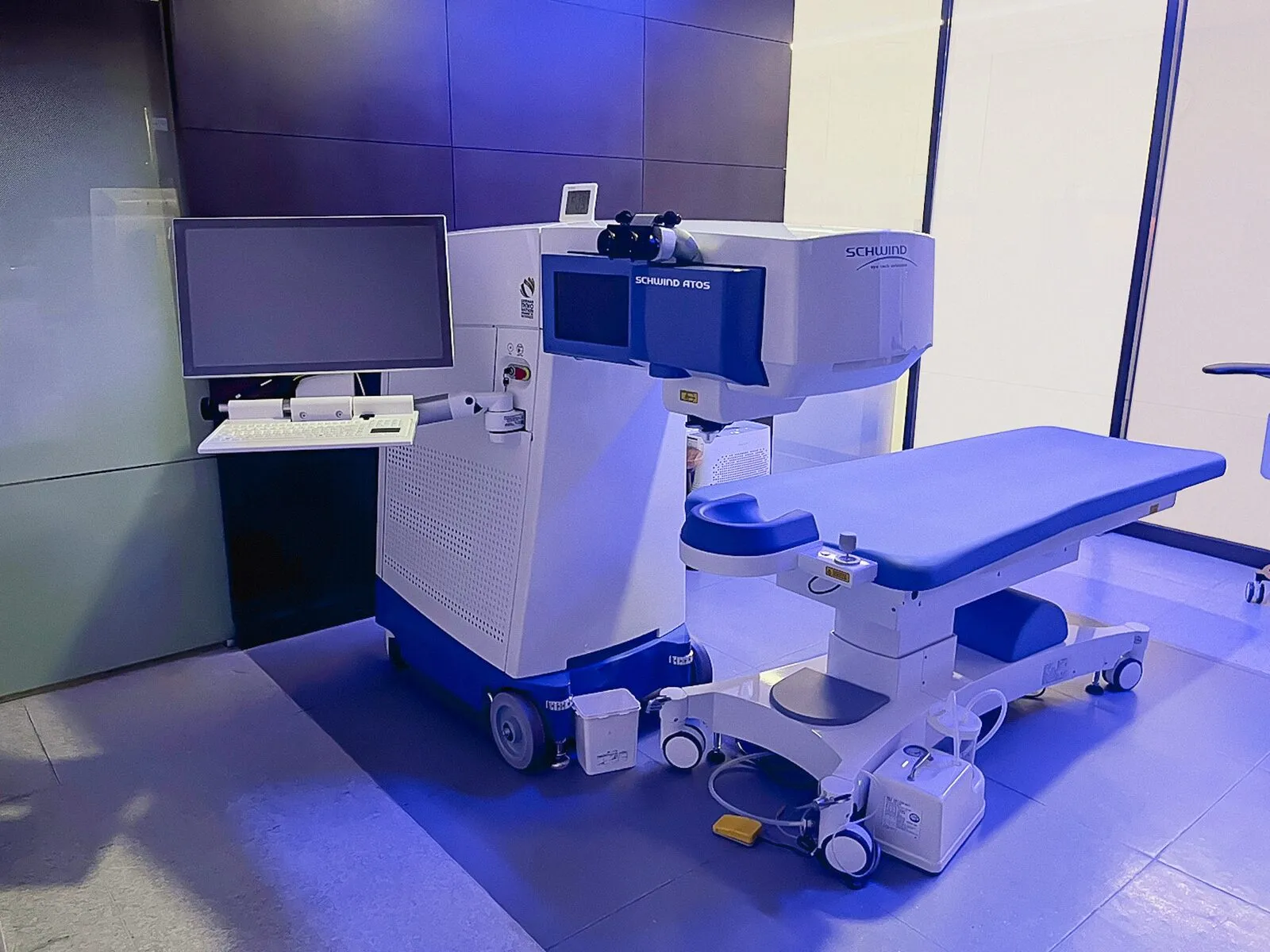
| New SMILE LASIK | 2 mm micro-incision, tissue removed with the SCHWIND ATOS laser | No flap, so no flap complications |
The flap is why LASIK at Sky Eye recovers so quickly, and it is also why flap problems sit on its list. LASEK and its slower first week avoids the flap but asks more of your calendar. New SMILE LASIK works through a 2 mm opening, and Smart Nova LASIK is New SMILE with CenTrax, which corrects rotation and docking errors during treatment. None of the three takes temporary dryness or night glare off the list.
The lasers are checked every day as part of the clinic's complication-prevention program, and each surgeon's name is published on a dedicated page, so you can see who will operate before you arrive.
Can a five-day trip cover LASIK safely?
Say you're 27, working as a junior auditor in Kuala Lumpur, around minus 5 with a little astigmatism, and you've saved five days of leave around a weekend. If your scan leaves a comfortable amount of cornea, LASIK or New SMILE fits those days, because early discomfort is short. If the scan says your cornea is thin, the plan changes: LASEK blurs vision for 5 to 7 days, and I would rather you come back with more leave than fly home unable to read the departure board.
Here is how those days could run:
- Two weeks before: contact lenses out, glasses on.
- Tuesday evening: land at Incheon and get an early night.
- Wednesday: the exam. Dilating drops usually blur near vision for a few hours, so keep the afternoon free of screens and paperwork.
- Thursday: the clinic is closed for equipment inspection, so this is your day for the city, in glasses.
- Friday: surgery, if the exam said yes. Rest with your eyes closed for most of the evening.
- Saturday: the first check usually falls 24 to 48 hours after surgery, and the clinic is open 10:00 to 14:30 on Saturdays for exams and surgeries. Confirm this works for your date before you buy flights.
- Sunday: the clinic is closed; pack, rest your eyes, fly Monday.
Cabin air is dry, so keep lubricating drops in your carry-on and use them on the flight. Don't rub your eyes, and if you were given a shield for sleeping, wear it on an overnight flight, when hands drift to the face without your noticing.
Where I stand on LASIK risk
LASIK going wrong is rare, and much of that rarity is earned before surgery, by turning away eyes that shouldn't have it. I would rather plan LASEK around a longer trip, or recommend no surgery at all, than fit an unsuitable cornea into five days of leave. Treatment should fit the eye, not the calendar.
The consultation is free. Sky Eye Clinic is at 723-26 Banpo-dong, Seocho-gu, Seoul, about a five-minute walk from Nonhyeon or Sinnonhyeon Station. Before then, message us on WhatsApp with that same prescription and ask about the complication that's been holding you back, whether it's dry eye, night halos or a cornea someone once called thin.
— Dr. Kim Sang-Myung, Ophthalmologist
Results vary by individual.
Sources
- What are the risks and how can I find the right doctor for me? (LASIK)
- When is LASIK not for me?
- What should I expect before, during, and after surgery? (LASIK)
- Modern Laser In Situ Keratomileusis Outcomes (Sandoval HP, Donnenfeld ED, Kohnen T, et al.), The Literature
- Phakic Intraocular Lenses: What are the risks?
Questions answered
If my LASIK result is a little off, can it be corrected later?
Often, with a laser touch-up, but only if enough untouched cornea remains after the first treatment. That is one more reason the residual thickness matters from the start. If a touch-up isn't safe, glasses or contacts for specific tasks such as night driving are the usual answer.
How long do halos and glare usually last after LASIK?
For most people they fade over weeks to a few months as the cornea settles. People with larger pupils may notice them longer in dim light, which is why pupil size in low light is worth asking about at the exam.
What happens if my eye moves during the laser?
Modern lasers follow the eye's position during treatment, and treatment can pause if the eye moves too far. For New SMILE, the eye is held by a gentle docking, and the Smart Nova version adds CenTrax to correct rotation and docking errors.
Is flying a few days after LASIK risky?
Cabin pressure is not a known problem for a LASIK cornea. The practical risks are dryness from cabin air and rubbing your eyes while half asleep, so use lubricating drops and keep your hands away from your face.
Does a very high prescription raise the odds of a problem?
Generally yes. Results tend to be less predictable with very large prescriptions, and more tissue has to be removed. In those eyes a lens implant such as ICL may come into the conversation, though it carries its own risks, including earlier cataract and raised eye pressure.
Get your free consultation before you decide
- Free consultation and checkup, even if you decide against surgery
- Same price as Korean patients, no overseas surcharge
- Interpreters in English, Japanese and Chinese