
Is LASIK Worth It? Yes, When Your Cornea Leaves Room
Is LASIK worth it when your contacts mostly work, or are you about to pay for surgery to fix something that isn't really broken?
On this page
What LASIK changes, and what it leaves alone
It stops being worth it when the scan shows a thin or irregular cornea, a prescription that is still moving, or eyes already sliding into presbyopia.
Hello, I'm Dr. Kim Sang-Myung, an ophthalmologist at Sky Eye Clinic in Seoul.
I'm comfortable telling someone no after the corneal scan, because LASIK isn't for everyone. The clinic has a Pentacam for corneal thickness and shape and a Corvis ST for how stiff the cornea is, and the surgeon who consults with you is the one who performs your surgery, named on the clinic's surgeon disclosure page.
LASIK reshapes the clear front window of your eye so light lands on the retina without help. A thin flap is lifted, a laser removes a measured amount of tissue from the layer underneath, and the flap is laid back down.
Think of the contact lens you put in every morning. It sits in front of the cornea and bends light. LASIK carves that same correction into the cornea itself, so there is nothing to take out at night and nothing to forget on a trip.
The catch is that carving is subtraction. A typical cornea is roughly 540 microns thick at the center, the flap uses about 100 of those, and every diopter of correction removes more. What stays under the flap, the residual stromal bed, is what holds the eye's shape for the rest of your life. Many surgeons won't leave less than about 250 microns there, and plenty prefer a larger margin.
Risks and side effects to know
LASIK also leaves some things exactly as they were. The lens inside your eye still stiffens in your 40s, a strongly nearsighted retina still needs its checkups, and dry eye you already have won't disappear.
Which numbers decide whether it's worth it for you?
The value question is arithmetic before it's anything else. These are the measurements that turn a general yes into your yes or your no.
| Number | What it shows | When it changes the answer |
|---|---|---|
| Prescription over the last 1–2 years | Whether your eye has stopped changing | A shift in the past year means wait |
| Central corneal thickness | How much tissue there is to work with | Thin for your correction: LASEK or New SMILE LASIK |
| Corneal shape map | Regular curve or a steepening pattern | Early keratoconus signs: no LASIK |
| Corneal stiffness | How the cornea flexes under a puff of air | A soft cornea weighs against removing tissue |
| Tear film | How your eye surface copes now | Marked dry eye can worsen after a flap |
| Age and near focus | How close presbyopia is | Past about 40, plan for reading glasses |
Say you're 29, living in Chicago, about minus 3.50 in both eyes, in daily contacts since high school, and your eyes are red by six in the evening. If your last two prescriptions match and the shape map is regular, the numbers usually work for you: a moderate correction leaves the residual bed well above that floor. If the map shows the lower cornea steepening, I would stop there. The question then becomes whether that cornea needs monitoring or corneal cross-linking, and laser correction is off the table.
One thing to plan before your trip: contact lenses mold the cornea for a while after you take them out. The US Food and Drug Administration advises stopping soft lenses for about two weeks before the baseline exam, and longer for toric or rigid lenses. A cornea still shaped by a lens can measure thicker, flatter or more irregular than it really is, which is the worst possible input for a decision like this.
When LASIK is the wrong trade
If your cornea is thin for the amount of correction you need, a LASEK-type surgery that keeps the most cornea is the safer choice. There's no flap, so every untouched micron counts toward strength. The cost is a slower start: in the clinic's own comparison, early discomfort with LASEK lasts up to three to four days and blurring five to seven days, against about half a day with LASIK. I go through that choice in more detail in how LASIK and LASEK compare for a thinner cornea.
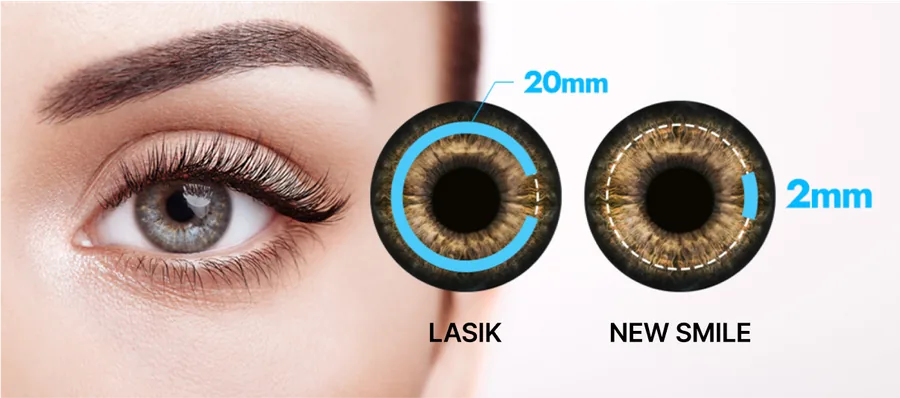
New SMILE LASIK works through a 2mm micro-incision with no flap, on a SCHWIND ATOS laser, and is listed for high myopia with thin corneas. Smart Nova LASIK builds on it with CenTrax, which corrects for eye rotation and docking error.
For very high prescriptions or very thin corneas, an EVO or EVO+ ICL lens sits inside the eye and removes no cornea at all. It is intraocular surgery, so it carries its own risks, such as raised eye pressure or an earlier cataract in some people.
Serious problems after laser correction are rare, but when they happen, surgery that went ahead against the exam's advice is part of the story. So when a scan says wait or choose another method, I take that as the answer, even if the flight is already booked. Several doctors here had LASIK or LASEK themselves, so we know how much you want the glasses gone; that wish doesn't move the floor on corneal thickness.
Does it last, and what happens in your 40s?
For most moderate nearsighted corrections, the result holds for years. Some eyes drift back a little, more often after large corrections, and a touch-up is only possible if enough cornea remains. That is one more reason the residual bed matters on day one.
Presbyopia is a separate clock. The lens inside everyone's eye loses flexibility in their 40s, and LASIK at 38 doesn't delay that; reading glasses arrive on the usual schedule. If you're already holding your phone farther away, ask about presbyopic LASIK or LASEK at the consultation rather than correcting only for distance.
Here's the tip almost nobody gives you: ask for a copy of your pre-surgery measurements and keep it. Decades from now, a cataract surgeon has to calculate the power of your new lens, and a cornea reshaped by a laser makes that calculation harder without the original numbers. A one-page printout from before surgery helps that future surgeon.
What moves the cost of LASIK for your eyes
Whether it's worth it also depends on what you'll actually pay for your case, and these are the things that move it:
- The method: LASIK, LASEK, New SMILE LASIK or Smart Nova LASIK use different lasers and steps.
- Your astigmatism: a customized treatment such as Co-Wave changes the plan.
- What the exam finds: if your cornea points to LASEK or an ICL, the procedure itself changes.
- What's included: the exam, eye drops and post-op checks.
- Your days in Seoul: hotel nights and leave from work count toward the real total.
Ask on WhatsApp what your case would come to, mentioning the method you're leaning toward and your astigmatism number.
Dry eye, halos and flap problems: how common, and what then
Dryness is the reaction most people notice, usually strongest in the first weeks to months and handled with lubricating drops. Glare, halos or starbursts around lights at night are also common early on and tend to fade as the cornea settles. Vision can fluctuate through the day for the first weeks. How long each of these lasts varies from one person to the next. Flap-related problems such as a wrinkle or a shifted flap are possible with LASIK, though uncommon.
People who should wait or look at another option:
- Your prescription changed in the past year
- You're pregnant or breastfeeding, when the prescription can shift
- The cornea is thin for the correction or shows an irregular shape
- An autoimmune disease or poorly controlled diabetes could slow healing
- You already have marked dry eye
- You play contact sports where a blow to the face is likely
Once you're back home, sudden worsening pain, vision that drops instead of improving, a red eye with discharge, or a hit to the eye means seeing a local ophthalmologist that day. Bring your surgery record naming the method and laser. Here the same medical team supports you from examination and consultation through surgery and the key post-operative checks, so plan your trip so those checks happen in Seoul.
If dryness or night driving is what worries you most, note how many hours a day you spend on screens and whether you already use eye drops, send that on WhatsApp, and ask whether a flap or no-flap method fits that history.
Planning the trip around your checks
The clinic's complication-prevention program includes a daily equipment check, and on Thursdays the clinic closes for equipment inspection. Saturdays are for exams and surgeries only. So a Thursday arrival means your exam starts Friday at the earliest; leave space for the check after surgery before your return flight, and ask at booking how many days the checks need for the method you're likely to have.
If someone traveling with you is more comfortable in another language, a medical interpreter for that language is provided at no extra charge.
What to check before you fly, wherever you book
- Which instruments measured your corneal thickness, shape and stiffness, and whether you can have the printout
- Whether the doctor who examines you is the one who operates, by name
- How much residual bed your planned correction would leave
- What the quote covers: exam, drops, post-op checks and the rule if a touch-up is needed
- Which checks happen before you fly and who you contact once home
- Whether the consultation can happen in a language you're comfortable with
This doesn't have to be Sky Eye. Any clinic that answers all six clearly has given you most of what you need to decide.
Where I stand
So is LASIK worth it for you? With a steady prescription and a cornea that has room to spare, I think it is. With a thin or irregular cornea it isn't, and a different method or no surgery is the better trade. Nothing about this needs deciding this month; your cornea will measure the same next season.
Send a photo of your latest prescription on WhatsApp, along with any corneal thickness reading you've had at home, and ask how much cornea would be left after your correction. That number, together with how still your prescription has been, settles the question for you. Sky Eye Clinic is at 723-26 Banpo-dong, Seocho-gu, Seoul, about a five-minute walk from Nonhyeon or Sinnonhyeon Station.
— Dr. Kim Sang-Myung, Ophthalmologist
Results vary by individual.
Sources
Questions answered
Can both eyes be treated on the same day?
With laser vision correction, both eyes are commonly treated in one session. Treating both together also means one recovery period instead of two, which matters when you're traveling.
How soon can I fly home after LASIK?
Flying itself doesn't harm a healing LASIK flap, but the dry cabin air makes eyes feel gritty, so keep lubricating drops in your carry-on. What decides the date is the post-op check, so book your return only after you know when that check happens.
Will I need glasses for night driving afterward?
Most people don't, but halos and glare around headlights are common in the first weeks. If they're still bothering you at night after that, mention it at your follow-up; a small residual prescription is one of the things that can be measured and discussed.
Can LASIK be redone if my eyes change later?
A touch-up is sometimes possible, but only if enough corneal tissue remains under the flap. That's why the residual bed after the first surgery matters: it decides whether you have any room left later.
I'm 42. Is LASIK still worth it?
It can be, as long as you know reading glasses are coming either way. At this age it's worth asking whether presbyopic LASIK or LASEK suits you instead of a distance-only correction.
Get your free consultation before you decide
- Free consultation and checkup, even if you decide against surgery
- Same price as Korean patients, no overseas surcharge
- Interpreters in English, Japanese and Chinese