
Korea Smart Nova LASIK Side Effects Long Term: Does No Flap Mean No Risk?
Korea Smart Nova LASIK side effects long term: are you afraid that dry eyes or night halos will still be with you years after you've flown home?
On this page
Does no flap mean no long-term risk?
Give this ten minutes before you pay for a seat to Seoul.
You'll come away knowing which side effects can outlast recovery, what reviews get right and wrong, how the methods differ and what decides the cost, so you can pick what fits your eyes and your budget.
Hello, I'm Dr. Kim Sang-Myung, an ophthalmologist at Sky Eye Clinic in Seoul. I completed my training at Yonsei Severance Hospital and work in vision correction.
We have ten ophthalmologists, and several of our doctors had LASIK or LASEK themselves. The same medical team supports you from exam through surgery and key post-op checks, and our complication-prevention program includes daily equipment checks.
I wrote this because many people read "no flap" as "nothing left to worry about later", and then skip the questions that matter most at 25 or 30.
Smart Nova LASIK makes no flap, so flap complications are off the table. Dry eye, glare or halos and a small prescription drift can still happen, and for some people they last.
No. It removes one category of risk and leaves the others in place.
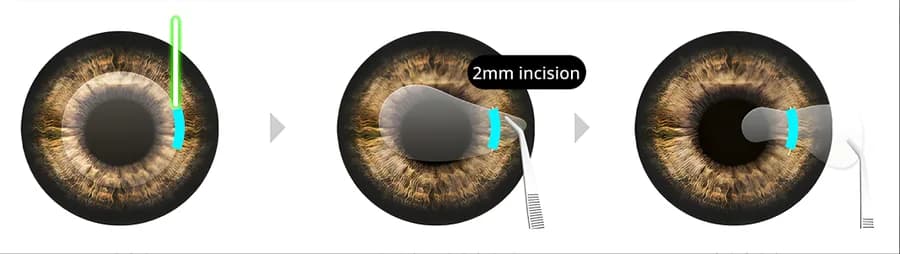
Smart Nova is New SMILE LASIK with CenTrax added, a system that corrects rotation and docking errors. It runs on the SCHWIND ATOS laser. The surgeon removes tissue through a 2mm incision and leaves no flap, which means a flap can't be displaced or wrinkled years later.
The correction still happens by taking tissue out of your cornea. So the surface of the eye still has to heal, its nerves still have to recover, and light still passes through a reshaped cornea at night. Those three facts are where long-term dry eye, halos and drift come from, with or without a flap.
Korea Smart Nova LASIK side effects long term: what the studies can and can't tell you
Here is the belief I'd correct first: that a ten-year result exists for the exact operation you're considering. I can't point you to one for Smart Nova. The U.S. FDA says plainly, on its LASIK pages, that there are no long-term data available for current procedures.
What we have is the nearest relative. These papers followed SMILE, an earlier lenticule procedure done on a different manufacturer's laser, so read them as a guide and not as a Smart Nova result.
| Study | Who was followed | What it found |
|---|---|---|
| Blum et al., 2016 | 56 of 91 eyes, at 5 years | Regression of 0.48 D; no eye lost two or more lines |
I take two things from this. Drift over a decade looks small on average, which is reassuring for someone who'd live with the result for 40 years. But these groups are small, and the ten-year paper also recorded more higher-order aberrations, the optical irregularities linked to night-vision complaints.
Which side effects can outlast recovery?
The American Academy of Ophthalmology says almost everyone who has LASIK gets dry eyes and changing vision during the day, usually fading within a month. For some people they take longer or never fully resolve. Its guidance is written about LASIK, so I'd use it as a starting point for Smart Nova.
| Effect | Typical course | What I'd weigh |
|---|---|---|
| Dry eye | Usually fades within a month; lingers for some | Whether contact lenses already dry out on you |
| Glare, halos, starbursts | Can be temporary or lasting | How much you drive or work after dark |
| Prescription drift | Small on average in the studies above | Whether your prescription is still moving |
| Ectasia (cornea weakening and bulging) | Rare, can appear late | Corneal shape and strength on your scans |
One thing people file under side effects isn't one. The Academy notes that almost everyone with excellent distance vision will need reading glasses after around age 40, with or without surgery. If you have Smart Nova at 28 and buy readers at 45, the surgery didn't wear off. Your lens aged.
If I had one question for a person in their twenties, it would be about the past year: did your glasses change? A moving prescription can make a good correction look like a failed one later on. I'd also look hard at the corneal scans, because a cornea that steepens toward the bottom is a reason to slow down. We have a Pentacam for mapping corneal shape and a Corvis ST for looking at how the cornea responds to pressure.
What do reviews get right about long-term side effects?
Review threads tend to repeat a few claims, and they don't all hold up.
- "Vision goes blurry and clear for a while, then settles." Mostly true. Changing vision is common early on.
- "No flap, so nothing can go wrong later." False, for the reasons above.
- "Mine's been perfect, so the long-term risk is hype." This doesn't answer the question. Many reviews are written in the first weeks, and a long-term effect can't show up in a post written that early.
- "My eyes are still dry years later." Believable. Persistent dry eye is a recognized outcome. A single thread just can't tell you how common it is.
I'd read forums for the questions they raise, then take those questions to a doctor who has your scans.
Who should hold off, and what if something changes at home?
Risks and side effects to know
In the first weeks, dryness, fluctuating vision, glare and light sensitivity are common and usually temporary. Less often they persist. Serious visual side effects are rare, but they have occurred when surgery went ahead despite an exam result advising against it, and that's why I'd never argue with a scan to fit a travel date. Results differ from person to person.
The FDA lists groups who may face added risk or may be poor candidates. As general medicine, you should raise these before going ahead:
- A prescription that changed in the past year, or being in your early 20s or younger
- Pregnancy or breastfeeding, or hormone fluctuations such as from diabetes
- Autoimmune disease, immunodeficiency, or medications that affect healing, such as steroids or retinoic acid
- Keratoconus, thin corneas, existing dry eye, glaucoma, uveitis, or herpes near the eye
- Boxing, wrestling, martial arts or other frequent blows to the face
Say you're 26, teaching English somewhere in Asia, about minus 5, with ten days off in February. If your prescription changed eight months ago, I'd tell you it's too soon for this trip, because our LASIK criteria ask for one stable year. If it hasn't changed but your contacts dry out by mid-afternoon, I'd spend the visit on your tear film and on what lingering dryness would mean for your classroom days and your screen time.
After you fly home, sudden pain, a drop in vision or increasing redness means seeing an eye doctor that day. Slower changes, such as dryness that isn't easing or halos that bother you at night, still deserve a visit. The CDC's medical tourism advice is to keep copies of your records and plan follow-up care before you travel, so find an ophthalmologist near home in advance and carry your surgical report.
Before you decide, tell us on WhatsApp whether your contacts feel dry by the end of the day and when you'd have to fly back, then ask which of these effects you should weigh most.
Methods compared: Smart Nova, New SMILE, LASIK and LASEK
The long-term question changes with the method, because each one leaves the cornea differently.
| Method | How it works | Long-term point to ask about |
|---|---|---|
| Smart Nova LASIK | New SMILE with CenTrax; 2mm incision, no flap | No flap complications; dry eye, halos and drift still possible |
| New SMILE LASIK | SCHWIND ATOS; 2mm incision, no flap | Same as above; listed for high myopia with thin corneas |
| LASIK | Thin flap, laser on stroma; Amaris Red SPT, Co-Wave | Flap-related complications possible; may not suit a thin cornea |
| LASEK | Surface epithelium removed, laser on stroma | No flap; early discomfort up to 3 to 4 days, blurring 5 to 7 days |
Our LASIK page says it directly: LASIK is not for everyone, and below a certain corneal thickness I'd steer you to a LASEK-type procedure that preserves the most residual cornea. If thickness is your main question, read how your cornea decides between LASIK and LASEK.
If your cornea rules out laser correction, an ICL lens implant removes no corneal tissue. It's still surgery inside the eye, and the FDA lists risks such as cataract and raised eye pressure.
What decides the cost?
Four things move the figure for your case:
- The method you end up with: Smart Nova, New SMILE, LASIK, LASEK or ICL
- What your exam shows, since scans can change which method fits
- How many days you stay in Seoul around surgery and key post-op checks
- The follow-up you arrange once you're home, including any eye-doctor visits there
For the figure itself, ask on WhatsApp what it would cost for your case, and name the method you're weighing.
Your first message
Send it on WhatsApp with the one long-term effect you'd least want to live with, and ask which method raises that concern least for someone with your numbers. When you come to Seoul, the doctor examines your eyes and recommends the procedure that fits them.
Results vary by individual.
Sources
- LASIK — Laser Eye Surgery
- When is LASIK not for me?
- Ten-year outcomes following small incision lenticule extraction for up to -10 Dioptres myopia (Xia F, et al. Clin Exp Op
- Five-year results of Small Incision Lenticule Extraction (ReLEx SMILE) (Blum M, et al. Br J Ophthalmol 2016;100(9):1192-
- Medical Tourism
- Phakic Intraocular Lenses: What are the risks?
Questions answered
Can Smart Nova side effects start years after surgery?
Most begin early, then ease. Things that can show up later include gradual prescription drift and, rarely, ectasia. The available long-term studies followed an earlier lenticule procedure, not Smart Nova itself.
Is Smart Nova a different operation from New SMILE LASIK?
Smart Nova is New SMILE LASIK with CenTrax added, which corrects rotation and docking errors. Both use the SCHWIND ATOS laser, a 2mm incision and no flap.
Will I still need reading glasses after Smart Nova?
Probably, at some point. The American Academy of Ophthalmology notes that almost everyone with excellent distance vision needs reading glasses after around age 40, with or without surgery.
I do martial arts. Does having no flap settle the question?
It removes the worry about a flap shifting, though the FDA lists frequent blows to the face as a risk factor for LASIK. Mention your sport early, and compare the methods with that in mind.
Get your free consultation before you decide
- Free consultation and checkup, even if you decide against surgery
- Same price as Korean patients, no overseas surcharge
- Interpreters in English, Japanese and Chinese


