Korea Smart Nova LASIK Procedure Steps in Order: Which Step Could Cut Your Trip Short?
Planning around the Korea Smart Nova LASIK procedure steps in order, and worried that one of them could stretch a short trip or end it before surgery happens?
On this page
What happens at each step, from contact-lens break to follow-up
Read this before you book flights or ask for days off.
You'll come away knowing what each step involves, the risks and who should wait, what reviews get right and wrong about recovery, and what decides the cost. That's enough to choose a method and a travel window that fit your eyes and your budget.
Hello, I'm Dr. Kim Sang-Myung, an ophthalmologist in vision correction at Sky Eye Clinic in Seoul. I completed my ophthalmology training at Yonsei Severance Hospital, and I'm a full member of the Korean Society of Cataract and Refractive Surgery.
We have 10 ophthalmologists working in separate centers for vision correction, cataract and presbyopia, and retina and glaucoma. Smart Nova and New SMILE LASIK both run on the SCHWIND ATOS laser, and the same medical team stays with you from the exam through surgery and the key post-op checks.
I'm writing this because people tend to read the steps as a fixed itinerary, when the exam is the one step that can rewrite all the others.
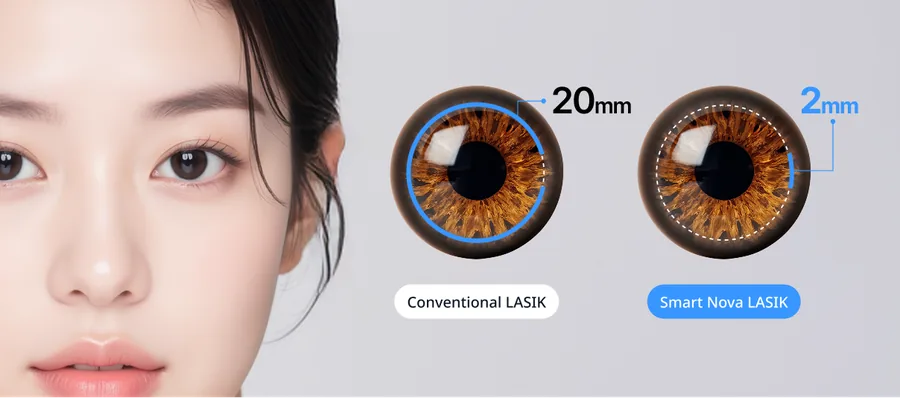
The order goes like this: a break from contact lenses, the eye exam, the consultation where the method is chosen, surgery day with numbing drops and the laser, then follow-up checks before you fly. Smart Nova LASIK is the New SMILE method with CenTrax added, which corrects for rotation and docking error during the laser step.
If you have a recent glasses prescription or an old exam printout, send a photo of it on WhatsApp and ask one thing: which of these steps someone with your numbers should leave extra days for.
Here's how the Korea Smart Nova LASIK procedure steps in order look from a traveler's side. Everything after step two happens only if the exam supports it.
- Stop wearing contacts before the exam. Lenses reshape the cornea for a while. The U.S. Food and Drug Administration's LASIK guidance asks wearers to switch to glasses for weeks before the baseline exam, and longer for rigid lenses. Ask how long you need when you book, because this step often decides your departure date.
- The eye exam. Your prescription is measured along with corneal thickness, corneal shape, pupil size and the tear film, and many clinics also use dilating drops. The clinic has a Pentacam, a Corvis ST and a Cirrus OCT 6000. If you're dilated, near vision usually stays blurry for a few hours, so don't plan an afternoon of reading.
- The consultation and the choice of method. This is where Smart Nova, New SMILE, LASIK or LASEK is chosen. The doctor confirms the procedure and the final fee at your free exam, not before.
- Surgery day. Numbing drops go in, a holder keeps your eyelids open, and a curved interface docks onto the eye. You stay awake and look at a light. The laser shapes a thin, lens-shaped piece of tissue inside the cornea, which is removed through an incision of about 2 mm. There is no flap. In Smart Nova LASIK, CenTrax corrects for rotation and docking error. That matters most if you have astigmatism, because the eye can turn slightly between sitting up for the exam and lying down for surgery.
- Drops and follow-up checks. You leave with eye drops and the usual instructions about not rubbing, keeping water out and resting your eyes from screens. Before you buy a return ticket, confirm at booking how many checks you need in Seoul and on which days.
Which step is most likely to stop you?
The exam. It's also the step people leave the least time for.
Laser correction removes corneal tissue, so I care about how much cornea will be left afterwards and how stable it is. If the cornea is thin for the amount of correction you need, or the shape map shows it bulging unevenly, I slow down. Uneven steepening can be an early sign of keratoconus, and laser correction can make keratoconus worse. For that reason, the shape of your cornea tells me more than your prescription does.
LASIK isn't for everyone. When a cornea is thinner than a certain threshold, I'd point you toward a LASEK-type procedure that keeps the most cornea in place. The trade-off is a slower, more uncomfortable start, and you can read what LASEK involves before you decide. I go through that choice in more depth in how your cornea decides between LASIK and LASEK.
Say you're -5.50 with 1.50 of astigmatism, you live elsewhere in Asia, and you have a Friday-to-Monday window. If your cornea measures well and you've been out of contacts long enough, Smart Nova is worth discussing, and astigmatism is exactly where the rotation correction does its job. If the same exam shows a thin cornea, I'd talk you through LASEK instead. I'd also tell you that three or four days of discomfort don't fit a three-day window. If the map shows an irregular pattern, I wouldn't operate on that trip.
Several of the doctors here had LASIK or LASEK themselves before recommending it, so the team can describe the first days from the patient's side too. The point I want you to take from this section is more serious. Rare but serious visual side effects have occurred when surgery went ahead despite an exam result advising against it. If your exam says wait, going home in glasses is the right result for that trip.
Does Smart Nova hurt, and what do reviews get right about recovery?
Review threads about small-incision laser surgery tend to repeat three claims.
"It didn't hurt." For the surgery itself, that's mostly accurate, because the numbing drops do the work. Reviews leave out the pressure and the brief dimming of vision while the interface is docked, which lasts through the laser portion. When the drops wear off, a scratchy, watery feeling for some hours is common.
"I could see right away." That's partly true. Many people see well within the first day or so, but vision often swings for weeks while the cornea settles, hazy one morning and sharp the next. That swing is part of normal healing. It's also why a review written on day two tells you little about month three.
"It was all done in one day." Treat that as one person's schedule. How close together your exam and surgery can be depends on your contact-lens break, your exam results and the appointment calendar.
Reviews also rarely say that recovery differs by method. With flap LASIK, early discomfort usually lasts about half a day. With LASEK, discomfort can last up to three or four days and blurring five to seven. New SMILE LASIK, the method Smart Nova builds on, uses no flap and causes minimal damage to the corneal surface.
Risks and side effects to know
The common reactions are usually temporary: dry or gritty eyes, glare and halos around lights at night, and vision that changes through the day. For many people these ease over weeks to a few months, though dryness lasts longer for some.
Less often, the eye ends up under- or over-corrected and may need further treatment. With lenticule surgery in particular, the tissue can be harder than expected to separate during the procedure, which can slow recovery. How your eyes heal is individual, and only the in-person exam can decide whether you're a candidate.
The FDA's guidance on who LASIK may not suit is a good guide for any laser correction. It's worth waiting or skipping if your prescription changed in the past year, if you're pregnant or breastfeeding, or if you have an autoimmune disease or another condition that slows healing. The same goes for severe dry eye, thin or irregularly shaped corneas, or regular contact sports. An active eye infection or inflammation also means waiting until it clears.
After you fly home, keep to the drop schedule, don't rub your eyes, and carry your surgery record with you. The U.S. Centers for Disease Control and Prevention advises medical travelers to bring copies of their records and plan follow-up at home before they leave. If your vision suddenly drops, the pain gets worse, or redness comes with discharge, see an ophthalmologist where you live that day, then message us with what they found.
If one of those lines sounds like you, put it in a WhatsApp message with the dates you could be in Seoul. Then ask which weekday your first post-op check would fall on.
What decides the cost of Smart Nova LASIK for your eyes?
The method is the biggest factor, and the exam chooses it: Smart Nova, New SMILE, LASIK with Co-Wave on the SCHWIND Amaris Red SPT, or LASEK. Your prescription and astigmatism decide whether the rotation correction in Smart Nova earns its place for your eye. If the exam rules out laser and a lens-based option like ICL comes up, you're looking at a different procedure altogether.
The rest is the trip: how many days in Seoul the follow-up checks need, which sets your accommodation and time off, and the drops you take home. The doctor confirms the procedure and the final fee at your free exam. For a figure for your own case, ask on WhatsApp and attach a photo of your prescription.
Can you fit it into a long weekend in Seoul?
You might, but plan around the clinic's week. It's open Monday to Wednesday and Friday from 10:00 to 16:30, with lunch from 13:00 to 14:00. On Saturdays it's open 10:00 to 14:30 for exams and surgeries only. It's closed on Thursdays for equipment inspection, and on Sundays and public holidays.
Say you land Thursday night. The earliest exam is Friday. If surgery is on Saturday, the clinic is closed Sunday, so your first check can't be earlier than Monday. A Korean public holiday falling on Monday pushes it further. Check the holiday calendar before you choose dates.
The clinic is about a 5-minute walk from Nonhyeon Station (Line 7 Exit 5, Sinbundang Line Exit 4) or Sinnonhyeon Station (Line 9 Exit 2). On surgery day, take a taxi back to your hotel or bring someone with you, and keep the evening free. Flying soon after surgery is usually less of a problem than the cabin air, which dries the eyes. Keep your drops in your carry-on and ask your surgeon when you're cleared to fly.
Send your contact-lens type and how long you can go without them, plus the one question that would decide your dates. When you come to Seoul, the doctor examines your eyes and recommends the method that fits them, whether that's Smart Nova or a slower option that suits your cornea better.
Results vary by individual.
Sources
Questions answered
Is Smart Nova LASIK the same as New SMILE LASIK?
Smart Nova LASIK uses the New SMILE method, removing tissue through an incision of about 2 mm with no flap, and adds CenTrax, which corrects rotation and docking error. Both run on the SCHWIND ATOS laser.
Will I be awake during the laser?
Yes. Numbing drops are used, a holder keeps your eyelids open, and you look at a light while the laser works. Most people feel pressure and see the light dim briefly while the interface is docked.
What should I bring to the eye exam in Seoul?
Bring your glasses, any old prescriptions or exam printouts, the type of contact lenses you wear and when you stopped them, and a list of your medicines and health conditions. Plan for dilating drops to blur your near vision for a few hours afterwards.
Is the clinic open on Thursdays?
No. Sky Eye Clinic is closed on Thursdays for equipment inspection, and on Sundays and public holidays. Saturday hours are 10:00 to 14:30, for exams and surgeries only.
How soon can I fly home after Smart Nova LASIK?
Ask your surgeon when you're cleared to fly, and book your flight after your follow-up checks in Seoul. Cabin air dries the eyes, so keep your drops in your carry-on and use them on the flight.
Get your free consultation before you decide
- Free consultation and checkup, even if you decide against surgery
- Same price as Korean patients, no overseas surcharge
- Interpreters in English, Japanese and Chinese


