Korea Smart Nova LASIK vs LASEK: Which Fits a One-Week Trip?
Korea Smart Nova LASIK vs LASEK: if you have one week of leave and a budget for one trip, which of the two gets you on the flight home seeing well enough to go back to work?
On this page
How do Smart Nova and LASEK differ on the eye itself?
If your leave is already approved but the flight isn't booked, the section on trip days is the one that can change your plans.
Recovery, risks and the number of days each method keeps you in Seoul differ more between these two than most comparison charts show. Those three things decide which one fits a short trip when your cornea gives you a choice.
Hello, I'm Dr. Kim Sang-Myung, an ophthalmologist at Sky Eye Clinic in Seoul. My field is vision correction: LASIK, LASEK and New SMILE.
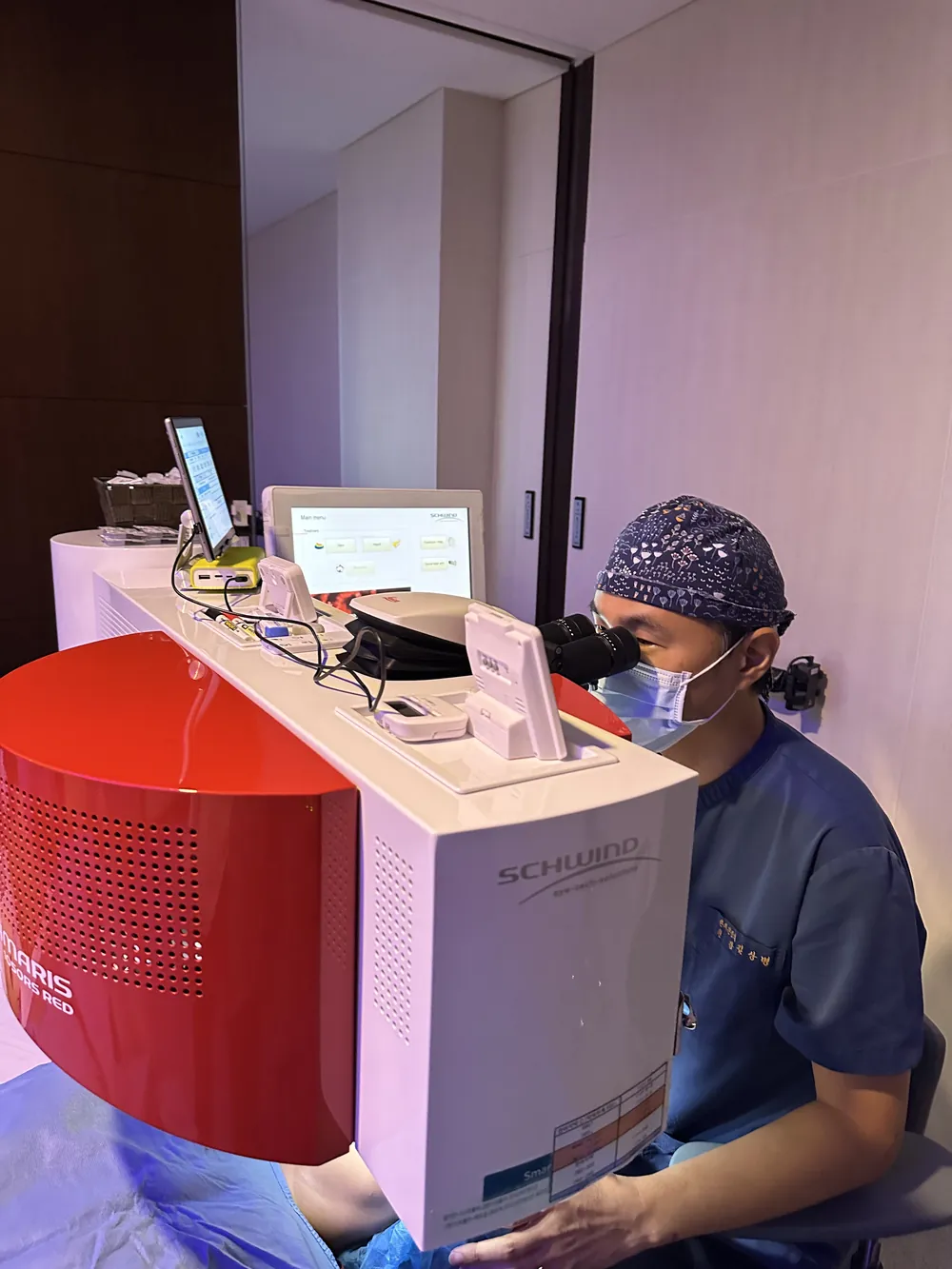
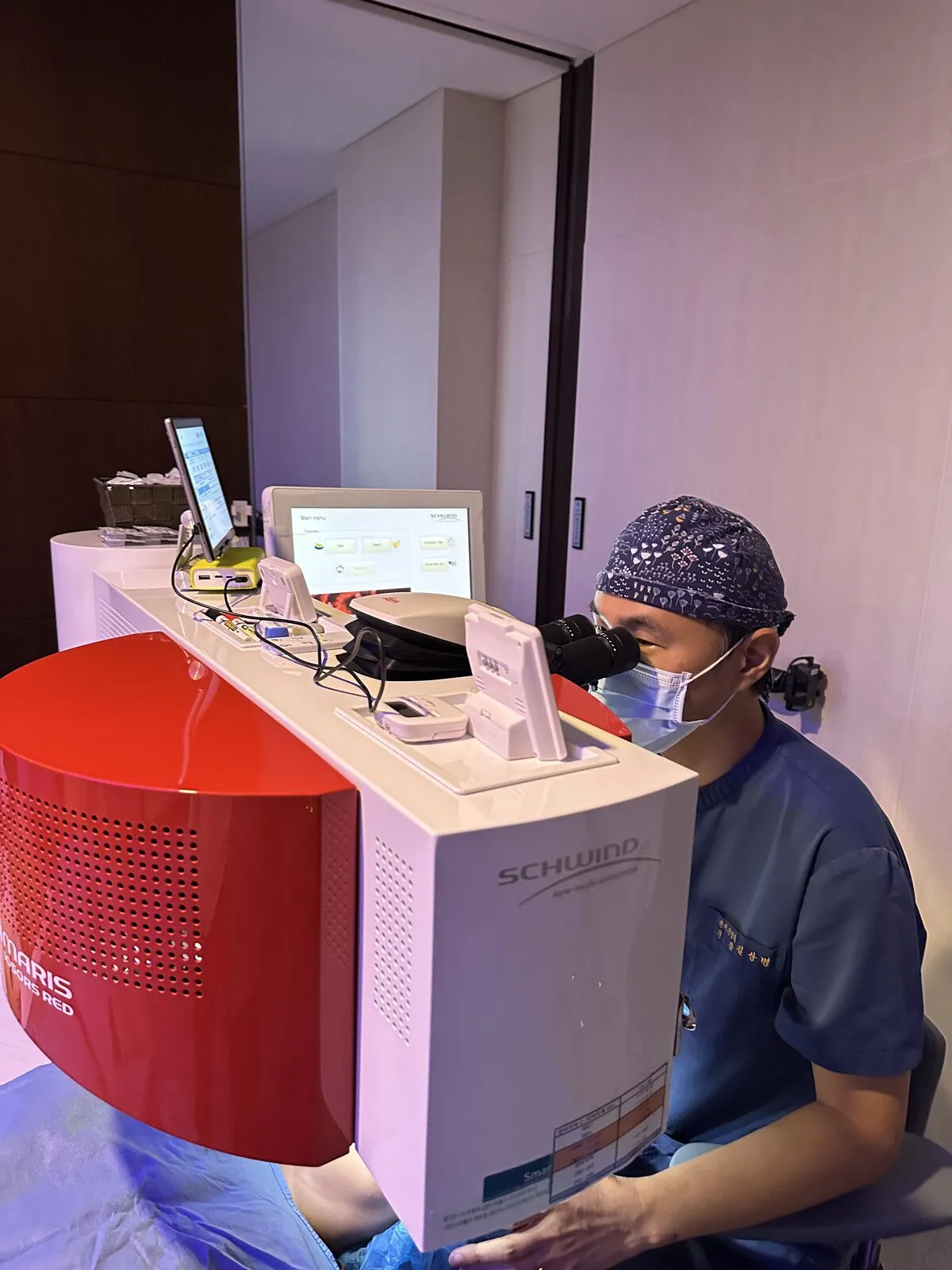
We perform both procedures in this comparison. Smart Nova LASIK runs on the SCHWIND ATOS laser, and LASEK comes in three forms here, including Amaris Red LASEK. Several of our doctors had LASIK or LASEK themselves. Our WhatsApp Business line is in English, and foreign patients get a medical interpreter for their language at no extra charge.
Most people choose between these two on recovery speed alone, then find out at the exam that their corneal thickness had already made the choice for them.
LASEK means up to three or four sore days and about a week of blur, but it leaves the most cornea behind when yours is on the thin side.
If you have a corneal thickness reading from any past eye exam, send a photo of that printout on WhatsApp along with your leave dates, and ask whether your numbers leave both methods open. The consultation is free.
Smart Nova LASIK is built on the New SMILE method. The SCHWIND ATOS laser shapes a thin disc of tissue inside the cornea, and that disc comes out through a small incision. Smart Nova adds CenTrax, which corrects for rotation and docking errors during treatment. That matters if you have astigmatism, because the eye can turn slightly when you lie down, and astigmatism correction depends on the right axis.
LASEK works from the outside in. The thin surface layer of the cornea, the epithelium, is removed, the laser reshapes the tissue underneath, and the epithelium grows back under a protective contact lens. We offer standard LASEK, Amaris Red LASEK and 2Day LASEK.
| Smart Nova LASIK | LASEK | |
|---|---|---|
| How the laser gets in | Incision about 2 mm, no flap | Surface layer removed, regrows under a protective lens |
| Early discomfort | Minimal corneal damage | Up to 3 to 4 days; blur for 5 to 7 days |
| Thin cornea | The New SMILE method is listed for high myopia with thin corneas | Recommended when LASIK would leave too little cornea |
One thing explains most of the recovery gap. Smart Nova leaves the surface of the eye intact, while LASEK has to heal a new surface over several days.
Recovery: what the first week feels like with each
With LASEK, the first three or four days are the hard part. Light sensitivity, tearing and a gritty, stinging feeling are common while the surface regrows under the protective lens. Your vision stays blurred for five to seven days, then keeps sharpening over the following weeks. Most people can watch a screen during that week, but reading small text for hours is tiring.
With Smart Nova, the surface isn't disturbed.
Dryness, and some glare or halos around lights at night, can happen after either one in the first weeks. Lubricating drops and time are the usual answer.
If your cornea gives you the choice and you're flying straight back into a work week, I wouldn't pick LASEK for that trip. If your cornea doesn't give you the choice, I would rather you move the flight than switch to a method your exam advised against.
How many days in Seoul does each one need?
Start with the calendar, because our hours shape it. We're open Monday to Wednesday and Friday from 10:00 to 16:30, with lunch from 13:00 to 14:00. On Saturday we're open from 10:00 to 14:30 for exams and surgeries only. Thursday is closed for equipment inspection, and so are Sundays and public holidays.
For LASIK-type surgery, the U.S. FDA describes a first check within a day or two of the operation. LASEK adds another step: the protective lens usually comes out once the surface has healed, several days after surgery, and you'll want that visit to happen in Seoul. That is why LASEK takes more days out of a trip.
The same medical team supports you from the exam and consultation through surgery and the key post-op checks, so those visits are with people who already know your eyes.
Say you're 27, teaching English somewhere in Asia, about minus 4.5 with a little astigmatism, and you have Monday to Sunday in Seoul. If your cornea is thick enough for both methods, Smart Nova early in the week leaves room for the follow-up checks and a buffer before you fly. If your cornea is thin and LASEK is the advice, seven days is tight, since the blur alone can last most of that week.
In that case I'd tell you to ask for a longer window rather than squeeze the healing in.
For a short trip, Korea Smart Nova LASIK vs LASEK comes down to the cornea first and the calendar second.
On WhatsApp, send the days you could land and leave, and ask how many days in Seoul each method would need for you, with the Thursday closure counted.
What you can check before you fly
Several things that can cancel a surgery can be checked from home. First, your prescription: laser correction is meant for adults 18 or older whose prescription has stayed the same for the past year. If your last two glasses prescriptions differ, bring both.
Second, contact lenses. The FDA's LASIK guidance tells people to stop wearing contacts for a period before the baseline exam, because lenses change the shape of the cornea and can throw off the measurements. Ask when you book how long to leave yours out, and pack glasses.
Third, your dates. Line them up against the Thursday and Sunday closures, and if you're pregnant or breastfeeding, put the trip off for now. We have a Pentacam and a Corvis ST for mapping the cornea's thickness, shape and stiffness, but any earlier thickness printout you have still helps you ask sharper questions.
Who should lean toward LASEK, and who toward Smart Nova?
LASIK isn't for everyone, and the same goes for a flap or an incision. If your cornea is thinner than a certain threshold for your correction, a LASEK-type procedure that preserves the most residual cornea is what I'd recommend. Some people also lean toward surface treatment because nothing is cut into the cornea at all.
Smart Nova suits you if your cornea leaves the choice open, you have only a few days off, and you go straight back to screens. In general, lenticule procedures like this treat nearsightedness with or without astigmatism.
If you're past 40 and starting to hold your phone farther away, that's a separate conversation. We also offer presbyopic LASIK and LASEK, and the exam is the place to raise it.
What can go wrong with either one?
Risks and side effects to know
The common reactions are temporary. Expect dryness, light sensitivity, and glare or halos at night that usually ease over the first weeks to months. Vision can also fluctuate from day to day early on. LASEK adds the sore first three or four days and roughly a week of blur. Less often, vision ends up a little under- or over-corrected, and a further treatment comes up later.
Some people should wait or skip surgery, as a matter of general medicine: anyone whose prescription is still changing, anyone pregnant or breastfeeding, people with certain autoimmune conditions or on medications that slow healing, and anyone whose cornea is thin or irregularly shaped. An irregular cornea can be an early sign of keratoconus, which needs a different plan. The FDA lists similar reasons in its guidance on when LASIK is not for you.
Serious visual side effects, though rare, have happened when surgery went ahead despite an exam result advising against it. That's why I follow the exam even when it isn't the answer someone hoped for. How each eye heals varies from person to person, and the exam is where suitability gets decided.
If something feels wrong after you fly home, such as sharp pain, vision getting worse instead of better, spreading redness or discharge, see an ophthalmologist that day and bring your surgery records. After LASEK, if the protective lens falls out before it's due to be removed, don't put it back in yourself. Before you leave Seoul, ask which records to take home and which symptoms mean you should get seen.
What moves the cost between the two
The method is the first factor: Smart Nova on the ATOS laser, or one of the three LASEK forms. Whether you're treating one eye or both matters next. Then come the days you spend in Seoul and the follow-up visits you stay for, which run longer with LASEK. Your doctor confirms the procedure and the final fee at your consultation, after the exam. Deposit and payment method are also settled after the consultation.
On WhatsApp, ask what Smart Nova and LASEK would each cost for your eyes, and attach a photo of your latest prescription. If you're wondering about the deposit or how to pay, ask that in the same message.
Your first message on WhatsApp
The consultation is free, and one photo is enough to start: your latest prescription, or a corneal thickness printout if you have one. On exam day, the first thing I'll look at is your corneal thickness map next to the amount of correction you need, because that shows whether both methods are open to you.
Send the photo with your leave dates and ask the question that settles your trip: if my cornea allows either method, how many days in Seoul would each one need, and what should I take home for my eye doctor there?
Results vary by individual.
Sources
Questions answered
Is Smart Nova LASIK the same as New SMILE LASIK?
Smart Nova is built on the New SMILE method, done on the same SCHWIND ATOS laser through a small incision with no flap. The difference is CenTrax, which corrects for rotation and docking errors during treatment.
Can I have surgery on a Saturday?
Yes. On Saturdays we're open from 10:00 to 14:30, and that time is set aside for exams and surgeries only.
Does CenTrax matter if I have astigmatism?
It's most useful for astigmatism. The eye can rotate slightly when you go from sitting to lying down, and astigmatism is corrected along a specific axis. CenTrax corrects for that rotation and for docking errors during treatment.
What is 2Day LASEK?
It's one of the three LASEK forms we offer, alongside standard LASEK and Amaris Red LASEK. Which form suits your eyes, and how it changes your recovery days, is worth asking about at your consultation.
How do I get to the clinic?
We're at 723-26 Banpo-dong, Seocho-gu, Seoul. It's about a five-minute walk from Nonhyeon Station (Line 7 Exit 5 or Sinbundang Line Exit 4) or Sinnonhyeon Station (Line 9 Exit 2).
Get your free consultation before you decide
- Free consultation and checkup, even if you decide against surgery
- Same price as Korean patients, no overseas surcharge
- Interpreters in English, Japanese and Chinese


