
Korea SMILE LASIK Candidate Qualifications: Does Your Prescription Decide? Mostly Not.
Worried that you won't meet the Korea SMILE LASIK candidate qualifications, or that a clinic abroad will say yes to anyone who has already booked a flight?
On this page
What actually decides whether you qualify?
Read this before you send your prescription anywhere.
By the end you'll know which measurements decide candidacy, which review claims hold up, how the methods differ and what decides the cost. That makes it easier to see whether New SMILE LASIK suits your eyes or another option fits them better, for your situation and your budget.
Hello, I'm Dr. Kim Sang-Myung, an ophthalmologist on the vision correction team at Sky Eye Clinic in Seoul.
We're a clinic of ten ophthalmologists, and several of our doctors had LASIK and LASEK themselves before recommending them to anyone. Our New SMILE LASIK uses the SCHWIND ATOS laser, and the clinic has a Pentacam and a Corvis ST for examining the cornea.
I'm writing this because many people treat their glasses prescription as the qualification, when the thickness, shape and stability of the cornea usually settle the question.
Most adults whose myopia, with or without astigmatism, has held steady for at least a year, whose cornea is thick and regular enough for the correction, and whose eyes are otherwise healthy can be considered for New SMILE LASIK. Signs of keratoconus, a prescription that is still changing, pregnancy, and some eye or autoimmune conditions usually rule it out or put it on hold.
If you have a recent eye exam printout or glasses prescription, send a photo of it on WhatsApp along with the question on your mind, such as which of those numbers matters most for SMILE.
SMILE works inside the cornea. The laser shapes a thin disc of tissue, called a lenticule, within the cornea, and the surgeon removes it through a small opening. Reinstein and colleagues describe the technique in detail in the journal Eye and Vision. On our New SMILE LASIK, that opening is about 2 mm and no corneal flap is made.
Tissue the lenticule takes away doesn't grow back. So the real question is how much cornea remains after the correction, and whether that cornea was healthy to begin with. Three measurements carry more weight than your minus number:
- Thickness. A larger correction means a thicker lenticule. A cornea that starts on the thin side can run out of margin before your prescription is fully corrected.
- Shape. A map that steepens unevenly, often toward the lower part of the cornea, can be an early sign of keratoconus. Removing tissue from a cornea like that can weaken it further.
- Stability. The US Food and Drug Administration lists a change in your glasses or contact lens prescription within the past year as a reason LASIK may not be for you. The same reasoning applies to SMILE, since both reshape the cornea.
If I could see only one result from your exam, I'd choose the shape map over the prescription. A minus 8 eye with a thick, regular cornea is often easier to plan for than a minus 3 eye with an irregular map.
LASIK isn't for everyone, and SMILE isn't either. When a cornea is too thin or irregular for the correction someone needs, I'd rather say so in Seoul than have them find out later at home. Serious visual side effects, although rare, have happened when surgery went ahead despite an exam result advising against it.
Beliefs about SMILE candidacy that don't hold up
Most of what people read about Korea SMILE LASIK candidate qualifications comes from forums and clinic ads, and four beliefs keep coming back.
“No flap means thin corneas are fine”
Having no flap removes flap complications. It doesn't remove the need for enough cornea underneath the correction. Below a certain thickness, I'd point you toward a LASEK-type procedure that preserves the most residual cornea, or toward a lens. The trade-off is laid out in our piece on how your cornea decides between LASIK and LASEK.
“If my surgeon at home said no, a clinic in Korea will say yes”
Clinics can disagree at the margins, because measurements, thresholds and lasers differ. A no based on keratoconus signs or an unstable prescription should get the same answer anywhere. If you were turned down at home, the reason you were given and the scans behind it are worth bringing with you.
“A high prescription rules me out”
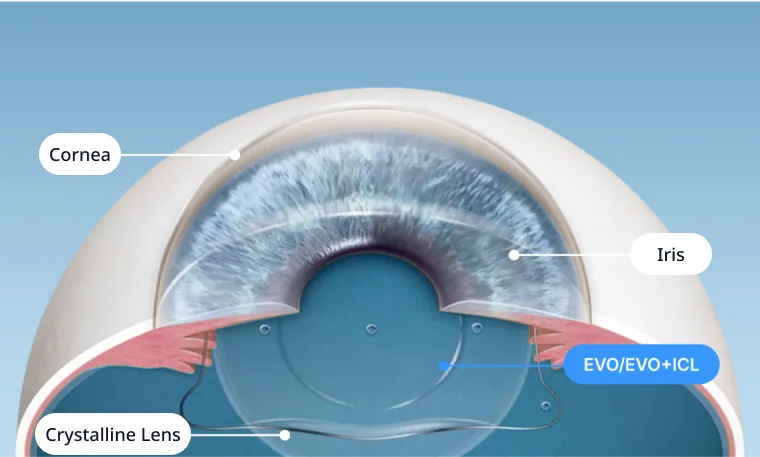
Not on its own. A high minus with a thick, regular cornea may still be within range for laser correction. When it isn't, our ICL lens implant (EVO/EVO+) is one option: it doesn't remove corneal tissue, and it's used for high myopia, thin corneas and dry eye. It carries its own risks. The FDA lists possible problems such as raised eye pressure, cataract and loss of cells from the inner surface of the cornea, so it's a separate decision with its own exam.
“Dry eye makes SMILE the automatic choice”
Because SMILE works through a small incision, it's often discussed as disturbing fewer of the corneal nerves that help keep the eye moist. That still doesn't make a dry eye a good starting point. The FDA counts dry eyes among the reasons LASIK may not suit you, and an eye that is already dry before surgery usually needs to be looked at first.
Is your cornea enough for SMILE, or does another method fit?
In short, these are the vision correction methods at our clinic that come up in this decision. The descriptions come from our procedure pages. Which one fits you is a question your measurements answer.
| Method | What happens | Often considered when |
|---|---|---|
| New SMILE LASIK | Lenticule removed through a 2 mm incision, no flap, SCHWIND ATOS laser | Myopia, including high myopia with thin corneas |
| Smart Nova LASIK | New SMILE LASIK plus CenTrax, which corrects rotation and docking error | Alignment matters, as it does with astigmatism |
| LASIK | Thin flap, laser on the layer beneath, Amaris Red SPT with Co-Wave | Enough thickness; early discomfort about half a day |
| LASEK | Surface layer removed, laser beneath; it regrows under a protective lens | LASIK would leave too little cornea; discomfort up to 3 to 4 days |
| ICL (EVO/EVO+) | Lens placed inside the eye, no corneal tissue removed | High myopia, thin corneas, dry eye |
Our New SMILE LASIK page and Smart Nova LASIK page cover each procedure in more detail. If your measurements show keratoconus, laser correction comes off the table, and keratoconus care such as corneal cross-linking becomes the subject instead.
Say you're minus 7 with thin corneas and one week in Seoul
Say you're about minus 7 in both eyes with a little astigmatism. Your prescription hasn't changed in two years, a clinic at home said your corneas are on the thin side, and you have one week in Seoul.
The first thing I'd look for is the shape map. If it shows a keratoconus pattern, the laser conversation ends there. If the shape is regular, the next question is how much cornea a minus 7 lenticule would leave. With margin to spare, New SMILE LASIK or Smart Nova LASIK stays on the table. If it's tight, LASEK keeps more cornea, but our own comparison notes discomfort for up to 3 to 4 days and blurring for 5 to 7 days, which would fill most of a one-week trip. ICL sidesteps the thickness problem and brings the lens-related risks described above.
Your contact lenses matter too. Lenses can change the shape of the cornea, so the FDA's LASIK guidance advises stopping them before the baseline exam: about two weeks for soft lenses, and longer for toric or rigid ones. Measurements taken too soon can point everyone in the wrong direction.
What do reviews get right about SMILE candidacy?
Review threads tend to repeat three claims about who qualifies, and they hold up to different degrees.
“One clinic said no and another said yes.” This does happen, and it isn't automatically a warning sign, since measurements and thresholds differ. What matters is the reason. A no for keratoconus signs deserves more weight than a yes that never mentions the corneal map.
“I could see clearly the next day.” Many people do see well quickly after SMILE. Vision can still fluctuate for weeks while the cornea settles, and a quick first day says nothing about whether someone was a good candidate.
“Exam and surgery happened on the same day.” That can be possible when contacts were out long enough and nothing needs re-measuring. If you wear lenses, or your readings come out borderline, leave room in your plans for a second visit.
What decides the cost of SMILE in Korea?
Cost follows the decision above, so most of the factors are ones your exam settles:
- The method your measurements point to. New SMILE LASIK, Smart Nova LASIK, LASIK, LASEK and ICL are separate procedures.
- One eye or both.
- Whether a repeat measurement is needed, for example after contacts have been out longer.
4. 5. Follow-up at home with your own eye doctor in the months after.
If you'd like an idea before then, ask on WhatsApp what it would cost for your case and include a photo of your prescription.
Risks and side effects to know
The FDA describes hazy or blurry vision, glare, halos or starbursts around lights at night, and dryness as common in the first days and weeks after laser surgery. For many people these settle over weeks to a few months. For some, night glare or dryness lasts longer.
As general medicine, these are reasons to wait or to choose a different method:
- a prescription that changed in the past year
- a thin or irregular cornea, or any sign of keratoconus
- pregnancy or breastfeeding, when hormones can shift the prescription
- autoimmune disease, poorly controlled diabetes, or medicines that slow healing, such as isotretinoin
- a history of herpes infection in the eye, glaucoma, or significant dry eye
- contact sports where eye injuries are common
Whether you qualify is settled at the in-person exam in Seoul, because thickness and shape have to be measured on the day.
If, after flying home, pain increases, vision gets worse instead of slowly clearing, or redness spreads, see an ophthalmologist where you are promptly and take your surgery records with you.
Before you message
Send the dates of your last two glasses prescriptions on WhatsApp, in English, and ask whether that history counts as stable. When you come to Seoul, your doctor examines your eyes and recommends the method that fits them.
Results vary by individual.
Sources
Questions answered
How old do you need to be for SMILE in Korea?
Laser vision correction is done in adults, and FDA approvals for LASIK lasers start at age 18 or older depending on the device. Age matters less than whether your prescription has stopped changing for at least a year.
Can I qualify for SMILE if I have astigmatism?
Astigmatism is commonly corrected together with myopia in laser vision correction. Alignment matters when astigmatism is treated, which is what CenTrax on our Smart Nova LASIK corrects for. Whether your amount is within range is a measurement question.
How long should I stop wearing contact lenses before the exam?
The FDA's LASIK guidance suggests about two weeks for soft lenses and longer for toric soft or rigid lenses, because lenses can change the shape of the cornea and distort the measurements.
I had LASIK years ago. Can I have SMILE now?
The FDA lists previous refractive surgery among the reasons to be cautious. A second procedure turns on how much cornea remains and how the first one was done, so bring your old surgery records to the exam.
Can I have SMILE while pregnant or breastfeeding?
Usually not. Hormonal changes during pregnancy and breastfeeding can shift your prescription, so the general advice is to wait until it has settled again.
Get your free consultation before you decide
- Free consultation and checkup, even if you decide against surgery
- Same price as Korean patients, no overseas surcharge
- Interpreters in English, Japanese and Chinese


