
Korea SMILE LASIK Consultation Booking Appointment: What If Your Eyes Get a No?
Worried that a Korea SMILE LASIK consultation booking appointment could end in a long flight and a "no" because of your high prescription or thin corneas?
On this page
What does the exam need to settle before surgery can be planned?
Go through this before you choose flight dates.
By the end you'll have a list of what to prepare, plus what the exam must settle, how recovery runs day by day, what reviews miss and what decides the cost. That lets you pick a trip length that suits your eyes and your budget.
Hello, I'm Dr. Kim Sang-Myung, an ophthalmologist at Sky Eye Clinic in Seoul, and a full member of the Korean Society of Cataract and Refractive Surgery.
New SMILE LASIK is one of several methods on our menu, alongside LASEK and ICL lens implants, so a result that rules out one method doesn't have to end the conversation.
I wrote this because people with strong prescriptions often build a whole trip around one procedure's name, and only learn in the exam room that their cornea calls for something else.
Book the consultation first and the flights second.
Then ask whether New SMILE LASIK is worth planning around with those numbers.
Three questions matter most for a strong prescription: how thick the cornea is, how much tissue the correction would remove, and whether the cornea's shape and stiffness look normal. A high number on its own isn't the problem. The problem is how much healthy cornea would be left after treatment.
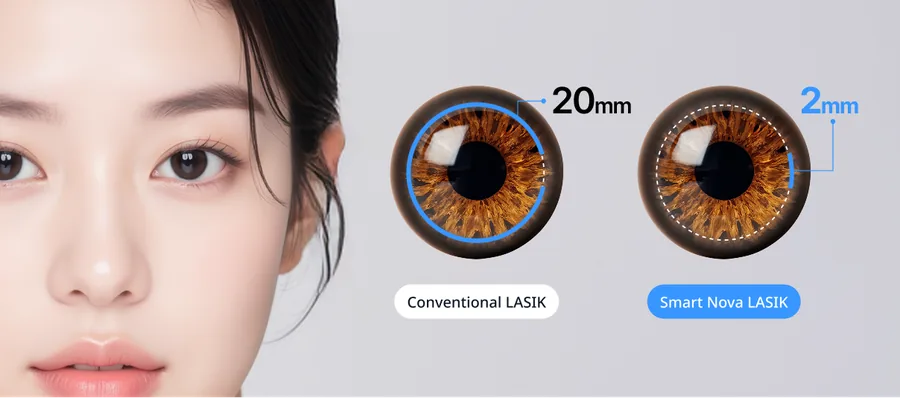
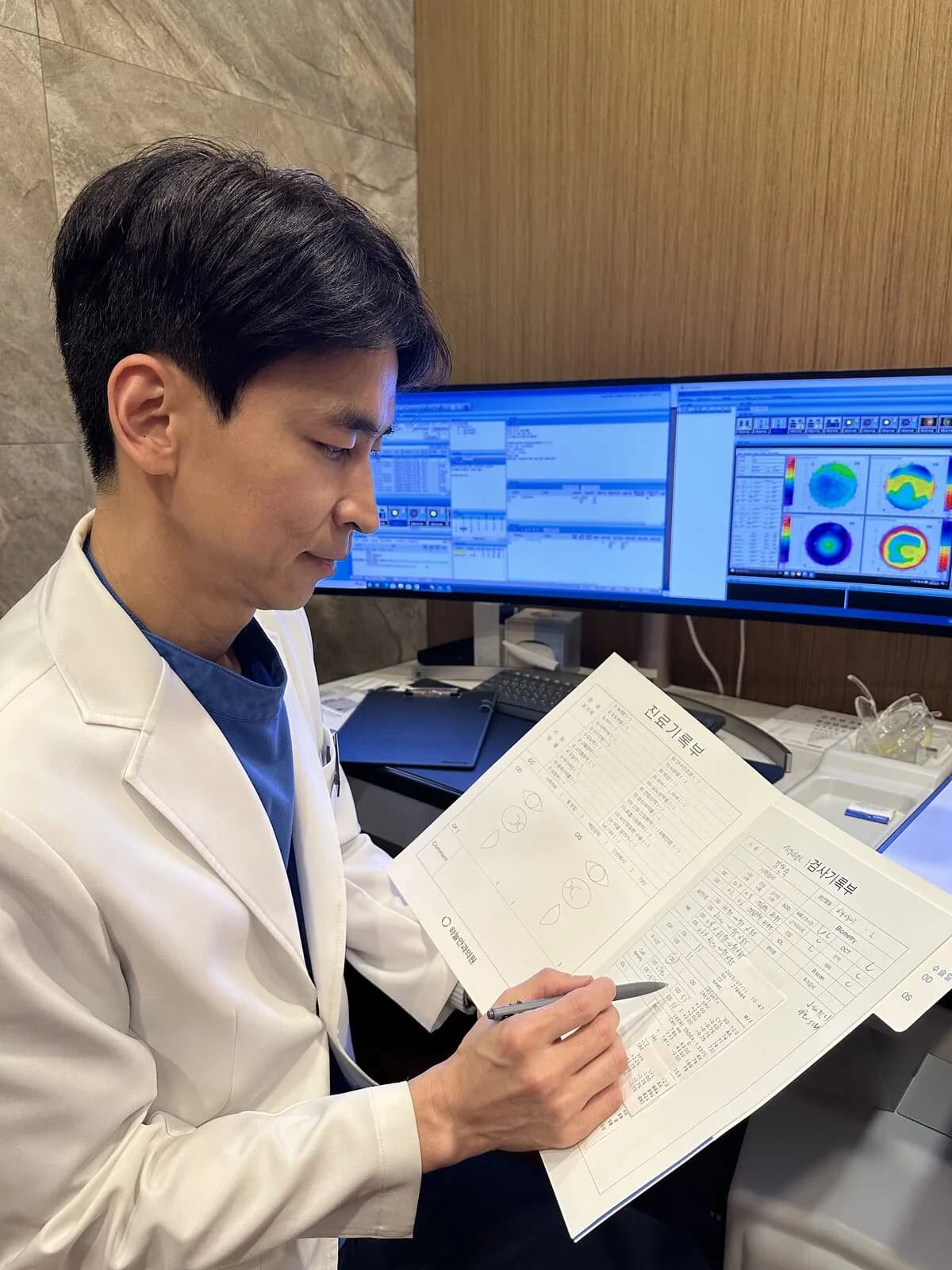
The clinic has a Pentacam and a Corvis ST, instruments built to map the cornea's shape and thickness and test how it responds to pressure. Our comparison lists New SMILE LASIK for high myopia with thin corneas, with a 2mm micro-incision and no flap. That listing opens the discussion, and your measurements still decide it.
LASIK isn't for everyone, and that's why the doctor at home may have told you no. Past a certain corneal thinness, I'd steer you toward a LASEK-type procedure that preserves the most residual cornea. Comparing LASIK and LASEK by corneal thickness goes into that decision in more depth.
A "no" after a long flight is disappointing, and I understand that. Serious visual side effects, although rare, have occurred when surgery went ahead despite an exam result advising against it. If your numbers say stop, the trip has still given you an answer you can use.
How does booking the appointment work, and what does the calendar allow?
You can start a Korea SMILE LASIK consultation booking appointment through the consultation page or on WhatsApp. The clinic sees patients Monday to Wednesday and Friday from 10:00 to 16:30, with lunch from 13:00 to 14:00. Saturday runs from 10:00 to 14:30 for exams and surgeries only. Thursdays, Sundays and holidays are closed.
Your contact lenses set the earliest possible exam date, and this catches many people out. The US Food and Drug Administration (FDA) says to stop soft lenses for 2 weeks before the initial evaluation, toric soft or rigid gas permeable lenses for at least 3 weeks, and hard lenses for at least 4 weeks. Since those weeks happen at home, put them on your calendar before you pick a date.
The clinic is at 723-26 Banpo-dong, Seocho-gu, about a 5-minute walk from Nonhyeon Station (Line 7 Exit 5, Sinbundang Exit 4) or Sinnonhyeon Station (Line 9 Exit 2).
What does recovery look like day by day, and how does it affect your trip?
In short, these markers come from FDA and American Academy of Ophthalmology guidance on LASIK. Ask your doctor how each applies to the method you end up with.
| When | What's typical | What it means for the trip |
|---|---|---|
| Surgery day | Burning, itching, grittiness, hazy vision | Arrange a ride, since calming medicine can impair driving; keep the evening clear |
| Within 24 to 48 hours | First follow-up visit | Stay in Seoul for this, and check it doesn't land on a closed day |
| Days 1 to 3 | Non-contact sports usually resume | Light sightseeing may be possible; ask first |
| Up to 2 weeks | No lotion, cream or makeup around the eye | Pack accordingly |
| About 1 month | Dryness and shifting vision usually fade | Carry drops your doctor approves on the flight and at home |
| 1 to 2 months | No swimming or hot tubs | Skip the spa and beach add-on |
| 3 to 6 months | Vision may still be settling; glare and halos can last | Follow up with an eye doctor at home |
If you're switching to New SMILE LASIK from a LASIK plan, leave some slack for reading and screens in the first days.
How many days should you plan in Seoul?
I can't give one number that holds for every strong prescription, because your method sets it. Build it from parts instead.
Say you're minus 9, your cornea was called thin at home, you wear toric lenses and you land on a Sunday. Your lens break started three weeks earlier. Monday is your first open day for the exam. If the result supports surgery on Tuesday, a check can fall on Wednesday, before the Thursday closure. If the exam points you to LASEK, the clinic's own comparison lists discomfort of up to 3 to 4 days and blurring of 5 to 7 days, so you'd want a longer stay before flying.
That's why I'd leave open the option of a longer trip until the exam is done. If you can, choose a flight you can change.
To sharpen your own version, add two details to your message: which lenses you wear and how many weeks away from work you could take. Then ask which weekday would make the most sense for arriving.
What do reviews say about consultations and same-day surgery?
Threads about Korean eye clinics tend to repeat a few claims, and it helps to sort them.
"You can have the exam and the surgery on one day." Treat this as a question for your booking, because it only holds if your lens break was long enough and your results support surgery. A strong prescription is a poor reason to rush.
"Korea will say yes when home says no." Doctors do sometimes disagree, because methods and thresholds differ. A method that wasn't discussed at home may suit you. That still isn't a promise, and some eyes shouldn't have surgery anywhere.
"High myopia means SMILE by default." This one is false. Thickness, shape and stability can all change the recommendation, whatever the prescription.
Which methods might your exam point to?
On our menu, these are the realistic options for a high prescription:
- New SMILE LASIK uses the SCHWIND ATOS laser, with no flap and so no flap complications.
- Smart Nova LASIK is New SMILE LASIK with CenTrax added, which corrects rotation and docking errors. It appears on the Smart Nova page.
- LASEK removes the surface epithelium and treats the cornea beneath it, and the early recovery runs longer.
- ICL (EVO/EVO+) implants a lens without reshaping the cornea. It's on our menu for high myopia, thin corneas and dry eye. It's still surgery inside the eye, and the FDA lists risks for implanted lenses that include cataract and raised eye pressure.
What decides the cost?
The main factors are the method your exam supports, the laser or lens involved, how many days you stay in Seoul, and your follow-up care once you're home. A strong prescription matters mostly because it can shift you to a different method.
Your doctor confirms the procedure and the final fee at your free exam. For an earlier idea, ask on WhatsApp what it would cost for your case, and mention which methods you're weighing.
What are the risks, and when should you wait?
Risks and side effects to know
Expect some burning, grittiness and hazy vision early on, then dry eyes and vision that shifts through the day, which often fades within about a month. Glare, halos and difficulty driving at night can last for months, and for some people symptoms persist. Published series on this type of surgery also report uncommon issues such as difficult tissue extraction and suction loss.
The FDA lists a prescription change in the past year, a disease or medication that may affect healing, and active contact sports as reasons you're probably not a good candidate. Pregnancy and breastfeeding call for a talk with your doctor about the added risks. Large pupils and thin corneas need screening, and the FDA warns that surgery on a cornea that's too thin may cause blinding complications.
Healing varies between people. If pain, redness or sudden vision loss starts once you're home, see a local ophthalmologist the same day and take your surgical records with you. The US Centers for Disease Control and Prevention's medical tourism advice supports planning that follow-up before you leave.
Your first message
One photo of your prescription is enough on WhatsApp, with one question: "With these numbers, which methods are worth discussing?" When you come in, your doctor examines your eyes and recommends the approach that fits them.
Results vary by individual.
Sources
Questions answered
Do I need an appointment for a consultation in Seoul?
Yes. All exams, surgeries and consultations at Sky Eye Clinic are by appointment.
Can I bring my records from a doctor who said no?
Also note the reason you were given at home.
What language is the consultation in?
Our WhatsApp Business line is in English. The clinic lists English, Japanese and Chinese as languages it supports.
Should I go ahead if my prescription changed last year?
The FDA counts a prescription change in the past year as a reason you're probably not a good candidate. Mention the change when you first get in touch, and consider waiting until your numbers hold steady.
Get your free consultation before you decide
- Free consultation and checkup, even if you decide against surgery
- Same price as Korean patients, no overseas surcharge
- Interpreters in English, Japanese and Chinese


