
Korea SMILE LASIK vs PRK: Which One Fits a Short Trip?
Stuck on Korea SMILE LASIK vs PRK because you have one short break and can't spend it unable to read a subway map?
On this page
What actually differs between SMILE, LASIK and PRK?
Give this five minutes before you fix your dates.
You'll see what decides the cost, what reviews get right and wrong, and how recovery differs, so you can pick the method that fits your cornea and the days you have.
Hello, I'm Dr. Kim Sang-Myung, a vision correction ophthalmologist at Sky Eye Clinic.
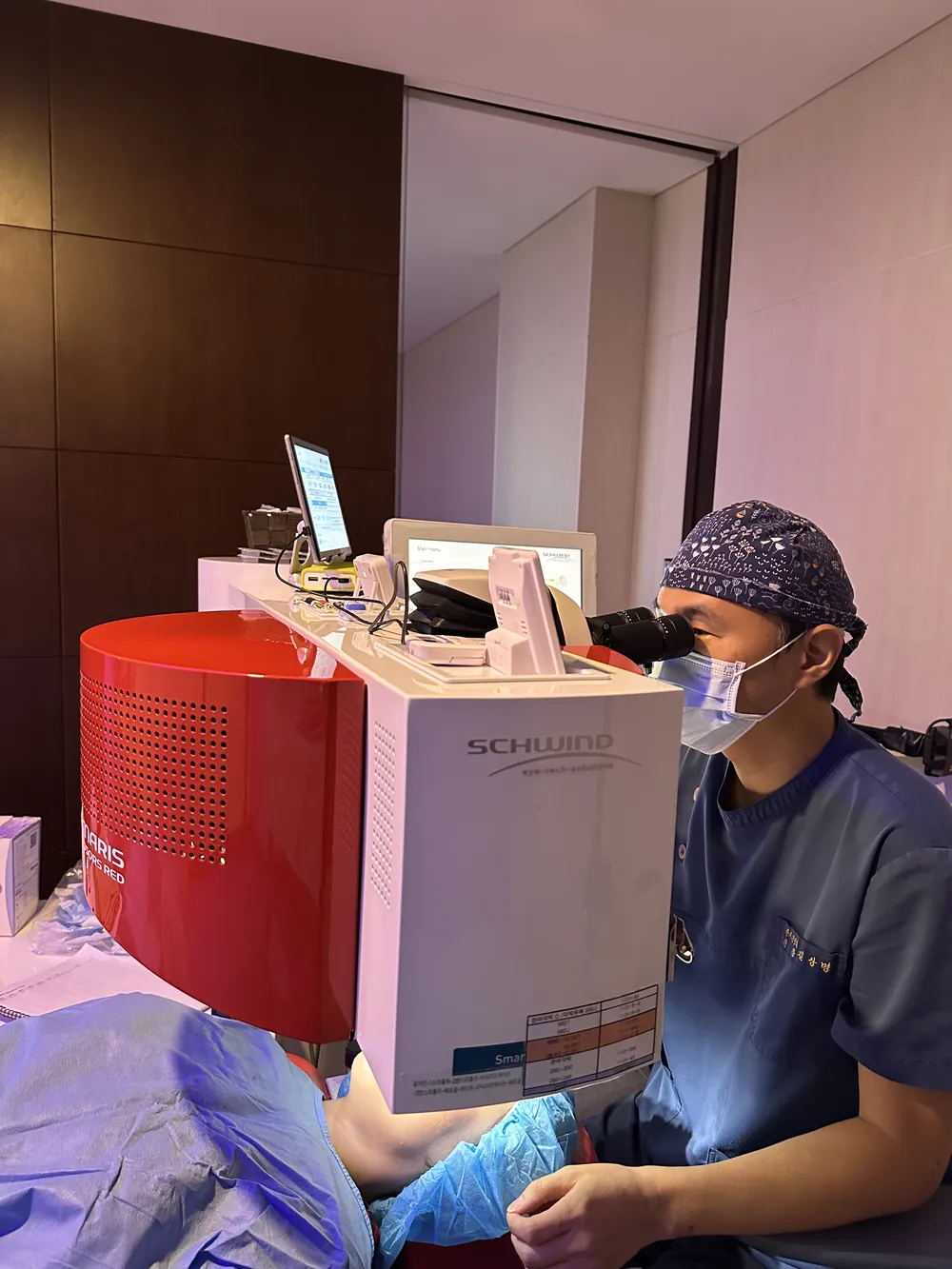
We perform New SMILE LASIK on a SCHWIND ATOS laser, and LASEK and LASIK on a SCHWIND Amaris Red SPT. PRK isn't on our menu by name; LASEK is the surface treatment we offer, so that's the one I'll compare. Our WhatsApp Business channel is in English.
People often choose from recovery stories, then find at the exam that their cornea rules out the method they'd picked.
If your eyes allow both and your days are tight, New SMILE LASIK generally means less early downtime than PRK-type surface treatment. Surface treatment takes longer to settle, and your corneal measurements decide whether you have a choice at all.
So start with your own numbers: send your prescription and your trip dates on WhatsApp, and ask which of these methods fits inside those dates.
The difference is how the laser reaches the corneal tissue it reshapes. That single step drives most of what you'll feel afterward.
| Method | What happens to the cornea | Early course |
|---|---|---|
| LASIK | Thin flap, laser on stroma | Discomfort about half a day; flap-related complications possible |
| LASEK (PRK family) | Surface epithelium removed, laser on stroma; it regrows under a protective lens | Discomfort up to 3 to 4 days; blurring 5 to 7 days |
| New SMILE LASIK | 2mm micro-incision, tissue removed, no flap | Minimal corneal damage; no flap complications |
PRK and LASEK belong to the same family. Both work on the corneal surface and leave no flap, and they differ mainly in how the surface layer is handled. If a surgeon back home mentioned PRK, the closest option here is LASEK.
A 2014 review in Eye and Vision describes how the lenticule technique behind SMILE-type surgery developed. Keep in mind that published SMILE studies may have used a different laser from the SCHWIND ATOS. When you read one, check which platform it covers. New SMILE LASIK is the name we use for ours.
Which one suits which eye?
I'd sort it by your eye first and your calendar second.
Thin cornea. LASIK may not suit you, because the flap and the laser together can leave too little cornea. LASEK is advised in that situation, and New SMILE LASIK is listed for high myopia with thin corneas. Which one fits comes down to the measurements. The trade-off is covered further in how your cornea decides between LASIK and LASEK.
Contact sports or physical work. A flap is the concern here, and the FDA lists active contact sports among reasons to think twice about LASIK. That pushes many people toward a no-flap method.
Astigmatism. Astigmatism comes from an unevenly curved eye surface, as the National Eye Institute explains, so alignment matters. Smart Nova LASIK is New SMILE LASIK with CenTrax added, which corrects for rotation and docking error. Ask whether it makes a difference at your level of astigmatism.
Normal thickness and a tight schedule. LASIK, with Co-Wave customization on the Amaris Red SPT, has the shortest listed early discomfort, at about half a day. You'd be accepting a flap and the possibility of flap-related complications in exchange.
Very high myopia. Sometimes no laser method is the right call, and an ICL lens implant comes up instead because it doesn't remove corneal tissue. It's an intraocular surgery with its own risks, and the FDA lists cataract and raised eye pressure among them.
Your ten days, worked backward from the flight
Say you're 28, about minus 4.5, teaching English somewhere in Asia, with ten days off. You land in Seoul on a Friday night. Here's how I'd reason through that trip.
Our next open day is Saturday, 10:00 to 14:30, for exams and surgeries only. Sunday is closed, and so is Thursday, for equipment inspection. Other weekdays run 10:00 to 16:30, with lunch from 13:00 to 14:00. So your real starting points are Saturday or Monday, and everything by appointment.
The contact lens rule comes before any of that. FDA guidance for LASIK candidates is to stop soft lenses about 2 weeks before the baseline exam, toric or rigid gas permeable lenses about 3 weeks, and hard lenses about 4 weeks, because lenses change corneal shape. Confirm your own timing, but your glasses may need to go back on before you've packed.
If your exam points to LASEK, plan on up to 3 to 4 days of discomfort and 5 to 7 days of blurring. On a ten-day trip, that uses up most of the holiday, and a protective lens has to be managed too. You can still do it. Just treat Seoul as somewhere to recover, and save the sightseeing for the final days.
If New SMILE LASIK is open to you, you'll likely have more usable days, though sharpness can take time to arrive. Dilating drops, if used at your exam, usually blur near vision for a few hours, so keep that afternoon clear.
For the next message, add your lens type and when you last wore them, then ask how many days to keep between surgery and your flight home.
What do reviews get right and wrong?
Threads comparing Korea SMILE LASIK vs PRK tend to repeat a few claims.
"PRK is the painful one." Largely fair for the opening days. The surface layer has to regrow, and that's why early discomfort lasts longer. It's a temporary difference and doesn't tell you how the eye ends up.
"With SMILE you see perfectly the next day." Too strong. Many people function quickly, but some notice vision still sharpening over days or weeks.
"PRK gives worse final vision." Not as a general rule. When an eye suits surface treatment, final vision is often comparable, and the slower start is the larger trade-off.
"You can do the exam and surgery on the same day." Reviews do say this. Treat it as something to ask about, since your lens pause and exam results both have a say.
All of these are general claims. Reviews rarely state corneal thickness or prescription, and those are the two numbers you'd want before applying someone's story to your own eyes.
Risks and side effects to know
Common temporary effects with all three methods include dryness, fluctuating vision, and glare or halos at night, often easing over weeks to a few months. After LASEK, expect more early pain and light sensitivity, and some people develop temporary corneal haze. The surface is healing during those days, which is why drops and clean hands matter. After LASIK, flap-related complications are possible. After New SMILE LASIK, flap problems don't apply, but dryness and slower visual sharpening can. Under- or overcorrection can occur with any method.
General reasons to postpone or skip surgery include a prescription still changing, pregnancy or breastfeeding, autoimmune disease or medication that affects healing, significant dry eye, and thin or irregular corneas beyond what a method allows.
If you're home and get strong pain, sudden vision loss or worsening redness, see an ophthalmologist that same day with your surgery records. The CDC's medical tourism guidance is to plan follow-up care before you travel. Find out who that would be in your home city, and keep copies of your records.
Our doctors had LASIK and LASEK themselves, so they can tell you what the recovery really feels like. Those few sore days after surface treatment are a poor reason to pick a method your cornea doesn't suit. If your exam says LASEK and your break is short, I'd move the trip before I'd move the method.
What decides the cost across these methods?
A few things set the figure for your case:
- the method and laser your exam points to, such as New SMILE LASIK, Smart Nova LASIK with CenTrax, LASEK or LASIK
- any customization involved, such as Co-Wave
- how many days you stay in Seoul for checks, including your lodging
- the follow-up you'll arrange after going home
The doctor confirms the procedure and the final fee at your exam, since measurements can change the method. For a figure on your own case, ask on WhatsApp what each method open to you would cost, with a photo of your prescription.
Recovery on a holiday: what you can plan
A few limits apply whichever method you choose, so build them in early. Skip swimming pools and hot tubs for the period your surgeon advises, and don't rub your eyes. Pack sunglasses, because light sensitivity is common at first. Keep lubricating and prescribed drops within reach, and remember that airplane cabins dry the eyes.
The days themselves differ. After LASEK, keep your early plans indoors and close to where you're staying. After New SMILE LASIK or LASIK, you may manage more, though long screen sessions and bright night streets can feel tiring. In every case, leave room for your post-op check before you fly. Ask when it falls when you book, as the same medical team supports you through key post-operative checks.
On WhatsApp, a single photo of your glasses prescription is enough to start, along with the question you most want settled: SMILE or surface treatment, for your eyes and your break. You can ask before booking anything. When you come to Seoul, the doctor examines your eyes and recommends the method that fits them.
Results vary by individual.
Sources
Questions answered
Is LASEK the same as PRK?
They're close relatives. Both are surface treatments with no flap, and they differ mainly in how the surface layer is handled. We list LASEK, including standard, Amaris Red and 2Day LASEK options.
Which has less dry eye, SMILE or PRK?
Dryness is possible after either, and it's often temporary. A prior dry-eye history, screen hours and age tend to matter as well as the method, so mention them when you ask about your options.
Can I fit this into a long weekend?
Generally no. You may need to pause contact lenses for weeks beforehand, and you'd want room for an exam, surgery and a post-op check before flying. Surface treatment needs more days still.
Why might a clinic recommend LASEK when I asked for New SMILE LASIK?
Measurements can favor another method. Corneal thickness, corneal shape and prescription all affect the choice, and a method that looked convenient for your schedule may not suit the eye.
Does New SMILE LASIK use a different laser from other SMILE-type surgery?
Lasers differ between clinics. Ours uses a SCHWIND ATOS. When you read a study or review about SMILE, check which laser it describes before assuming it applies here.
Get your free consultation before you decide
- Free consultation and checkup, even if you decide against surgery
- Same price as Korean patients, no overseas surcharge
- Interpreters in English, Japanese and Chinese


