
LASIK Cost Korea: Why Your Cornea Sets the Price Before the Laser Does
Is the LASIK cost Korea clinics list online the figure you'd actually pay, if your prescription is strong and a surgeon at home has already called your corneas thin?
On this page
Why your cornea sets the price before the laser does
Read this before you line up quotes or book a flight.
You'll come away knowing what moves the cost, which methods fit a strong prescription, what reviews get right and wrong, and how recovery fits a short trip. That makes it easier to see which route suits your eyes and your budget.
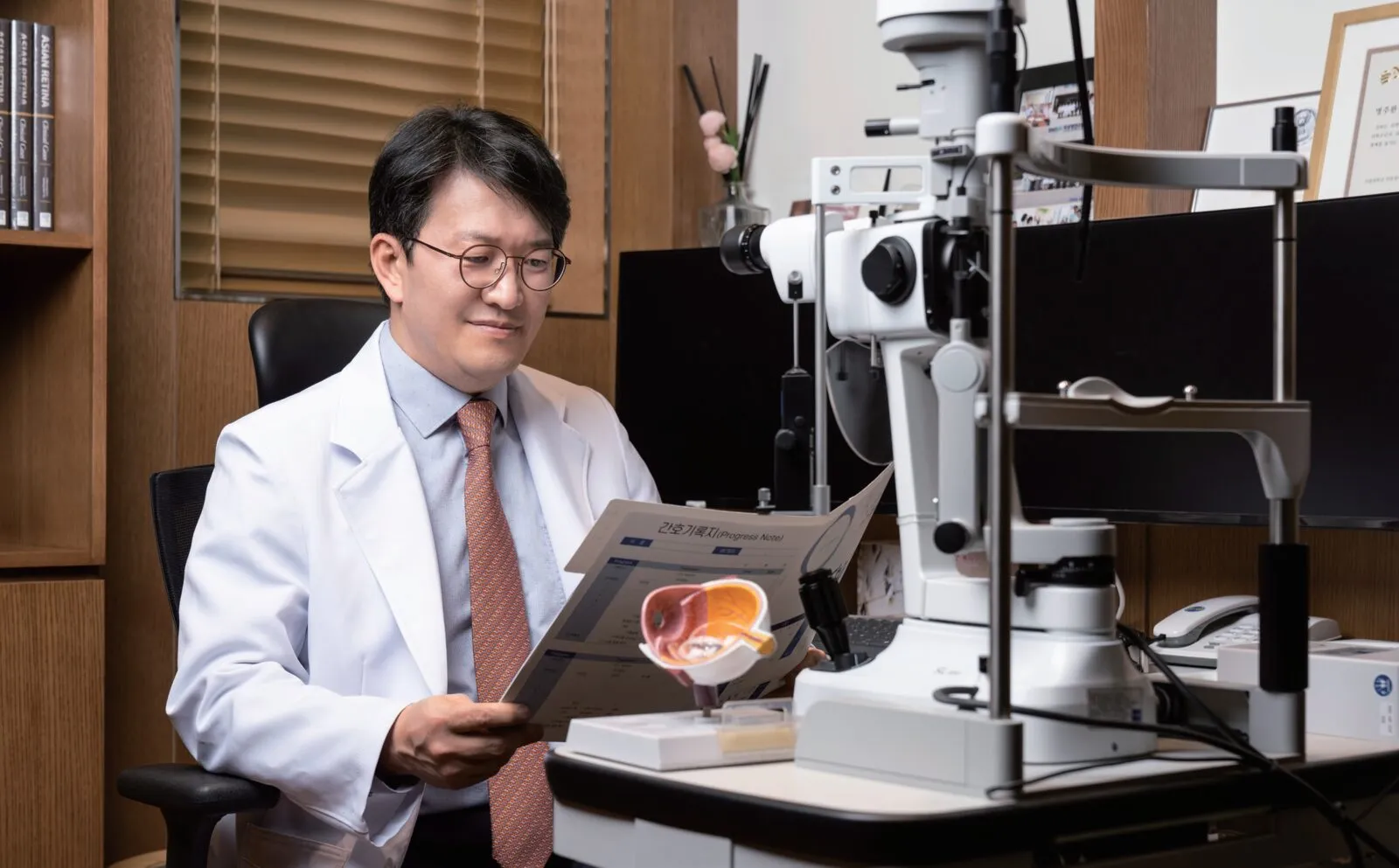
Hello, I'm Dr. Kim Sang-Myung, an ophthalmologist on the vision correction team at Sky Eye Clinic in Seoul.
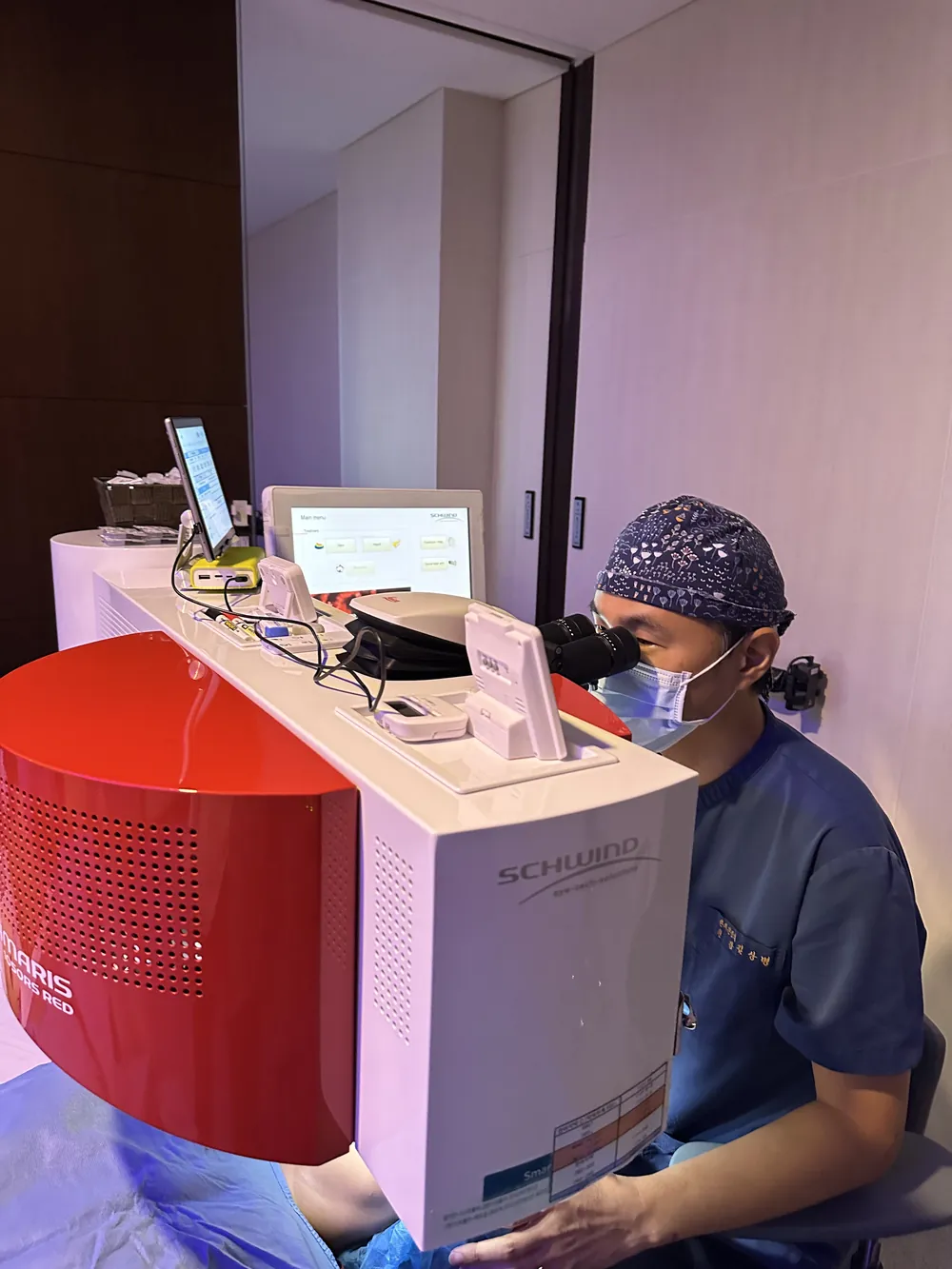
We're a clinic of 10 ophthalmologists with separate centers for vision correction, cataract and presbyopia, and retina and glaucoma. Several of our doctors had LASIK or LASEK themselves. For laser correction we have the SCHWIND Amaris Red SPT and the SCHWIND ATOS, and we also implant EVO/EVO+ ICL lenses.
I wrote this because people with a strong prescription tend to compare one headline LASIK figure, when their exam may lead to a different procedure altogether.
For a strong prescription, the cost is set first by which method your cornea can safely take, then by the laser option within that method, then by how many days you spend in Seoul.
If you have your latest glasses prescription or contact lens numbers, take a photo and send it on WhatsApp with one question: what would each method that's possible for numbers like these cost? Asking with your own numbers keeps the answer about your eyes instead of an average eye.
Laser vision correction works by removing a measured amount of corneal tissue, and a stronger prescription generally means removing more of it. In LASIK, the surgeon first creates a thin flap; on our LASIK page that flap is about 160 micrometers thick.
So for someone at -8 or -10, the corneal thickness and shape matter more to me than the price list. LASIK is not for everyone. When a cornea is thinner than a certain threshold, I'd point you to a LASEK-type surgery that preserves the most cornea. If even that would leave too little, a lens implant that doesn't reshape the cornea becomes the option to discuss.
We have a Pentacam and a Corvis ST. Devices like these map the cornea's thickness and shape and show how it responds to pressure, which a prescription alone can't tell you. Your cornea decides.
That's why two people with the same prescription can leave the same exam with different plans, and different costs.
Methods for a strong prescription, side by side
In short, these are the options we offer for nearsightedness and astigmatism, and who each is generally meant for. Read the right-hand column first.
| Method | How it works | Who it may suit |
|---|---|---|
| LASIK | Flap about 160 micrometers, laser on the layer underneath | Corneas with enough thickness left after the correction |
| LASEK | Surface layer removed, laser applied, surface regrows under a protective lens | Corneas too thin for LASIK |
| New SMILE LASIK | ATOS laser, tissue removed through a 2mm incision, no flap | Listed by our clinic for high myopia with thin corneas |
| Smart Nova LASIK | New SMILE LASIK plus CenTrax docking and rotation correction | The same group, plus astigmatism correction |
| EVO/EVO+ ICL | Lens placed inside the eye, cornea not reshaped | High myopia, thin corneas, dry eye |
With LASIK at our clinic, the laser is the SCHWIND Amaris Red SPT, with a Co-Wave customized option. New SMILE LASIK uses the ATOS laser to separate a small piece of tissue that the surgeon removes through a 2mm incision, so there's no flap. Smart Nova LASIK adds CenTrax, which corrects eye rotation and small docking errors and takes refraction input in 0.05D steps.
The EVO ICL lens implant leaves the cornea alone, which is why it comes up for high myopia, thin corneas and dry eye. It is surgery inside the eye, though, and it carries its own rare risks, such as raised eye pressure or an earlier cataract, so it deserves its own conversation.
What decides the LASIK cost in Korea for your case
A LASIK cost Korea figure quoted without an exam describes one method on an average eye. For your eyes, five things move it.
The method your exam allows comes first. LASIK, LASEK, New SMILE LASIK, Smart Nova LASIK and ICL use different technology and are generally priced as separate procedures. For a strong prescription this is usually the biggest factor, and it's the one you can't pick from home.
The laser option within that method comes next. Choosing Co-Wave customization for LASIK, or Smart Nova LASIK over New SMILE LASIK, is a choice of laser mode, and it can change the fee.
What the exam turns up can shift the plan. If the cornea is thinner than expected or its shape raises a question, the procedure you flew in for may change, and the cost with it.
Your days in Seoul belong in the budget too: hotel nights, time off work, flight dates. The method decides how many you need, and LASEK's slower early recovery usually asks for more days than LASIK or New SMILE LASIK.
Follow-up once you're home is the last piece.
Your doctor confirms the procedure and the final fee at your free exam. Before that, you can ask on WhatsApp what it would cost for your case; mention your prescription and the methods you're curious about.
Told no at home: would a clinic in Korea say yes?
Say you're -9.50 with 2.00 of astigmatism, your contacts dry out by mid-afternoon, and your surgeon at home declined LASIK because your corneas are too thin for that correction. Here's how I'd reason about it.
If the measurements leave enough tissue for a surface procedure, LASEK may be possible. If they suit New SMILE LASIK or Smart Nova LASIK, which our clinic lists for high myopia with thin corneas, that becomes the conversation. If neither leaves a safe margin, I'd look at the ICL, and whether it fits depends on the space inside your eye.
If the corneal map shows a shape that suggests early keratoconus, laser correction is off the table for now. The question then becomes stabilizing the cornea, for example with corneal cross-linking.
When a yes comes from Korea after a no at home, it usually means a different method fits your eye. The safety line itself stays where it was.
I take a no from your home surgeon seriously. Serious visual side effects, though rare, have happened when surgery went ahead despite an exam result advising against it. If your measurements here say the same thing, the right outcome of your trip may be a lens implant, or no surgery for now, and I'd rather you hear that before you book anything else.
The map carries the thickness and shape that a prescription can't show.
What do LASIK reviews from Korea get right?
Review posts and forum threads about LASIK in Korea repeat a few claims. Some hold up medically; some hold up only for certain methods.
'Korea operated on me when home wouldn't.' This can happen, mostly because a different method was available. A cornea that's too thin for a safe correction is too thin in any country.
'I was back to normal the next day.' That's true for many people after LASIK, where early discomfort usually lasts about half a day, and our clinic says face washing, basic makeup and light exercise are possible from the day after New SMILE LASIK. It doesn't describe LASEK, where discomfort can last 3 to 4 days.
'SMILE is always the better choice.' A procedure without a flap avoids flap complications, which is a real advantage. Whether it suits you still comes from your measurements, and LASEK or LASIK fits some eyes better.
'Night halos go away.' For many people, glare and halos ease over the first weeks to months. In some they persist, and larger corrections are generally linked to more night symptoms.
Recovery on a short trip: how many days should you plan?
The operation itself is short. On our first-visit guide, surgery takes about 15 minutes, though the time varies with the method. You then rest in the recovery room, the doctor checks your eyes and explains the result, and you get aftercare instructions before going home.
What decides your days is the method. LASIK discomfort usually settles in about half a day. LASEK takes longer: up to 3 or 4 days of discomfort and 5 to 7 days of blurring while the surface regrows under a protective lens. The FDA's patient guidance expects a first follow-up within 24 to 48 hours after LASIK, so don't plan to fly out the same evening.
Build the calendar around our hours. We're open Monday to Wednesday and Friday from 10:00 to 16:30, and Saturday from 10:00 to 14:30 for exams and surgeries only. We're closed Thursdays for equipment inspection, and on Sundays and holidays. If you land on a Wednesday night, your first possible day with us is Friday.
We're about a 5-minute walk from Nonhyeon Station or Sinnonhyeon Station, which matters on a day when your eyes are tired.
Who should wait, and what to do if something feels off at home
Risks and side effects to know
Dry eyes, glare, halos and vision that shifts from day to day are common in the first weeks, and for many people they ease over a few months. With LASIK, flap-related complications are possible; New SMILE LASIK has no flap. How quickly any of this settles varies from person to person.
Some people should wait or skip laser correction for now. Our LASIK page describes candidates as adults 18 or older whose prescription hasn't changed in the past year. The FDA's patient page adds other reasons LASIK may not be right for you, including thin corneas, pregnancy or nursing, and certain diseases or medications that affect healing.
If something feels wrong after you fly home, such as vision dropping suddenly, pain that gets worse, or a red eye with discharge, see an eye doctor near you that day rather than waiting for a scheduled check. The CDC advises medical travelers to bring copies of their records home, so ask for your surgery details and medication list before you leave Seoul.
Send your travel dates on WhatsApp with the one question you most want answered, for example how many days in Seoul to plan for the method you're leaning toward. When you come, the same team stays with you from the exam through surgery and the key checks afterward, and your doctor recommends the method that fits your cornea.
Results vary by individual.
Sources
Questions answered
Does a stronger prescription mean a higher LASIK cost?
What a strong prescription usually changes is which method is possible: LASIK, LASEK, New SMILE LASIK, Smart Nova LASIK or an ICL. Those are priced as different procedures, and your doctor confirms the procedure and the final fee at your free exam.
Can I have New SMILE LASIK if my corneas are thin?
Our clinic lists high myopia with thin corneas among the people New SMILE LASIK suits. Your surgeon confirms it with a full corneal examination, because thickness and shape both matter.
Does LASIK hurt?
Surgery is done with numbing eye drops. On the day you may feel irritation, tearing and a grainy feeling; after LASIK this discomfort usually lasts about half a day. LASEK discomfort can last 3 to 4 days.
What does CenTrax add in Smart Nova LASIK?
CenTrax corrects eye rotation and small errors during docking, the step where the laser attaches to the eye. Smart Nova LASIK also takes refraction input in 0.05D steps. It runs on the ATOS Nova Centrax laser.
Can I ask about the cost for my case in English?
Yes. Our WhatsApp Business channel is in English, and the clinic lists English, Japanese and Chinese. A photo of your prescription is enough to start the conversation.
Get your free consultation before you decide
- Free consultation and checkup, even if you decide against surgery
- Same price as Korean patients, no overseas surcharge
- Interpreters in English, Japanese and Chinese


