
Choosing a Smart Nova LASIK Specialist After 40: The Measurements That Should Make a Surgeon Say No
If you're past 40 and weighing Smart Nova LASIK, how to choose a clinical specialist probably comes down to one uncomfortable question: will this surgeon tell you no when your eyes call for it?
On this page
What Smart Nova LASIK is, and what CenTrax adds
Choose the one whose exam is built to find reasons not to operate, and who can show you the numbers behind the answer: the corneal tissue left after treatment, the shape and stiffness of the cornea, a prescription that has held for a year, and at your age, whether your reading vision or your natural lens is already changing.
Hello, I'm Dr. Kim Sang-Myung, an ophthalmologist on the vision correction team at Sky Eye Clinic in Seoul.
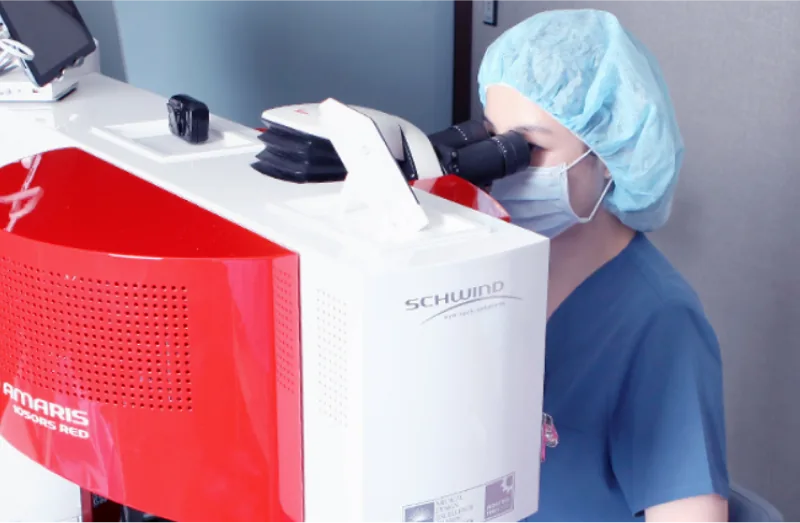
Smart Nova LASIK here runs on the SCHWIND ATOS laser with CenTrax, and the clinic's Pentacam and Corvis ST are the scans that bear on whether you should have it at all. Several of the doctors here had LASIK or LASEK themselves before recommending them, and the clinic has separate centers for presbyopia and cataract, so a no to laser doesn't leave you with nowhere to go. A medical interpreter for your language is provided at no extra charge.
The consultation is free. You'll arrive knowing which question is really yours.
Smart Nova LASIK is New SMILE LASIK done on the SCHWIND ATOS laser with the CenTrax system added. The laser shapes a thin disc of tissue inside the cornea, and that disc is removed through an incision about 2 mm long, so there's no flap to lift. The clinic introduced the CenTrax equipment in 2025; the Smart Nova LASIK procedure page covers the steps.
CenTrax corrects for rotation and docking error. When you lie down, your eye rolls slightly in its socket compared with when you sat up for your scans. For someone with astigmatism, a treatment placed a few degrees off the axis corrects less of it than planned, so lining the treatment up with the eye as it sits on the table matters more the more astigmatism you have.
A review of small-incision lenticule extraction by Reinstein and colleagues explains the thinking behind the small incision: more of the front of the cornea, the part that gives it much of its strength, stays uncut than with a flap. That's a real advantage. It doesn't change any of the limits below.
Which numbers should make a surgeon say no?
Five measurements, and your prescription on its own isn't one of them.
- Tissue left behind. Every laser correction removes tissue, more for higher prescriptions. Most refractive surgeons want a margin of untouched cornea left beneath the treated zone, often discussed as at least about 250 to 300 micrometers. A cornea that's ample for minus 3 can be too thin for minus 8.
- Shape. A corneal map, which the clinic's Pentacam produces, shows whether the cornea steepens toward the bottom or is thinnest off-center. Both can be early signs of keratoconus, a condition laser correction can make worse.
- Stiffness. Corvis ST records how the cornea deforms under a puff of air. A cornea that's soft for its thickness is a reason to stop, even when the thickness looks fine.
- Stability. The U.S. Food and Drug Administration advises against LASIK while your prescription is still changing; a year of unchanged glasses is the usual bar.
- Surface and general health. Dry eye, pupils that open wide in dim light, pregnancy, and conditions such as poorly controlled diabetes or autoimmune disease are on the FDA's list of reasons LASIK may not suit you.
When thickness is the problem, LASIK isn't for everyone, and the answer is often a surface treatment that preserves the most cornea; I've set out how corneal thickness decides between LASIK and LASEK separately. When the prescription is high and the cornea thin, a lens implant that removes no tissue comes into the conversation, with its own risks inside the eye, including cataract and raised pressure.
The trust test I'd suggest is one you can run by message: ask a clinic what would make them refuse to operate on you. If the answer names measurements, you're talking to people who examine. If a clinic books you for Smart Nova on your age and prescription before anyone has measured your cornea, that's a schedule, not an exam. Serious side effects, though rare, have followed surgery that went ahead against what the exam advised.
When I'd advise against it after 40
Presbyopia is the reason this section exists. The American Academy of Ophthalmology describes it as the gradual loss of near focus that starts for most people in their 40s, and no corneal laser for distance stops it. If you're nearsighted and you read by sliding your glasses up, correcting your distance takes that trick away.
Say you're 49, a high school teacher in Vancouver, minus 3.5 with mild astigmatism, and you read the class register with your glasses on your forehead. If that trade sounds fine, it's a reasonable choice. If it doesn't, presbyopic LASIK or LASEK, which sets the two eyes up to share distance and near work, is the option to ask about.
The second limit is the lens inside your eye. If the exam shows your natural lens already starting to cloud, I'd steer you away from reshaping the cornea. A cataract operation later would replace that lens and correct your prescription in the same step, and the clinic's cataract and presbyopia center is where lens-based options are discussed.
If you're over 45, add two lines to your WhatsApp message: whether you read with or without glasses today, and whether an eye doctor has ever mentioned early cataract changes. Those two lines can change which option is worth flying for.
Checking a clinical specialist from home
Most of what tells you how a clinic decides can be checked before you book a flight.
- A named surgeon. Sky Eye publishes its surgeons by name on its doctors page. Mine lists: Ophthalmologist; Full Member, Korean Ophthalmological Society; Completed Training, Yonsei Severance Hospital Ophthalmology; Full Member, Korean Society of Cataract and Refractive Surgery. Society memberships are something you can verify.
- The same people from exam to checks. The same medical team stays with you from examination and consultation through surgery and the key post-operative checks, so the person who reads your scans isn't a stranger on surgery day.
- Equipment checked before your day. The clinic's complication-prevention program includes daily equipment checks, and the clinic closes every Thursday for equipment inspection. Plan your exam and surgery around Thursday.
- More than one machine to offer. LASIK, LASEK, New SMILE, Smart Nova, ICL, presbyopic laser and cataract surgery are all on the menu here. A clinic that can offer the alternative has no reason to fit your eye to one laser.
Dry eye, night halos and under-correction: the risks to weigh
The common reactions are temporary. Dryness, vision that sharpens and blurs through the day, and glare or halos around lights at night are usual in the first weeks and tend to ease over the following months.
Less common is a result that lands short of or past the target, which may need a second treatment. After a lenticule procedure like Smart Nova, that touch-up is often done as a surface laser, and whether it's possible again comes back to the tissue you have left. Rare but serious problems include infection, inflammation at the treated layer, and ectasia, a gradual weakening and bulging of the cornea that the shape and stiffness scans exist to screen for.
On the long view, a ten-year follow-up of small-incision lenticule extraction for myopia up to minus 10, published in Clinical and Experimental Optometry in 2024, reported refraction that stayed largely stable over that decade. Results in any one eye still vary, which is why the screening above matters more than a study average.
I'd ask you to wait if your prescription has changed in the past year, you're pregnant or breastfeeding, your dry eye already bothers you daily, or a general condition like diabetes isn't under control. Once you're home, see an eye doctor the same day for pain that's getting worse, a sudden drop in vision, or a red eye that isn't settling, and carry a copy of your scan results and surgery record so they can see what was done.
Your first message, and what the exam looks at
The consultation is free, in English on WhatsApp Business. Send your current prescription with roughly how long it's been unchanged, and ask what, in your case, would point away from Smart Nova.
At the exam, the number to see first for someone your age is the corneal thickness the treatment would leave, side by side with your corneal map; your reading vision is the next conversation. Sky Eye Clinic is at 723-26 Banpo-dong, Seocho-gu, Seoul, about five minutes on foot from Nonhyeon Station (Line 7, Exit 5) or Sinnonhyeon Station (Line 9, Exit 2).
If you're still deciding between clinics, send that prescription photo on WhatsApp now and keep the answer next to the others you collect.
Results vary by individual.
Sources
- When is LASIK not for me?
- What should I expect before, during, and after surgery? (LASIK)
- Small incision lenticule extraction (SMILE) history, fundamentals of a new refractive surgery technique and clinical out
- Ten-year outcomes following small incision lenticule extraction for up to -10 Dioptres myopia (Xia F, et al. Clin Exp Op
- What Is Presbyopia?
Questions answered
Is Smart Nova LASIK the same as New SMILE LASIK?
Smart Nova is New SMILE LASIK on the SCHWIND ATOS laser with CenTrax added, which corrects for the eye's rotation and docking error on the table. The incision and the no-flap approach are the same; the difference matters most for people with astigmatism.
Do I need to stop wearing contact lenses before the exam?
Yes. Lenses reshape the cornea slightly, and the scans need its own shape.
Can Smart Nova fix my reading vision too?
No. It corrects distance, and presbyopia keeps progressing after 40 whatever the laser does. If you want less dependence on reading glasses, ask about presbyopic LASIK or LASEK instead.
I already have dry eyes. Does that rule me out?
Not automatically, but it moves you down the list. Laser surgery can make dryness worse for months, so significant dry eye is usually treated and reassessed first; in some cases a lens implant, which doesn't cut corneal nerves, becomes the better fit.
Can I combine the exam and surgery in one trip?
Often, if your contact lenses are out long enough beforehand and the scans give a clear yes. Leave spare days anyway: a borderline scan may need a repeat measurement, and you'll want the early check after surgery before you fly.
Get your free consultation before you decide
- Free consultation and checkup, even if you decide against surgery
- Same price as Korean patients, no overseas surcharge
- Interpreters in English, Japanese and Chinese


