
Is No-Flap Always Better? SMILE LASIK Korea, Sorted by Eye Type
SMILE LASIK Korea searches mostly lead to one procedure: a laser shapes a thin, lens-shaped piece of tissue inside the cornea, the surgeon removes it through a small opening without cutting a flap, and it suits nearsighted eyes (with or without astigmatism) whose prescription and corneal measurements pass the pre-op exam.
On this page
What is SMILE LASIK, and how does New SMILE LASIK work?
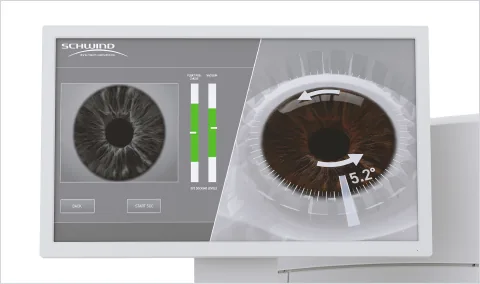
At Sky Eye Clinic in Seoul it is called New SMILE LASIK and runs on the SCHWIND ATOS laser through a 2 mm incision, and a second version, Smart Nova LASIK, adds CenTrax to correct for eye rotation and docking error. The worry most people flying in carry is simpler than any of that: what happens if something feels off a week later, when you're back home and the surgeon is a long-haul flight away?
Forum threads cover day one well. They rarely say which laser a clinic uses, which weekday the clinic is closed, or what paperwork to carry home for your own eye doctor, and those details shape the trip. All three are below, along with the eyes this procedure doesn't suit.
If you have a recent glasses or contact lens prescription, send a photo of it on WhatsApp together with the dates you're considering.
SMILE-type surgery corrects myopia by removing tissue from inside the cornea through a small incision, without the flap that LASIK lifts. A femtosecond laser cuts a thin lenticule within the corneal stroma, the surgeon slides it out, and the cornea's curvature changes. At this clinic the incision is 2 mm and the laser is SCHWIND ATOS.
Risks and side effects to know
A 2014 review in Eye and Vision by Reinstein, Archer and Gobbe traces how the technique developed and lays out its rationale. The front part of the corneal stroma, which carries much of the cornea's strength, is left largely intact, and fewer of the nerves near the surface are cut than when a flap is made. That second point is why dry eye comes up so often in SMILE discussions. Fewer cut nerves is a reason for interest, and dry eye still happens after SMILE-type surgery.
One detail confuses people reading English-language forums. "SMILE" is used loosely for lenticule surgery performed on lasers from different manufacturers. The principle is shared; the laser, its software and the clinic's name for the procedure differ. When you compare clinics, ask which laser platform they use and write the answer down. Here it is SCHWIND ATOS, and the New SMILE LASIK procedure page describes it in the clinic's own words.
Smart Nova LASIK is the same New SMILE LASIK procedure with CenTrax added, which is designed to compensate for rotation of the eye and docking error. Rotation matters most when astigmatism is part of your prescription. Astigmatism correction has an axis, and an eye that turns slightly between sitting upright and lying under the laser shifts that axis.
The clinic publishes its surgeons' names, and you can check who operates on the doctors page before you book. Vision correction is one of three specialist centres here, alongside cataract and presbyopia, and retina and glaucoma.
The measurements that come before anyone says yes
Candidacy for SMILE-type surgery rests on four things: a stable prescription, enough corneal thickness, a regular corneal shape, and a cornea that responds normally to pressure. The clinic's equipment list includes Pentacam for corneal shape and thickness mapping, Corvis ST for corneal biomechanics, and Cirrus OCT 6000.
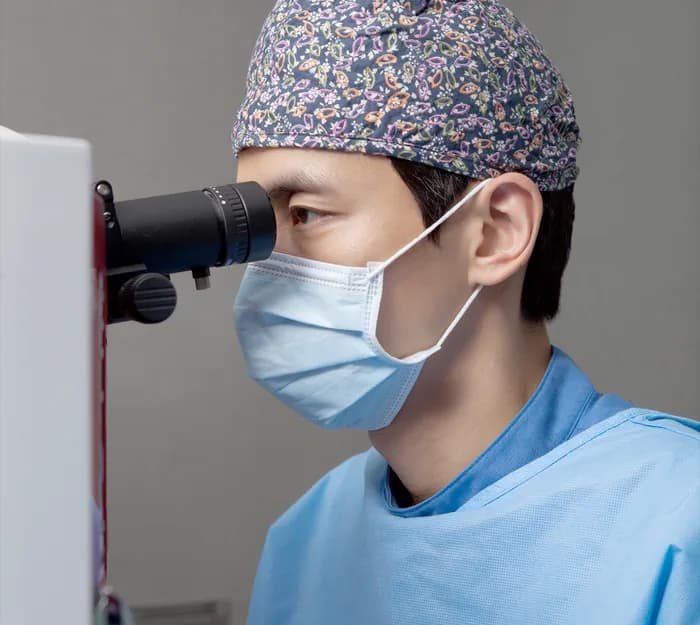
Surgeons generally look past the single thickness number on a Pentacam map. Where the thinnest point sits matters, and so does whether the back surface of the cornea bulges forward more than the front, a pattern that can be an early sign of keratoconus. Corvis ST gives a different view: a puff of air dents the cornea while a high-speed camera records how it gives way and springs back.
A cornea that is thick enough on paper but gives way more than expected makes surgeons cautious about any procedure that removes tissue. When the maps raise a keratoconus question, laser vision correction is set aside and corneal cross-linking becomes the conversation.
Contact lenses temporarily change the shape of the cornea, so these measurements are only trustworthy after a break from them. The FDA's LASIK guidance tells patients to stop soft lenses for two weeks before the baseline evaluation, and longer for toric, rigid gas-permeable and hard lenses.
Which eyes does SMILE LASIK tend to suit?
SMILE-type surgery is usually considered for nearsighted adults, with or without astigmatism, whose prescription has been stable, whose corneas are thick and regular enough on the maps, and who would rather not have a flap, often because of contact sports or a job where knocks to the face happen. The table shows how this clinic's menu lines up by eye type.
| What the exam shows | Option usually discussed | Why |
|---|---|---|
| Moderate myopia, normal thickness and shape | New SMILE LASIK | No flap; 2 mm incision on SCHWIND ATOS |
| Myopia with astigmatism where axis alignment matters | Smart Nova LASIK | CenTrax compensates for rotation and docking error |
| Good thickness, a profile suited to a flap procedure | LASIK | SCHWIND Amaris Red SPT with Co-Wave customized treatment |
| Thinner cornea | LASEK | Surface treatment; no flap, no lenticule |
| High myopia, thin cornea or dry eye | ICL (EVO/EVO+) | No corneal tissue removed |
| Irregular shape suggesting keratoconus | No laser; cross-linking assessment | Removing tissue could weaken the cornea further |
The table is a starting map, and the exam redraws it. Many people arrive set on one procedure because a friend had it, and that's a reasonable place to start a conversation. If the maps rule out SMILE-type surgery, the choice often narrows to the two older laser methods, and a separate post explains how corneal thickness splits LASIK from LASEK.
For thinner corneas there is also the clinic's LASEK options page, which covers standard, Amaris Red and 2Day LASEK, and for prescriptions beyond what laser work can comfortably remove, the ICL lens implant, which leaves the cornea untouched.
People sometimes hear "no flap" and assume that makes it the right choice for everyone. I don't see it that way. A flapless procedure still removes tissue from the cornea, so the cornea has to be suited to that, and for some eyes the sensible answer is a lens that removes nothing at all. Several of the doctors at this clinic have had LASIK or LASEK on their own eyes, and the question worth asking is the one you'd ask for yourself: which option leaves this particular cornea with enough strength in reserve?
What can go wrong, and who should wait?
The common effects are temporary: dry or gritty eyes, glare and halos at night, and sharpness that fluctuates over the first weeks. Less common is an under- or over-correction that may need further treatment. Rare problems include infection or inflammation inside the cornea. Results differ between people, and suitability is settled at the in-person exam.
Two points are specific to SMILE-type surgery. For some people vision clears a little more gradually over the first day or two than after LASIK. If a touch-up is needed later, it is usually done as a surface treatment or by another method, because there is no flap to lift.
The FDA page "When is LASIK not for me?" lists situations where laser vision correction is usually postponed or avoided, and most of them apply to SMILE-type surgery as well:
- a prescription that is still changing
- pregnancy or nursing, or hormonal changes that affect vision
- some autoimmune conditions, or medicines that affect healing
- corneas that are thin or irregular on the maps
If a doctor at home has already told you your corneas are thin or your eyes are dry, that report is worth having in hand before you plan anything.
Send a photo of that report on WhatsApp, along with your current prescription.
How many days should you plan in Seoul?
The FDA notes that the first visit after LASIK usually happens 24 to 48 hours after surgery. The number of nights is set at the consultation, and it grows if surgery can't follow the exam straight away.
The clinic's hours shape the calendar more than people expect:
- Monday to Wednesday and Friday: 10:00–16:30, lunch 13:00–14:00
- Saturday: 10:00–14:30, exams and surgeries only
- Sunday and public holidays: closed
All exams, surgeries and consultations are by appointment. A Wednesday-night landing makes Friday, not Thursday, the first possible exam day, and a check the day after a Wednesday surgery also falls on Friday. The clinic is in Seocho-gu, about a 5-minute walk from Nonhyeon Station (Line 7 Exit 5, Sinbundang Line Exit 4) or Sinnonhyeon Station (Line 9 Exit 2).
The U.S. CDC's medical tourism guidance suggests leaving recovery time before a long flight home and arranging follow-up care before you travel. For most people weighing SMILE LASIK Korea plans, that means counting the contact lens break, the exam, the surgery and the check as one block of leave, then adding a margin.
Follow-up once you're back home
Arrange your home follow-up before you leave Seoul. Book a routine appointment with an ophthalmologist or optometrist for the weeks after your return, and carry copies of your records so that doctor isn't starting from zero.
The CDC recommends getting copies of your medical records from the treating facility. For this surgery, the useful set is:
- the pre-op measurement printouts (corneal maps and thickness)
- the surgery record, naming the procedure and the laser (for example, New SMILE LASIK on SCHWIND ATOS)
- your eye-drop schedule, written with generic drug names
- the surgery date for each eye
Tell the home doctor plainly that it was lenticule surgery with no flap. After LASIK, the flap is the first thing an examining doctor looks for, and knowing there isn't one changes what they check.
Dryness, sharpness that comes and goes, and halos at night are expected in the first weeks. Pain that increases, redness that worsens, discharge, a sudden drop in vision or light sensitivity that keeps building are reasons to see a local eye doctor the same day and to message the clinic with what you're seeing.
Before you settle on dates, send one thing on WhatsApp: the question that has stopped you booking so far. It might be a thickness number from an old exam, a prescription that changed last year, or how Thursday's closure fits your leave.
Results vary by individual.
Sources
Questions answered
Is SMILE LASIK the same thing as LASIK?
Both reshape the cornea with lasers, but LASIK lifts a flap and reshapes the tissue underneath, while SMILE-type surgery removes a small lens of tissue from inside the cornea through a small incision. At Sky Eye Clinic the flapless version is New SMILE LASIK on the SCHWIND ATOS laser, and LASIK is done on the SCHWIND Amaris Red SPT.
Can SMILE-type surgery correct astigmatism?
It is commonly used for nearsightedness with astigmatism, within limits set by the laser and by your corneal measurements. Because astigmatism correction has an axis, eye rotation matters; Smart Nova LASIK adds CenTrax, which is designed to compensate for rotation and docking error. The amount and axis that can be treated in your eye are measured at the exam.
What does SMILE surgery feel like?
Numbing drops are used, and many people describe pressure rather than sharp sensation while the eye is held steady under the laser. Afterwards, eyes often feel scratchy, watery or light-sensitive for a few hours, and the FDA's LASIK guidance describes similar short-term discomfort after laser surgery. Your surgeon gives you drops and instructions for that first evening.
Does Sky Eye Clinic work in English?
The clinic lists English, Japanese and Chinese among its languages. Exams, surgeries and consultations are all by appointment, and for English-speaking readers the contact channel is WhatsApp.
Can I fly home the day after SMILE LASIK?
The FDA notes that the first check after LASIK usually happens 24 to 48 hours after surgery, so plan to have that check in Seoul before your flight. The surgeon confirms when you can fly based on how that check goes. Remember the clinic is closed on Thursdays and Sundays when you count days.
Get your free consultation before you decide
- Free consultation and checkup, even if you decide against surgery
- Same price as Korean patients, no overseas surcharge
- Interpreters in English, Japanese and Chinese


