
Does SMILE LASIK in Korea Hurt? Pressure on the Table, a Gritty First Day, and What Helps
Korea SMILE LASIK pain management: will you need strong painkillers and a few days in a dark hotel room before you can fly home?
On this page
Does the laser part of SMILE hurt?
Most people won't. Numbing drops mean the laser itself feels like pressure, and the gritty, watery stretch afterwards usually fades over the first day. The procedure with several sore days is LASEK, and your corneal scan decides which one you get.
Hello, I'm Dr. Kim Sang-Myung, an ophthalmologist in the vision correction center at Sky Eye Clinic in Seoul.
If the scan says your cornea doesn't suit New SMILE LASIK, I'd rather tell you that in the exam room than let the pain question pick your surgery. The clinic has a Pentacam and a Corvis ST for mapping the cornea, runs New SMILE LASIK on the SCHWIND ATOS laser, checks its equipment daily, and names each operating surgeon on a public page.
If a doctor at home has already called your corneas thin or borderline, send a photo of that report on WhatsApp and ask whether New SMILE LASIK is still worth discussing for your numbers. The consultation is free, and if you'd rather talk it through in your own language at the exam, a medical interpreter is provided at no extra charge.
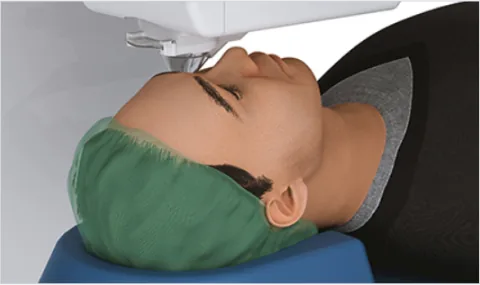
For most people it's pressure, not pain. Numbing drops go in first, the eye is held steady with gentle suction, and the light you're asked to look at can blur or dim for a short while. People tend to remember that dimming as the strange part.
The belief worth correcting is that no flap means no sensation at all. New SMILE LASIK works through a 2 mm incision without a flap: the laser shapes a thin disc of tissue inside the cornea, and that disc is removed through the incision. A review in Eye and Vision by Reinstein and colleagues describes the same principle of removing tissue through a small incision instead of lifting a flap.
A smaller opening disturbs less of the corneal surface. It is still surgery on tissue full of nerve endings, though, and once the drops wear off your eye will let you know.
If you have marked astigmatism, Smart Nova LASIK is the version to know about. It is New SMILE LASIK with CenTrax added, which corrects for rotation and docking error, so the feeling on the table should be much the same. What changes is how closely the treatment lines up with your astigmatism.
The first hours after surgery: grit, tears and sleep
The sore part starts when the numbing wears off, usually within an hour or so. It feels like sand under the lid, with watering and sensitivity to light. The FDA's patient guidance lists the same sensations, burning, itching and the feeling that something is in the eye, and notes that a doctor may suggest a mild pain reliever.
Here is how the three laser options at the clinic compare in the early days, using the clinic's own descriptions.
| Procedure | Early discomfort | Why it differs |
|---|---|---|
| New SMILE / Smart Nova LASIK | Listed as minimal corneal damage | 2 mm incision, no flap |
| LASIK | About half a day | Thin flap, laser on the tissue beneath |
| LASEK | Up to 3 to 4 days; blur for 5 to 7 days | Surface layer removed, regrows under a protective lens |
The single thing that helps most on the day is closing your eyes for the first few hours. The clinic is about a five-minute walk from Nonhyeon Station (Line 7 Exit 5, Sinbundang Line Exit 4) or Sinnonhyeon Station (Line 9 Exit 2), so a room near either station means you're lying down soon after you leave. Book nothing for that afternoon: no shopping, no dinner plans, no screens.
What actually manages the pain?
Drops on schedule, closed eyes, a shield at night and your hands kept away from your face. That covers most of Korea SMILE LASIK pain management. A mild pain reliever has its place, but ask what you can take rather than reaching for whatever is in your bag.
- Set alarms for the drops. Post-surgery drops come with a schedule, and jet lag makes it easy to lose track. Leave a few minutes between two different drops so the second doesn't wash out the first.
- Use preservative-free artificial tears between doses. After the first day, dryness is what most people notice more than soreness.
- Wear the shield to sleep. You can rub an eye in your sleep without knowing it, and the FDA's guidance is plain that rubbing should be avoided after surgery.
- Keep sunglasses with you. Light sensitivity is normal for the first days.
- Give screens a rest the first evening. You blink less when you stare at a phone, and the eye dries faster.
Grit fades; it doesn't build. If the sore feeling gets sharper after the first evening instead of easing, or your vision drops along with it, that is the opposite of the usual pattern. I would want you seen that same day, rather than taking another tablet and waiting it out.
Why your corneal scan matters more than any painkiller
The scan decides the procedure, and the procedure decides how many sore days you have. If your cornea can't spare the tissue your prescription needs, the safer choice may be LASEK, the option with 3 to 4 sore days.
Every laser method corrects myopia by removing tissue, and a higher prescription removes more. So the number I care about is how much untouched cornea would remain after your correction; today's thickness is only half of it. The shape of the map matters too. A cornea that steepens unevenly can be an early sign of keratoconus, and laser correction can make that condition worse.
LASIK is not for everyone. When a cornea is thinner than a certain threshold, a LASEK-type procedure that keeps the most cornea is what I recommend. New SMILE LASIK is listed at the clinic for high myopia with thin corneas, but whether it fits yours comes down to the measurement. The thickness logic is set out in more detail in how your cornea decides between LASIK and LASEK.
Say you're minus 8 with two dioptres of astigmatism, an optometrist at home has called your corneas borderline, and you've heard enough about LASEK pain to want to avoid it. If the map is regular and enough cornea would remain, a SMILE-type procedure is a real option, and with that much astigmatism, Smart Nova LASIK and its CenTrax alignment are worth discussing.
If the same map showed uneven steepening, I wouldn't offer laser correction on that trip at all, whatever the pain profile. And if the leftover thickness were borderline, I'd choose LASEK and plan around the sore days with you. Two easier days are a poor trade for less cornea over the next forty years.
Risks and side effects to know
I take this seriously because rare but serious visual side effects have occurred when surgery went ahead despite an exam result advising against it. For very high prescriptions, or corneas too thin for any laser, the clinic also offers EVO ICL, a lens placed inside the eye without removing corneal tissue. It carries its own risks; the FDA lists raised eye pressure and cataract among the risks of phakic lenses.
If LASEK turns out to be the answer, it means a protective contact lens while the surface regrows, 3 to 4 sore days and blur for 5 to 7. That is a longer trip, and it's better to know before you buy the ticket.
So send your planned arrival date and your flight home on WhatsApp, and ask how many days to leave between surgery and the flight if the scan points to LASEK instead of New SMILE LASIK. Asking with your real dates gets you an answer about your trip, not a general one.
Can you fly home while your eyes are still sore?
Soreness is rarely what makes a flight hard; dryness is. Cabin air is very dry, so keep lubricating drops in the seat pocket, because checked luggage is no use mid-flight. Timing matters more: the FDA advises seeing your doctor within the first 24 to 48 hours after surgery, so book the flight after that first check.
The clinic's calendar matters here. It's closed on Thursdays for equipment inspection, and on Sundays and public holidays. A Wednesday surgery puts the next day on a closed Thursday, and a Saturday surgery puts it on a Sunday, so ask how the first check falls before you fix your dates.
The same medical team supports you from the exam and consultation through surgery and the key checks afterwards. Pack sunglasses, a written copy of the drop schedule in case your phone dies, and ask for a copy of your surgery record to show your eye doctor at home.
What if your eye hurts after you're back home?
Some dryness and a scratchy feeling can come and go for weeks, and night halos or vision that shifts through the day are common early on. Sharp pain, a red eye that keeps getting worse, discharge or falling vision are different. Those need an eye doctor the same day.
Laser correction is usually put off if your prescription changed in the past year, if you're under 18, pregnant or breastfeeding, or if you have a condition that affects healing, such as an autoimmune disease or poorly controlled diabetes. The FDA's page on when LASIK isn't advisable covers these, and a thin or irregular cornea is a reason for caution on top of them.
How each eye heals is individual, which is why the checks after surgery exist. Before you fly, find an ophthalmologist near home and keep your surgery record and drop schedule with you. You can also write to the clinic on WhatsApp in English with a photo of the eye and what you're feeling, but severe pain or falling vision should go to a local eye doctor first.
The consultation is free. When you're in Seoul, the number I'll want to see is how much cornea would remain after your correction, because that decides between a short gritty day and three or four sore ones. Before then, send a photo of your glasses prescription on WhatsApp, say which contact lenses you wear, and ask how long they need to stay out before your exam.
Results vary by individual.
Sources
Questions answered
Do I need to stop wearing contact lenses before the exam?
Yes. Contact lenses change the shape of the cornea, and the measurements that decide between New SMILE LASIK and LASEK need the cornea in its natural shape. The FDA advises leaving lenses out for a period before the evaluation, longer for rigid lenses than for soft ones, so plan this before you fly, not on arrival.
What if I flinch or my eye moves during the laser?
During SMILE-type surgery the eye is held still with gentle suction while the laser works, which is the pressure you feel. You're asked to look at a light, but you don't have to keep your eye still by willpower alone. If you're tense, say so before the drops go in.
Should I bring my own painkillers from home?
Bring the one you know you tolerate, and tell the doctor before surgery about everything you take, including blood thinners and supplements. Ask at the consultation whether you'll need it afterwards and which kind is suitable; many people find sleep and the prescribed drops are enough.
When does the dryness after SMILE-type surgery settle?
Dryness can come and go for weeks to a few months while the corneal nerves recover. Because a small incision with no flap cuts fewer of those nerves than a LASIK flap, SMILE is often associated with less dry eye, but keep using preservative-free artificial tears until it settles.
What if the scan shows my cornea is too irregular for any laser?
Then the conversation moves away from laser correction for now. The clinic treats keratoconus and offers corneal cross-linking, which aims to strengthen a weakening cornea; vision correction comes later, if at all, once the cornea is stable.
Get your free consultation before you decide
- Free consultation and checkup, even if you decide against surgery
- Same price as Korean patients, no overseas surcharge
- Interpreters in English, Japanese and Chinese


