
What Age Should You Get LASIK? In Your 20s, Stability Counts
"I'm 23. Am I too young for LASIK?"
On this page
Why is 18 only the starting line?
It's one of the first questions people in their early twenties bring to a laser consultation. Underneath it there's usually a second thought they don't say out loud: if I wait, I'm stuck with contacts for years, and if I go now, will my eyes drift back by 30?
LASIK can be done from 18, but the age that counts is the one at which your prescription stopped changing: at least a full year with no change. For many people that lands somewhere in the early-to-mid 20s, and the window usually stays open until reading glasses enter the picture in the 40s.
Hello, I'm Dr. Kim Sang-Myung, an ophthalmologist at Sky Eye Clinic in Seoul. I completed my training at Yonsei Severance Hospital Ophthalmology and work in vision correction.
If your scan says your eyes aren't ready, I'll tell you to wait. The clinic measures the cornea with Pentacam and Corvis ST, and the surgeon who consults with you performs your procedure, so the person who says "not yet" or "go ahead" is the one who would operate. You can write to us in English on WhatsApp Business, and a medical interpreter for your language is provided at no extra charge if English isn't your easiest language.
The quickest way to see where you stand is to send photos of your last two glasses or contact lens prescriptions on WhatsApp, with the dates visible, and ask whether that gap is long enough to plan a trip. The consultation is free, and two dated numbers side by side show you at a glance whether your eyes are still moving.
The clinic's LASIK criteria start at 18 and then add a second condition that matters more: your prescription has not changed in the past year. Age is a stand-in. What I actually want to know is whether your eye has stopped growing.
In most young people, nearsightedness comes from the eyeball being slightly too long from front to back. That lengthening often continues through the late teens and, for some people, into the early 20s, especially with long hours of close work. Laser correction reshapes the cornea to match the eye as it is on the day of surgery. If the eye keeps lengthening afterwards, the myopia creeps back, a little at a time.
Think of hemming trousers for a younger brother who's still growing. The tailor can get the length right today, and by next winter they're short again. The hem wasn't the problem. One stable year between two prescriptions is the closest thing I have to evidence that the growing is done.
To be honest, the birthday on your passport tells me less than two prescriptions taken a year apart. A 27-year-old whose numbers jumped last spring concerns me more than a 21-year-old whose numbers haven't moved in two years. I'd rather you wait twelve months and arrive with a stable eye than correct a number that's still changing.
Is 22 too young for LASIK?
Not by itself. If your prescription has held for a year and the corneal scan is normal, 22 sits inside the range the criteria allow. What changes the answer in your early 20s is usually one of these:

- Your prescription has shifted by about half a diopter or more since your last check. Many surgeons treat a change that size as a sign the eye isn't settled yet.
- You've needed new glasses more than once in the past two years.
- You recently started a job or course with far more screen and reading hours, and your distance vision has been slipping since.
If one of these fits, the better plan is to keep wearing glasses and get measured again in a year. The laser corrects today's number. A few more months in glasses are easier than chasing a number that hasn't finished moving.
There's a practical tip here. Before you plan anything, dig out your old glasses and prescription slips. An optician at home can read the power of an old pair, which gives you one more dated data point, and that tells you more about stability than any single exam.
What the scan checks besides your age
Age gets you to the exam. The exam answers the rest. At Sky Eye Clinic the first visit runs through auto-refraction (myopia, astigmatism and the curvature of the cornea), an eye pressure test, corneal topography to look for keratoconus and irregular corneas, and photography of the retina. There's also an optional Avellino corneal dystrophy DNA test; if the result is positive, surgery is avoided. Then the doctor examines your eyes in detail, including slit-lamp microscopy.
Topography matters more in younger eyes. Keratoconus, a gradual thinning and bulging of the cornea, usually first shows up in the teens and twenties, and laser correction can make it worse. A cornea that steepens toward the bottom is a reason to stop and look closely, whatever your age.
Corneal thickness is the other number. LASIK is not for everyone: if your cornea is thinner than a certain threshold, a LASEK-type procedure that preserves the most residual cornea is recommended. Many surgeons want roughly 250 to 300 microns of untouched cornea left beneath the treatment. If you want the detail, I've written separately about how corneal thickness splits LASIK from LASEK. Serious visual side effects, although rare, have occurred when surgery went ahead despite an exam result advising against it.
The U.S. Food and Drug Administration's patient guidance adds reasons to hold off that have nothing to do with age: pregnancy or breastfeeding, a prescription that's still changing, and conditions or medicines that can affect healing.
Three methods, three different first days
| Method | How it works | What to expect early |
|---|---|---|
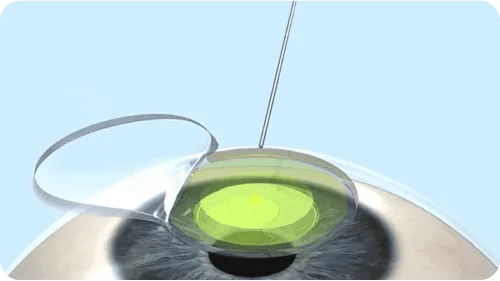
| LASIK | Thin flap, laser on the stroma | Discomfort for about half a day |
| LASEK | Surface layer removed, laser on the stroma | Discomfort up to 3 to 4 days, blur for 5 to 7 days |
| New SMILE LASIK | 2mm micro-incision, tissue removed, no flap | Minimal corneal damage, no flap complications |
LASIK with Co-Wave customization runs on the SCHWIND Amaris Red SPT. New SMILE LASIK on the SCHWIND ATOS uses a 2mm incision with no flap, and Smart Nova LASIK adds CenTrax, which corrects for rotation and docking error. The lasers are checked every day as part of the clinic's complication prevention program, and each surgeon's name is published on the site, so you can look up who operates before you fly.
Can you fit it into a short trip from elsewhere in Asia?
If you're flying in from Bangkok, Hanoi or Tokyo on a few days of leave, build the trip around three fixed points rather than the sightseeing.
Your first full day is the exam. Plan for it to take most of a morning and confirm the time at booking. If your pupils are dilated, near vision stays blurry for several hours, so don't plan an afternoon of reading menus and maps. Come in glasses, and bring the old pairs and prescription slips you found.
The calendar has two hard stops. The clinic is closed on Thursdays for equipment inspection, and on Sundays and public holidays. Saturday runs 10:00 to 14:30 for exams and surgeries only. If your leave starts on a Wednesday, that means your exam and any surgery fall on Friday or Saturday, and a Thursday flight-in is a rest day.
The third point is the first check after surgery. The FDA advises seeing your doctor within 24 to 48 hours, so you won't be flying out the evening of your surgery. If your scan points you toward LASEK, the 5 to 7 days of blur change the trip, and the length of stay is worth asking about before you book flights.
Getting there takes about five minutes on foot from Nonhyeon Station (Line 7 Exit 5 or Sinbundang Line Exit 4) or Sinnonhyeon Station (Line 9 Exit 2). Pack sunglasses for the walk back.
Dry eye, night glare and regression in younger eyes
The common effects in the first weeks are dryness, glare and halos around lights at night, and vision that is sharp one hour and soft the next while the surface heals. For most people these settle over weeks to a few months. How strongly any of it shows up varies from eye to eye, which is exactly why the scan matters.
Regression is where age comes in. If the eye was still lengthening when it was treated, some nearsightedness returns, and this is the main reason I hold back eyes that haven't had their stable year. Less common problems include under- or over-correction. Rare but serious ones include corneal thinning and bulging (ectasia) and infection, plus flap problems with LASIK specifically.
Who should wait, as general medicine: anyone whose prescription changed in the past year, anyone with a thin or irregular cornea on topography, and anyone pregnant or breastfeeding. The same medical team supports you from the exam through surgery and the key post-operative checks while you're in Seoul. Before you fly, ask for a copy of your scan and surgery record for an eye doctor at home, and if you notice worsening pain, a sudden drop in vision or redness that keeps increasing after you land, see a local ophthalmologist that day.
What changes once you pass 40?
Sometime in the 40s, the lens inside the eye stiffens and close-up focus fades. This is presbyopia, and it arrives whether or not you've had LASIK. Laser correction at 25 fixes distance vision; it doesn't push reading glasses back by a single year.
That isn't a reason to skip it in your 20s, just something to know going in. For people already in their 40s there are presbyopic LASIK and LASEK options, and once the natural lens starts to cloud later in life, the conversation moves to the clinic's separate cataract and presbyopia center.
Where I stand on age
Several of the doctors here had LASIK or LASEK themselves, so the recovery is something we can describe from the patient's side. Speaking for myself as a vision correction surgeon, I don't think there's a right birthday for LASIK. There's a right year, and it's the year your eyes stop moving and your cornea passes the scan. Some people reach it at 20, some at 28. At the exam I'll go through your scan with you and suggest the method that fits your cornea.
The consultation is free. On WhatsApp, send photos of those same two prescriptions with their dates, and ask whether a stable year is already behind you or still ahead. The clinic is at 723-26 Banpo-dong, Seocho-gu, Seoul (Building A B3–10F · Building B 1F).
Dr. Kim Sang-Myung, Ophthalmologist
Results vary by individual.
Sources
Questions answered
If I get LASIK at 21, will it wear off by 30?
The laser change to the cornea is lasting. What can return is nearsightedness from the eye itself continuing to lengthen. That's why a year of unchanged prescriptions matters more than the exact age: if the eye has stopped growing, the correction usually holds.
Is there an upper age limit for LASIK?
There's no fixed cut-off. Past 40, presbyopia means distance LASIK won't remove the need for reading glasses, and from the 50s onward early lens changes can make a lens-based option worth discussing instead. The health of the cornea and lens matters more than the number.
Can I have LASIK while pregnant or breastfeeding?
The FDA lists pregnancy and nursing as reasons to wait, because hormone changes can shift your prescription and affect healing. Most surgeons suggest waiting until your prescription has settled again after you finish breastfeeding.
Do I need to stop wearing contacts before the exam?
Yes. Contacts can temporarily change the shape of the cornea and distort the measurements. The FDA's guidance asks for about two weeks without soft lenses and longer for toric or rigid lenses. Ask when you book how long to stop for your lens type.
My prescription only changed by a small amount last year. Does that count as unstable?
A very small shift can be measurement noise. Many surgeons treat a change of about half a diopter or more as a sign the eye hasn't settled. Bring both prescriptions so the two readings can be compared side by side.
Get your free consultation before you decide
- Free consultation and checkup, even if you decide against surgery
- Same price as Korean patients, no overseas surcharge
- Interpreters in English, Japanese and Chinese