
What Does LASIK Do? It Fixes Focus, Not Every Cornea
“What does LASIK do to my eye, exactly, and could I get it done in one school break?”
On this page
What LASIK actually changes in your eye
People put that question to eye surgeons all the time. Behind it there's usually a quieter one: if I spend my savings and my holiday on this, what if my eyes are the kind it shouldn't be done on?
LASIK uses a laser to reshape the cornea, the clear front window of the eye, so light lands in focus on the retina. It corrects nearsightedness, farsightedness and astigmatism, but it can't stop your eyes from aging, it doesn't treat dry eye, and on a cornea that's too thin or irregular it's the wrong operation. Only a scan can show which kind you have.
Hello, I'm Dr. Kim Sang-Myung, an ophthalmologist at Sky Eye Clinic in Seoul. I completed my training at Yonsei Severance Hospital Ophthalmology and I'm a full member of the Korean Society of Cataract and Refractive Surgery.
I'd rather tell you after the scan that LASIK doesn't suit your eyes than operate on the wrong cornea, and the clinic has the equipment to make that call: a Pentacam for corneal shape and thickness, and a Corvis ST for how the cornea flexes. If LASIK is ruled out, LASEK, New SMILE LASIK and ICL are on the same menu. The surgeon who consults with you performs your procedure, and a medical interpreter for your language comes at no extra charge.
The consultation is free. On WhatsApp, send a photo of your current glasses or contact lens prescription with the dates of your break, and ask which kinds of surgery could fit inside that window. One photo is enough to start, and you can write in English.
The cornea does about two-thirds of your eye's focusing. If you're nearsighted, it bends light a little too strongly for the length of your eye, so the image comes into focus just in front of the retina. LASIK corrects that by removing a precise amount of tissue from inside the cornea.
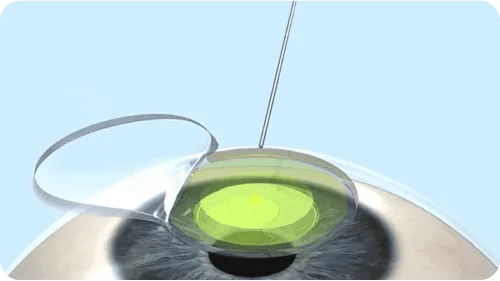
Think of it as taking the prescription in your contact lens and carving it into the front of your eye for good. In LASIK a thin flap is made first, about 160 micrometers thick when a microkeratome is used. The laser reshapes the layer underneath, and the flap is laid back down. Nothing is implanted and nothing is added; tissue is only taken away.
That last point is why the scan matters so much. An average cornea is a little over half a millimeter thick at the center. The flap uses part of it, the correction uses more, and the higher your prescription, the more the laser removes.
What can't LASIK fix?
In short, this is where people are most often surprised. LASIK changes the shape of your cornea and nothing else.
Risks and side effects to know
- Reading vision in your 40s. The lens inside your eye slowly loses its ability to focus up close, usually starting in the early to mid 40s. LASIK at 26 doesn't prevent that, so most people reach for reading glasses at some point. Presbyopic LASIK and LASEK exist for people already at that stage, which is a separate conversation.
- The length of a very nearsighted eye. A high prescription often comes with a longer eyeball and a stretched, thinner retina. LASIK removes the need for glasses, but the eye stays the same length, so the retinal checkups that high myopia calls for still apply.
- Dry eye. LASIK doesn't treat it, and for the first weeks or months it often makes dryness worse.
- A prescription that's still moving. If your numbers changed in the past year, the eye can keep drifting after surgery. LASIK is for adults 18 or older whose prescription hasn't changed in the past year.
- Cataract later in life. You'll still develop one eventually. When you do, the surgeon calculating your new lens needs to know your cornea was reshaped. Keep a copy of your pre-surgery measurements somewhere safe; it's a small file that saves a lot of guesswork thirty years from now.
How do I know if my cornea is the wrong kind for LASIK?
Your prescription alone won't tell you. Two people with the same minus 4.50 can have very different corneas, and the differences that matter are measured in microns.
Three things decide it. First, how thick the cornea is and how much would be left after the flap and the correction. Second, the shape across the whole surface: a cornea that steepens toward the bottom can be an early sign of keratoconus, a weakening condition that laser surgery can make worse. Third, how stiff the tissue is, which a thickness number doesn't show. A Pentacam maps the first two; a Corvis ST measures the third by recording how the cornea flexes under a puff of air.
One tip that can save you a wasted trip: contact lenses temporarily change the shape of your cornea, and readings taken before it settles back can be off. The FDA's patient guidance asks soft-lens wearers to stop about two weeks before the baseline exam, and longer for toric or rigid lenses. If you wear contacts every day, that means teaching in glasses for the last couple of weeks before you fly. Ask at booking how long to go without your type of lens.
The exam result is the one thing I won't negotiate on. Rare but serious visual side effects have happened when surgery went ahead even though the exam advised against it. If your scan points away from LASIK, the useful question stops being “can I still have LASIK?” and becomes “which method leaves my cornea strongest?”
If not LASIK, then what?
LASIK isn't for everyone, and a thin cornea is the most common reason. In that case a LASEK-type procedure, which preserves the most residual cornea, is the usual recommendation because it makes no flap at all. I've written more about that choice in how your cornea decides between LASIK and LASEK.
| Method | What it does to the cornea | Early discomfort |
|---|---|---|
| LASIK | Thin flap made, laser reshapes the layer beneath, flap laid back | About half a day |
| LASEK | Surface layer removed, laser on the layer beneath, regrows under a protective lens | Up to 3 to 4 days; blurring 5 to 7 days |
New SMILE LASIK here runs on the SCHWIND ATOS laser, and Smart Nova LASIK pairs it with CenTrax, which corrects for the eye's rotation and small docking errors. For very high prescriptions, or a cornea too thin for any laser, an ICL lens can be placed inside the eye without removing corneal tissue. It carries its own risks, including a higher chance of cataract and raised eye pressure, so it needs its own conversation.
Can you fit it into a school break?
Say you're 27, teaching English in Taipei, about minus 4.50 with some astigmatism, and the only gap in your contract is nine days over the winter holiday.
If the scan shows plenty of cornea, LASIK is the easiest fit, since the discomfort usually lasts about half a day. If it shows a thinner cornea and the choice moves to LASEK, the plan changes. You'd want the three to four sore days and the blurring that can last a week to fall inside the holiday, not in your first week back in the classroom. That means putting the exam as early in the trip as you can and leaving a spare day before the flight home.
Two calendar facts matter. The clinic is closed on Thursdays for equipment inspection, and Saturdays run 10:00 to 14:30 for exams and surgeries only, so check both before you book flights. And stop your contacts before you board, not after you land.
Dry eye, night halos, flap problems and ectasia
Common and temporary: dry, gritty eyes; glare, halos and starbursts around lights at night; vision that sharpens and blurs through the day. These usually settle over weeks to a few months, and how fast they settle differs from one person to the next.
Less common: under- or over-correction that leaves some prescription behind, sometimes treated with a second laser session if enough cornea remains. With LASIK specifically, flap-related complications are possible, such as wrinkles in the flap or a flap shifted by a hard knock in the early weeks.
Rare but serious: ectasia, a gradual bulging of a cornea that was weakened beyond what it could carry. It's the reason thickness and stiffness are measured before anything else is decided.
Who should wait, or choose something other than LASIK:
- Your prescription changed in the past year.
- You're pregnant or breastfeeding; hormone shifts can change the prescription.
- You have an autoimmune disease, poorly controlled diabetes, or take medication that slows healing.
- Your eyes are already significantly dry.
- You box, do martial arts or play another sport with blows to the face; a flapless method is usually the better match.
- Your scan shows a thin or irregular cornea.
While you're in Seoul, the same medical team supports you from the exam through surgery and the key post-operative checks. Once you're back in Taipei, sudden pain, a drop in vision, or redness that gets worse instead of better needs an ophthalmologist the same day. Before you leave, collect copies of your scans and surgery record, and find a local eye doctor you could call.
If any line on that wait list sounds like you, say so in your WhatsApp message and attach your last two prescriptions with their dates, if you have them. Two dated prescriptions show at a glance whether your eyes have settled.
What to ask any clinic before you book
You don't have to book with us to use this list. Ask these wherever you go, here included:
- What is my corneal thickness in microns, and how much would be left after surgery?
- Is the shape of the whole cornea mapped, and is its stiffness measured, beyond a single thickness reading?
- Is the surgeon who examines me the one who operates, and can I see that surgeon's name before surgery day?
- If LASIK is ruled out, which other methods are available under the same roof?
- When is the first check after surgery, and can I fly home after it?
- Will I leave with copies of my measurements and my surgery record?
Where I stand: LASIK does one job, reshaping the cornea, and on the right cornea it does that job reliably. On the wrong one I'd rather say no and show you the numbers. There's no need to decide anything before you've seen your own scan; another holiday will come around.
The consultation is free. What decides your answer is the thickness, shape and stiffness of your cornea, and those are what the exam measures.
— Dr. Kim Sang-Myung, Ophthalmologist
Results vary by individual.
Sources
Questions answered
Does LASIK hurt during or after surgery?
Surgery is done with numbing eye drops, so you feel pressure rather than pain. On the day you may have irritation, tearing and a grainy feeling, which for LASIK usually lasts about half a day. LASEK is different: discomfort can last up to three to four days.
Can I fly home the day after LASIK?
The change in cabin pressure isn't a problem for LASIK, but cabin air is very dry, which makes freshly operated eyes feel grittier.
Will I ever need glasses again after LASIK?
Probably reading glasses, once the lens inside your eye ages in your 40s. Some people also keep a small leftover prescription, or drift slightly over the years, especially if their eyes weren't stable before surgery.
Can LASIK be redone if my vision drifts?
Sometimes. A second laser session is only possible if enough untouched cornea remains under the flap, which is why the residual thickness from your first scan matters long after surgery. Keep that number with your records.
Do I need to speak Korean for the exam and surgery?
No. Foreign patients get a medical interpreter for their language at no extra charge, and the clinic's WhatsApp channel is in English.
Get your free consultation before you decide
- Free consultation and checkup, even if you decide against surgery
- Same price as Korean patients, no overseas surcharge
- Interpreters in English, Japanese and Chinese